


Review for ECHO: Secrets of the Lost Cavern

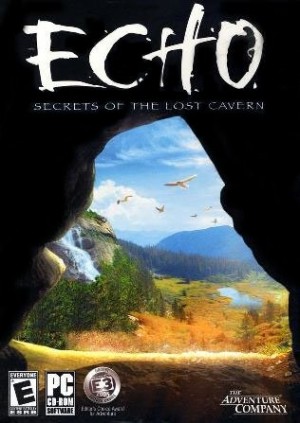


In the word's most common usage, an "echo" is a sound that repeats, becoming fainter and more distant until it is barely loud enough to be heard. There is often a connotation of solitude; a person alone, perhaps in a cave with no perceivable exit, calls out, desperate to find some hint of humanity nearby, and is answered by only the refrain of his own voice. This is the definition that has stuck in my mind since The Adventure Company announced they would publish Kheops Studio's new game about the prehistoric Lascaux cave under the name ECHO: Secrets of the Lost Cavern. After playing the game, though, I'm struck by another meaning—"a repetition or imitation of another"—which seems a much more fitting basis for the game's title.
Set 17,000 years ago in the landscape that is now France, ECHO tells the story of a Cro-Magnon young man's desire to study under a painter he admires. In the course of his journey, our hero Arok learns the fundamentals of cave painting just as a modern student would—through imitation and practice—and is ultimately transformed into an artist far more powerful than his master will ever be.
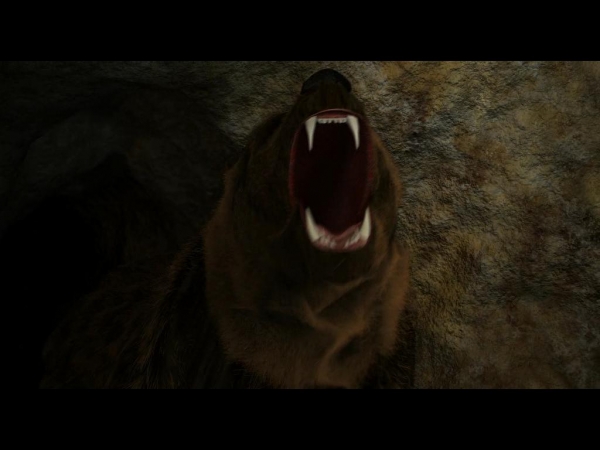
The game's opening cutscene shows Arok making a detour into a mysterious cavern when a lioness takes him by surprise during a hunt. Some familiar-looking markings on the cave's walls remind Arok of an encounter he had years ago with Klem, a renowned cave painter. Arok was too young to go with Klem at the time, but Klem encouraged the boy to seek him out later in life. These markings, Arok realizes, are clues Klem left behind for him. Our protagonist decides to leave his clan and follow his dream of becoming a painter. The cave where Arok will ultimately find Klem is based on Lascaux, the real-life Paleolithic cave discovered in France in the 1940s, making ECHO: Secrets of the Lost Cavern an imagined retelling of how the frescoes of Lascaux came to be.

The game is in first-person perspective, and the player controls Arok using a fairly intuitive interface. Moving the mouse pans the view around pre-rendered backgrounds. An animated cursor indicates when you can go forward. Right-clicking brings up an inventory bar at the bottom of the screen, along with icons to access the in-game documentation and Arok's goals (more on these in a bit), plus a magnifying glass to see inventory objects up close, and an option to select the main menu. Pressing 'Esc' during gameplay also displays the menu, from which you can save, load, and change game options.
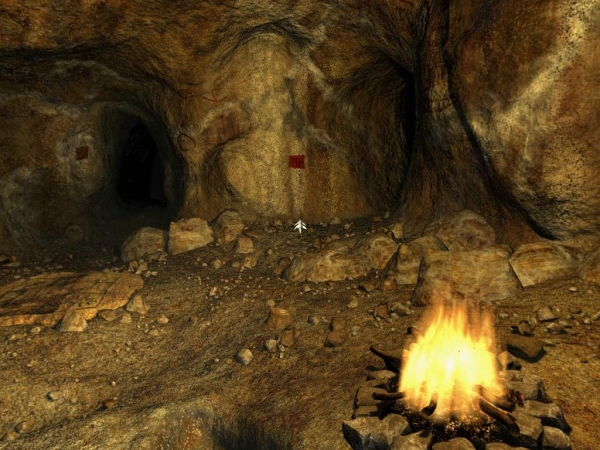
ECHO's graphics live up to the high standards set in Kheops' previous games. As Arok journeys to Lascaux, he travels from his snow-crusted homeland to a valley so lush and vibrant you'll feel the river's spray on your arms and the sun's heat on your face. The caves are equally well depicted, with flickering fires casting shadows on the walls and clusters of stalactites hanging from the ceiling. The ambient noises and tribal-sounding music provide a fitting backdrop for the prehistoric setting. Occasional cutscenes help the player identify with the main character by showing Arok in a third-person view. These high-quality clips are plentiful at the beginning of the game, but thin out as it progresses.
The game is educational in a laid-back way. If you want to learn more about the time period, there's a ton of information at your disposal in the "documentary database," a vast in-game encyclopedia that's accessed with the shell icon. (The shell flashes on the screen when something happens in the game that is explained in the database, but you can access it at any time.) In a few situations, the documentation helped me understand what to do next in the game, but for the most part the information is only supplemental. (Though it's interesting—who knew that in spite of their reputation, Cro-Magnons didn't live in caves?!) This database has a nice effect of being available for those who want to learn more, yet far enough out of the way that it won't annoy people that just want to play the game.
Another welcome touch is a listing of Arok's goals, accessed by the hand icon. (This, too, flashes when something new has been added.) It's a journal of sorts, in which Arok summarizes what he's just done and what he has to do next. This helped me get my bearings at points, and a few times even guided me in the direction of a puzzle solution. If you're stuck, this is the first place you should look. Arok's comments may save you from hours (or minutes, anyway) of fruitless wandering.
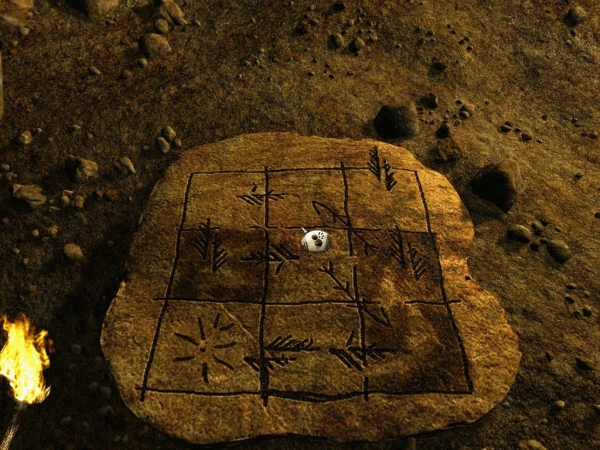
Arok's quest is broken into three parts: his exploration of the initial cave, which puts him on the path to find Klem; his trek through the valley and attempt to locate Klem; and his arrival at Lascaux, where he must prove himself to the great painter. I enjoyed the first part the most. Several of the puzzles in this segment involve animated cave paintings, meant to represent spirits in the rock. Arok has a gift to communicate with these spirits, and what he does in the puzzles affects the environment around him. These puzzles help Arok move through the cave, whether by illuminating a path he needs to follow, getting him past an animal blocking his path, or helping him across a water-filled chamber to reach the exit on the other side (my personal favorite). Although the puzzles are rather "adventure gamey" in nature—in other words, injected into the game to give the player something to do—their role as a form of communication between Arok and the cave spirits helps integrate them into the gameplay.
When Arok makes it out of the cavern, he is faced with more fundamental challenges, such as finding food to satisfy his growling stomach, gaining the trust of people who can help him, and making a bridge to cross the rushing river. This section is less mystical and more realistic, but the challenges—primarily inventory-based—are still enjoyable. The inventory can be a little awkward, however. You can't use one object on another within the inventory bar, which means an item must be put down somewhere before it can be combined with another item. But you can only place an item where the game lets you, as indicated by an animated cursor. As a result, I sometimes thought I couldn't use two items together, when in fact I just hadn't moused over the spot where the game wanted me to put the first of them down. It can also sometimes be hard to tell when an item in the environment can be picked up. The cursor animates when you put it over an object that can be taken, but even so, I missed a few things during my first (and even second) sweep through the screens.
There are a couple of painting-related puzzles in this middle part of the game, when Arok is tasked with restoring a fresco to prove he is worthy of meeting Klem. This is the first point where Arok really gets to paint, by finding the proper supplies and using them correctly on the wall. Like the other puzzles in the valley, it's a mechanical experience—you're mixing pigment and physically spreading it across the wall—and it serves as a nice transition to the third part of the game, which takes place at Lascaux.
Once Arok reaches Lascaux and gets in to see Klem, he is asked to fill the chamber with bulls and to get them to dance. The mystical element returns as puzzles again become a form of communication between Arok and the cave. However, some of these puzzles felt like busywork to me. The worst offender is a sort of slider puzzle that's significantly more difficult than the rest of the game's challenges. It's also the only point in the game when Arok is supposed to be painting, but you (the player) are forced to solve a puzzle instead. This took me out of the game, because even though I knew exactly what the fresco was supposed to look like, I just couldn't manipulate the slider to get it to look that way. This is not a challenge Arok, as the painter, would have to face. It didn't help that when I saved my game with the puzzle nearly complete, then reloaded it, the slider was reset—even though the screenshot on the save menu showed the puzzle nearly complete. Alt-Tabbing away from the puzzle caused it to reset, too. After well over two hours of frustration, this annoyance, plus the puzzle's mechanics (much harder to manipulate than the average slider), sent me to a walkthrough. Indeed, this was supposed to be Arok's hardest challenge—completing a fresco that not even Klem had been able to paint—but I would have preferred a less contrived method.
Although ECHO's prehistoric setting and premise score points for originality, the plot is straightforward and extremely singular. Arok wants to find Klem's cave and become a painter. That's about it. Along the way, nothing that happens is really surprising. Arok never misses the clan he left behind, never doubts his abilities, is never tempted to give up his quest or forced to choose between two paths. Some players may not mind this simplicity, but the absence of a deeper layer of storytelling left me disappointed. It wouldn't have to be complicated—even an implied love interest between Arok and Tika, the game's only female character, could have done the trick—anything to add a bit of tension from within and balance the external obstacles. That's not to say that ECHO's story is bad; it's just simple. The plot is well constructed and obviously well researched, but it lacks the complexity and character development I expected a coming-of-age tale to be infused with. I'll admit, though, that I have high standards when it comes to story. For those who prefer games with more puzzling and less plot, ECHO may have just the right balance.
In spite of these faults, ECHO is a quality game. The puzzle-heavy first-person adventure has become something of a cliché, but with the prehistoric setting and emphasis on cave painting, ECHO puts a new spin on that old convention. In fact, the complaint I expect to hear from many players is that the game is just too short. I felt that way myself, even after the two-hour slider debacle. The game took me just a few evenings to play, and the puzzles were easy enough that I really only got stuck once. When a game is as nicely put together as this one is, I want it to be at least twice as long. I guess that's to be expected of an echo, though. Even after it has faded into silence, you strain to hear just one more repetition.