
Review for Runaway: The Dream of the Turtle (DS)
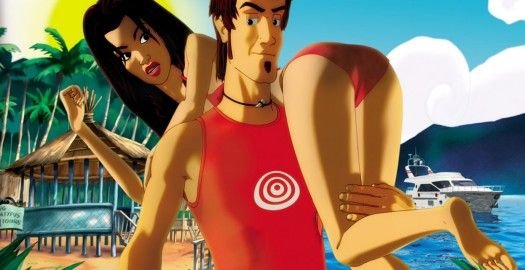

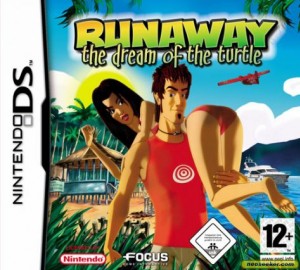

Many adventure gamers are already familiar with Runaway: A Road Adventure and its sequel on the PC, but when I picked up Runaway: Dream of the Turtle for the Nintendo DS, I was a newcomer to the series. Since the original game was never released on the handheld, I assumed the lack of a ‘2’ in the title meant that this was a game that could stand on its own and be experienced without any knowledge of its predecessor. Thankfully, this is exactly what I found, and better yet, it’s a highly enjoyable game that’s surprisingly well suited to the tiny platform.
As Dream of the Turtle begins, Brian Basco is on holiday with his stunning girlfriend Gina in Hawaii, where they charter a small plane to Mala island. Suddenly, the pilot has a heart attack and the plane starts to go down. There’s one parachute. The selfless (or not-so-selfless) Brian gives it to Gina and pushes her out of the plane, but bullets start flying at her defenseless descent. Brian, meanwhile, manages to land the plane himself in the middle of a dense jungle. Dazed and confused, with the pilot now missing and only a drunken lemur for company (that’s only the start of the weirdness), Brian realises that it probably isn’t the best idea to push one’s girlfriend out of an aeroplane mid-flight (who knew?), and so he starts a search for his missing partner, which leads him to uncover government conspiracies, a buxom barmaid, and awesome alien technology.
It turns out that Gina landed smack bang in the middle of a top-secret U.S. military camp. Its officials aren’t eager to help Brian, so he’ll have to use all of his wits to find another way to locate her. The game is divided into six chapters, and the first four form part of a backstory that Brian is narrating after the fact, at which point events resume in current time. His quest starts on Mala Island but soon leads him to Alaska and on to the high seas in search of sunken treasure that will help him save not only his girlfriend, but possibly the world. The intentionally silly plot can be confusing at times, but that’s largely due to the number of different factors involved: aliens, scientists, a Rastafarian with a telepathic helmet, the a.m.e.b.a project, and finding a certain stone which is crucial to everything.
The plot borrows a lot from, or pays homage to, traditional comic adventure games of yore, but there are lots of references to famous adventurers from film and television as well. These can sometimes be amusing and sometimes fall flat on their face. For example, there’s one part where an Indiana Jones-like skeleton is trapped under a boulder. While pop culture references to things like “Mulder’s sister” or Captain Haddock’s infamous catchphrase “Blistering Barnacles” may delight some people (it did me), there are plenty of opportunities where humour based on the actual game scenarios could have been a lot funnier. That being said, there are some genuinely amusing moments when the game hits its comic stride, such as the lemur, Little Devil, demanding a beer in return for his help.
Unfortunately, the main characters come across as a bit shallow, not least Brian Basco, who’s quickly swayed to ‘point-and-click’ with the local barmaid to supposedly aid his quest of finding his girlfriend. The girls in the game are pretty, the male characters often have one thing on their minds, and there are some jokes worthy of a certain teen movie about fruit-filled pastry. This doesn’t detract too much from the story, as most of the supporting characters are more interesting, like the evil villains and unhelpful military personnel. One of the drawbacks is that the game is a sequel, so there are times when characters seemingly have some kind of history that’s alluded to but never fully explained. It doesn’t really affect the enjoyment of the game, but will leave new players scratching their heads when Brian makes a nerdy reference, or mentions that he’s got a degree in physics, which seem out of place in the context of this game. One character in particular, Joshua, an eccentric technical wiz who has a central role in helping Brian on his quest, clearly has a backstory from the previous game which is relevant to the unfolding plot. In this instance, it would have added welcome depth if Brian offered a bit more exposition as to how they knew each other. A short introductory movie, or even narration, explaining what happened in the previous game would have been nicer still.
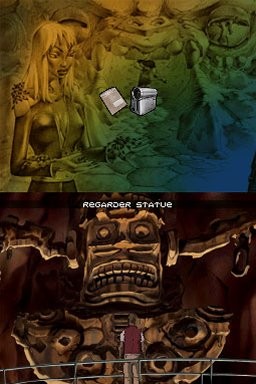
It’s clear from the start that Dream of the Turtle closely adheres to the classic style of adventure gaming, but it’s rather uniquely adapted for the DS. The game is presented from a third-person perspective, with 2D backgrounds that scroll as you walk across them. Moving around is simply a case of touching where you want to go with the stylus, with accessible areas indicated by the presence of arrows at the sides of the screen. The playable scene is presented on the bottom touch screen, and holding the stylus down zooms the camera in to offer a closer view that shows how you can interact with the environment; you then remove the stylus to perform the ‘click’ action. You can simply tap objects on the main screen for Brian to comment on them, but more often than not I found myself zooming in, as it’s hard to pinpoint everything at a distance. When an interaction is possible, an icon appears to tell you the options, and pressing the Y button cycles through any other choices available. This control system works well, and the zoom feature is a good idea given the limited size of the default viewing area. This allows a far greater amount of detail than would otherwise be possible.
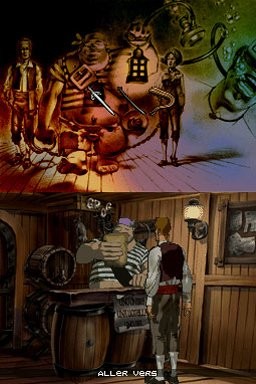
Even with the zoom feature, however, objects are sometimes not very obvious or just plain hard to see. Fortunately, there’s a handy hint button which highlights all hotspots within each scene. This is a helpful option and reasonably well executed, although you can’t interact with items while highlighted, and it doesn’t look great, highlighting things in blocks of translucent colour. A lot of the gameplay involves applying the many objects you find, so having a feature that helps to locate those elusive hotspots can save many hours of painful pixel hunting. All items in Brian’s possession are displayed on the top screen, but by clicking a backpack icon, the inventory is brought down to the bottom screen where you can then select and combine objects.
Another important aspect of the game, especially for solving puzzles, is the often lengthy dialogue trees. All conversations are text only, but this is actually beneficial, as the text is easily read and quickly skipped in puzzles requiring dialogue to be repeated many times. However, don’t tap too quickly when reading a conversation for the first time, as necessary pieces of information can be easily missed. If you do overlook something, the conversations can be repeated, and any information vital to your progress in the game is never lost for good, as characters are always willing to repeat the important points.
The puzzles in the game are of the standard ‘use this inventory item with that object/person’ variety, but they’re created with enough imagination to usually make them fun. Some may prove challenging, as certain objects don’t become available until you’ve established a reason to get them, while others will only become available by following a particular line of conversation with a character. It’s a fair bet that if you’re stuck, you haven’t said the right thing to the right person, but thankfully these instances are few and far between. Some puzzles require a combination of objects, most of the time in a logical way. Except when I say ‘logical’, often the logic becomes apparent only after the puzzle is completed. This means that thinking outside the box is a requirement, but as long as you have all the required items, the answer is never far away, even if it means depending on the 'try everything on everything' approach at times. There are moments of frustration here and there, but there is usually enough amusing detail and red herrings in the game to keep you occupied until you find the actual solution.
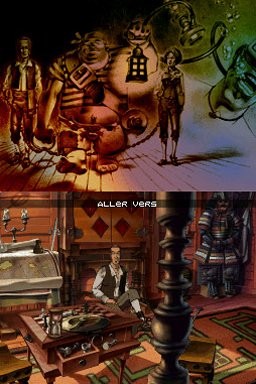
Like its PC counterpart, graphically Dream of the Turtle is beautiful, and is one of the major selling points of the game. In a cartoonish style similar style to the early Broken Sword games, the scenery is well designed and pleasing to the eye. Locations like the dense jungle and the beach on Mala Island look crisp and clear, with enough detail and interactivity to keep players amused. Cinematic sequences are pleasantly reproduced as well, with over an hour of video clips that look great even on the small screen. Character models in the game are nicely animated, too, and drawn with enough detail for the small screen that each one comes across as a unique character. The audio is also of a high quality, with a well-orchestrated score playing during the more dramatic moments.
There are three slots into which you can save your game, which is enough, and it’s nice to have multiple saves in case you want to go back and re-watch a video sequence. After the game is completed, you have access to all six chapters if you wish to replay a particular segment of the game. The ending, however, if you can even call it an ending, amounts to a ‘to be continued’ cliffhanger. This will be obvious as you approach the moment, as it’s clear halfway through the last chapter that there isn’t enough time left to resolve major plot points. Despite the lack of closure, however, I didn’t feel cheated, as I found the game to be satisfying and enjoyable enough after completing one of the major goals of the game. As a newcomer to Runaway, I was more interested in seeing where the adventure would take Brian next and what problems he would encounter rather than the actual goal of saving Gina, as she had limited screen time and it was hard to feel very invested in her character. Still, be forewarned that you aren’t getting a complete storyline, and some may be disappointed by the lack of a proper conclusion.

Of course, it’s hard to feel cheated after getting about 20 hours of gameplay to reach that point, and in this age of shorter and shorter games, this is respectable for any adventure, especially when pixel hunting is kept to a minimum. And for the most part, it’s time well spent. The classic adventure gameplay suits the DS to a tee here, the controls are simple and functional, and there’s a lot of gameplay to be enjoyed. The characters and storyline can be shallow and generic, but it still ends up being an entertainingly mad caper, and an attractive one at that.
Overall, there is much to recommend in this handheld conversion, but if you’ve played the PC version already, bear in mind that it’s only a port. As fun a game as it is on the DS, I can’t imagine anyone going out of their way to own it on both platforms. Assuming you haven’t yet played the game, then, anyone looking for a fun but challenging handheld adventure can’t go far wrong with Runaway: Dream of the Turtle. A crazy plot combined with exotic locations and plenty of sun, seas and stylus tapping make this one excursion on the DS that’s worth taking.