


Review for Undercover: Dual Motives

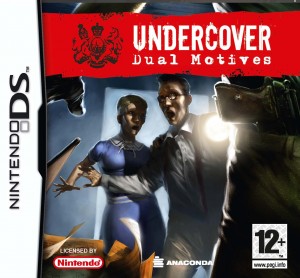

The Nintendo DS has become a popular platform for adventures since its inception, but from Ace Attorney to Touch Detective to Hotel Dusk, the lineup of original DS adventures has been almost exclusively Japanese to date. That’s neither a good nor bad thing, just a curious observation about the lack of Western adventures made for the handheld despite its obvious conduciveness to point-and-click gameplay. The lone exception so far has been Sproing’s Undercover: Dual Motives, which unfortunately won’t be inspiring any other intrepid developers to follow suit any time soon.
If you haven’t heard much about Dual Motives, that’s hardly a surprise. When it comes to the prequel to Operation Wintersun, “Undercover” represents not just the series name but its non-existent sales and marketing campaign. Somewhere along the line, however, under the watchful eyes of absolutely no one, the game was quietly released in the UK. And while I won’t go quite so far as to say it might be better off staying hidden, I will say that it doesn’t hold up to much scrutiny, delivering little more than a clumsy attempt at utilizing the unique DS features in what is already a substandard adventure.
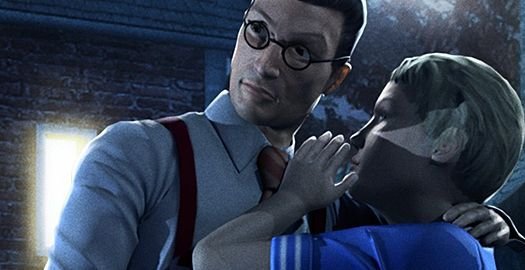
Like its PC predecessor, Dual Motives stars mild-mannered physics professor John Russell. Under the looming shadow of World War II, the game is set in an inexplicably tiny research facility where top English scientists have gathered to work on secret military projects. But there’s a traitor in their midst, and after a quick and dirty frame job established in the game’s introduction, all signs point to Russell, leaving him no choice but to expose the real culprit and clear his name in the process.
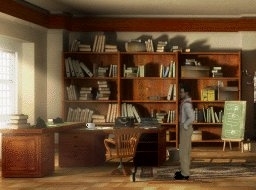
A WWII-themed spy game should be rife with adventuring possibilities, but it won’t be long before you realize that Dual Motives capitalizes on none of them. In fact, it really doesn’t even try. Other than providing an excuse for espionage, the war has no impact on the game whatsoever, and despite its title there’s nothing “undercover” about Russell’s exploits. Unlike the previous game, which took players behind enemy lines and into battle-ravaged territories, Dual Motives takes place entirely within the quiet confines of the remote facility where everyone recognizes Russell for the unassuming character he is. And while you do some sneaking around in between fetch errands for your colleagues, much of your "spy" work amounts to creating distractions only one step above yelling “Look behind you, a three-headed monkey!"
Luckily for Russell, he once again has the help of female cohort. This time around it’s Audrey, the facility secretary who’s convinced of his innocence for reasons known only to her. Players control both Russell and Audrey throughout the game, switching between them at will. The multiple protagonist concept also presents a wide array of possibilities, but again Dual Motives is limited only to its most basic uses. Both characters must work together on a few occasions, but other times the only real use of a second character is to gain access to one or two places the other isn’t allowed. And while that serves a perfectly reasonable purpose, to achieve it generally means trying exactly the same actions with both characters until one succeeds. Making that even more annoying is that there’s no way to make them both travel together.
Whether controlling Russell or Audrey, the action of the playable character displays on the bottom screen while the inactive character is shown on the top one. And I do mean “inactive”, as the character will merely stand in place where you left them, motionless until you beckon them again. Surely a better use could have been made for an entire screen than to emphasize the gimmicky nature of its second playable character, particularly since both the travel map and inventory take up entire screens of their own and either would have been a more logical choice instead.
This isn’t the only peculiarity in the use of screens, either, as dialogues are carried out between close-up character portraits placed top and bottom. What’s odd is that each person’s text is displayed on its own screen, meaning to read through a conversation requires constantly shifting your sight up and down to see the individual lines. It’s totally unintuitive, as I instinctively kept looking for dialogue where it just appeared last, never to find it waiting.
Not that you’ll spend much time talking to people, as none of them have anything interesting to say. From fellow scientists like the bomb and propulsion specialists to the ever-lurking but irrelevant MI6 agents, each is limited to his or her role as a plot device, which is generally to make your life a hassle in one form or another. Russell himself is utterly bland, though you’d expect as much from a bookwormish, non-heroic professor. Audrey has a bit more pep but no real distinguishing characteristics other than a refusal to do anything that will break a nail or get her dress dirty (an unwillingness she goes on to completely overlook when the game demands, mind you). Conversations are generally short and quick, rarely with as many as even two interactive choices. At least the mechanics speed things along, as the full text displays immediately, and a quick screen tap moves the dialogue forward. Translation from the original German can be a bit spotty, but given the limited sample size, that’s the least of the game’s worries.
You’ll do plenty of tapping elsewhere in Dual Motives; a stylus tap being the DS equivalent of the PC’s “click”. For the most part, the game plays out very much like a traditional point-and-click adventure. Tapping the touch screen either moves characters around the environment or interacts with objects. Unlike mouse-driven games, of course, available hotspots aren’t shown until actually clicked on, at which point a multi-cursor option allows you to examine or attempt to use them with a second tap. It all works well enough mechanically, though often you’ll click on something you think will be interactive only to accomplish nothing more than moving your character directly in front of the objects you’re interested in. You’ll also need be sure the character is within range of an interactive item, even just to look at it. Usually the locations are small enough not to matter, but occasionally you’ll inadvertently cause your character to slowly meander to distant points just to say there’s nothing useful there.
Contributing to this problem is an increased number of non-essential hotspots in the busier locations. Normally having more interactive options is a good thing, but there’s very little payoff here, as the character commentary is neither interesting nor helpful. But of course you’re forced to click on every bookshelf, door, and window, because you never know until you try… and then you’re sorry you did. A more important issue is that the handheld screen size often makes it hard to distinguish what smaller objects actually are. Fortunately, the game includes a hotspot highlight option, which shows all interactive items at the touch of a button. There are only a couple times I’d say this feature is really needed (good luck finding a footprint at night that wasn’t there during the day), but due to the ratio of useful:pointless items, it quickly became something I relied on simply to save myself the frustration.
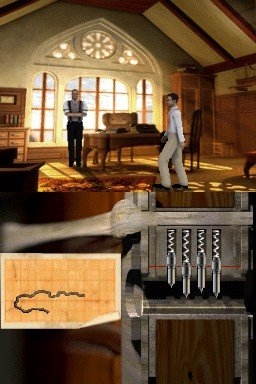
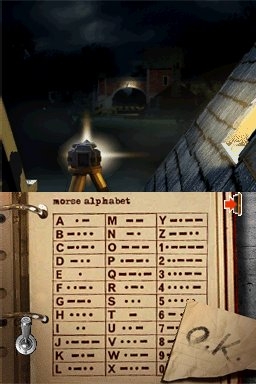
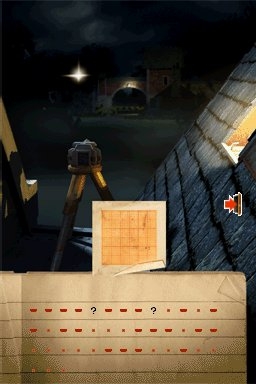
Where Dual Motives really sets itself apart, for better AND worse, is in its use of the touch screen in a variety of minigames. Apart from one game of darts, the word “minigame” is somewhat misleading (though that’s the one the game uses itself), as really it’s a collection of contextual activities. Whether cracking safes or making rubbings, the game offers exactly the sort of hands-on physical exercises that DS adventures should excel at. When done properly, that is. Yeah, that little caveat, and here they aren’t. All the goodwill earned from such promising actions as using the microphone to fire a blowgun or the touch screen to signal in Morse code is lost either through repetition or horribly finicky controls. Shaping a paper clip to pick lock tumblers may be quite interesting the first time but is dreary filler by the increasingly-difficult fourth, and even that is way better than the unresponsive fistfight controls, let alone what may be the singlemost wretched touch screen experience I’ve ever encountered in trying to manipulate the airflow from a fan. You’d think with a physicist as your main character that the game’s physics would at least passably resemble real-world ones, but you’d be wrong.
It’s a shame that the minigames are so poor, because the more traditional puzzles are entirely uninspired. Along with a single short Mastermind challenge, there’s the standard collect-and-combine inventory routine, but this is generally used for the dullest of errands. As one character says to Russell, “You help me with some menial tasks and I’ll tell you a little story afterwards.” Let’s face it, this strategy is commonplace in adventures, but the better games at least make an attempt to disguise it. And when not on the latest fetch quest, you’ll usually be trying to cause distractions to divert someone’s attention, occasionally using the exact same solution multiple times or with only small variations. This is a perfectly valid goal considering the situation, but it’s heavily overused here.
Creating distractions would be easy, of course, if allowed to run amok, but there are tight restrictions on what Russell and Audrey will do. With the threat of treason hanging over his head, Russell is still reluctant to do anything too bold or risky, even if it makes total sense to try. Audrey’s idea of helpfulness is to tell you that some efforts on her behalf are stupid, even when they’re not. This is merely the game’s way of forcing you to play by its rules, but it cheapens the experience in the process. You can only do the things the game wants you to do, and in the explicit order it wants them done, even if there’s no justification for such linearity. When trying to pick up someone’s boot to match a footprint discovered earlier, I expect better from a game than to offer me, “What would I do with those boots?” Come on, professor, it’s not rocket science.
Or maybe that’s the problem. Russell is a brilliant physicist working in a secret military facility, and he spends his game time doing Joe jobs and poking around empty rooms and skulking outside the local tavern. For the most part, he could just as easily be the site janitor who’s lost his keys and now on a mission to find them. There’s little challenge befitting a man of Russell’s intellect (or the player’s, if not getting hung up on one of its rigid puzzle triggers), and there’s even less sense of tension or intrigue. This is further undermined by the mystery itself, which drops in some ludicrous leaps of logic that defy all belief. The consequences are eventually ramped up (off-screen) late in the game, but the situation still lacks the gravity it demands. It’s all so superficial; a spy thriller dressed up like a day at the office.
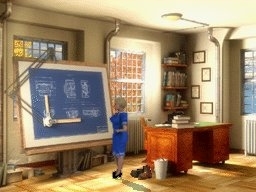
Certainly the lack of cinematics, animations, and voiceovers contributes to the shallow nature of the story, but as a handheld adventure, it’s understandable that corners were cut in presentation. What’s more disappointing is the limited number of locations, and the rather plain selection of those offered. The realistic graphics are decent enough, but the vanilla angles and muted colours do little to spruce things up with any variety. The switch from day to night midway through the game is a nice touch, but no substitute for new and interesting places to go and things to see. In fact, the overall environment is so small that the map becomes redundant, as it’s almost as many clicks to utilize the zip feature as it is to click your way to your destination at any given time. Except, of course, for the one location added secretly to the map with no way of reaching otherwise, despite being part of the same facility grounds.
Rounding out the disappointment is the game’s aural element. While rarely a strong point on the DS, Dual Motives certainly isn’t the game to buck the trend. The soundtrack consists of a limited number of orchestral tracks that range from acceptable to poor, though much of the time is spent in a preferable silence. Kudos are given for different footfall sounds on varying surfaces, but less so for all being way too loud, and less still for the notable lack of other sound effects in general.
All told, it took me a little under eight hours to finish Undercover: Dual Motives, which would have been an acceptable length in a better game. As it is, the meagre storyline, uninspired puzzles, and limited exploration already seem stretched at such a modest play time, and even fans of Operation Wintersun will find this handheld successor a shallow and unrewarding experience. The game does offer some creative uses for its DS-specific features, but sadly even these are handled too poorly to commend wholeheartedly. I’d like nothing more than to encourage more developers to embrace the DS as a viable adventure game platform (not just for ports), and I credit Sproing for being Western pioneers in this regard. However, not even dual motives of my own can make me hold this game up as a positive example of what the genre can be.