
Review for And Then There Were None

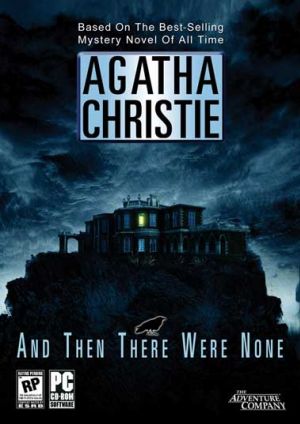
There is something inherently creepy about many children's nursery rhymes. "Oranges and Lemons", for instance, concludes with a rather ominous couplet, while "Three Blind Mice" certainly didn't end well for its eponymous little heroes. Capitalising upon this, Agatha Christie made many allusions to nursery rhymes in her work, perhaps never more successfully than with the "Ten Little Indians" rhyme in her best-selling mystery, And Then There Were None. Since the novel's first publication in 1939, the text has been adapted numerous times for both stage and screen. Now one of the most ambitious adaptations to date has been released, as AWE Productions has recreated And Then There Were None as a fully interactive PC adventure.
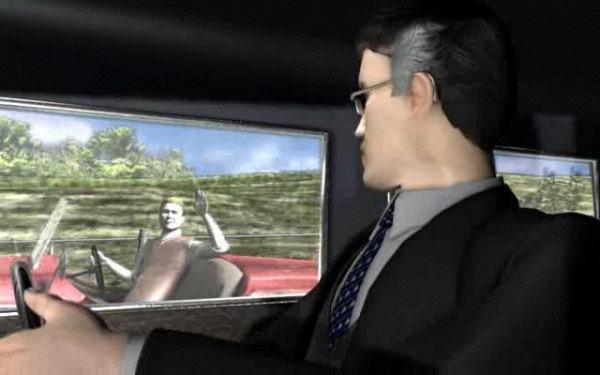
The story opens with a striking cinematic, as ten strangers, invited by the mysterious U. N. Owen to a weekend house party, make their way to a remote island off the coast of Devon. The weekend soon takes an unpleasant turn, however, when a gramophone record systematically accuses each of the guests of being responsible, directly or indirectly, for murders in the past. As the weekend progresses, the punishment for these past crimes is meted out by an unknown killer, according to the gruesome verses of "Ten Little Sailor Boys".
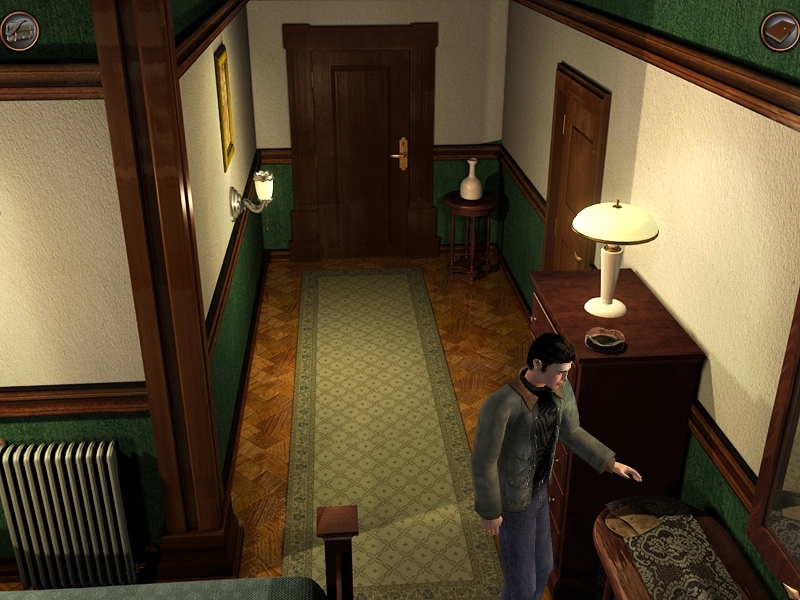
In order to adapt And Then There Were None to the adventure game medium, the developers, along with writer and designer Lee Sheldon, made several alterations. The major difference is the introduction of an eleventh playable character, Patrick Narracott, who is the brother of the novel's ferryman. Adapting the game also required a change of suspect and motive so that even Christie enthusiasts will have some surprises. Although not everyone will be pleased with this plot tinkering, credit is due to the designers for their imaginative writing, which produces an impressive adaptation, likely to satisfy most fans and be accessible enough to function as a standalone game for those unfamiliar with the novel. Some of the dialogue is taken directly from the book, although many of the scenes are original to the game, picking up on hints in the text and expanding aspects such as the island's history to supplement the plot and puzzles. Although the dialogues are excellent, some of the in-game descriptions are (perhaps) unintentionally hilarious, such as Narracott's strange radiator fixation and his delivery of 'profound' artistic insights every time he examines a painting.
A mark of the adaptation's success is that it only occasionally becomes strained, despite having been transferred to a medium with very different demands to that of text or screen. This awkwardness occurs when trying to introduce a playable dimension into some of the novel's most cinematic scenes, such as the early gramophone accusations. In the book, each character relates the details relevant to their accusation organically, as in a real conversation. In the game, however, instead of a simple cutscene, the scene is made 'playable' by casting Narracott as a prompter, approaching each character in turn to ask a series of near identical questions. Instead of Poirot-esque subtlety, Narracott storms in with his clumsy, repetitive questions, resulting in an artificial scene devoid of suspense, which takes ten times longer than the original and is about half as enjoyable.
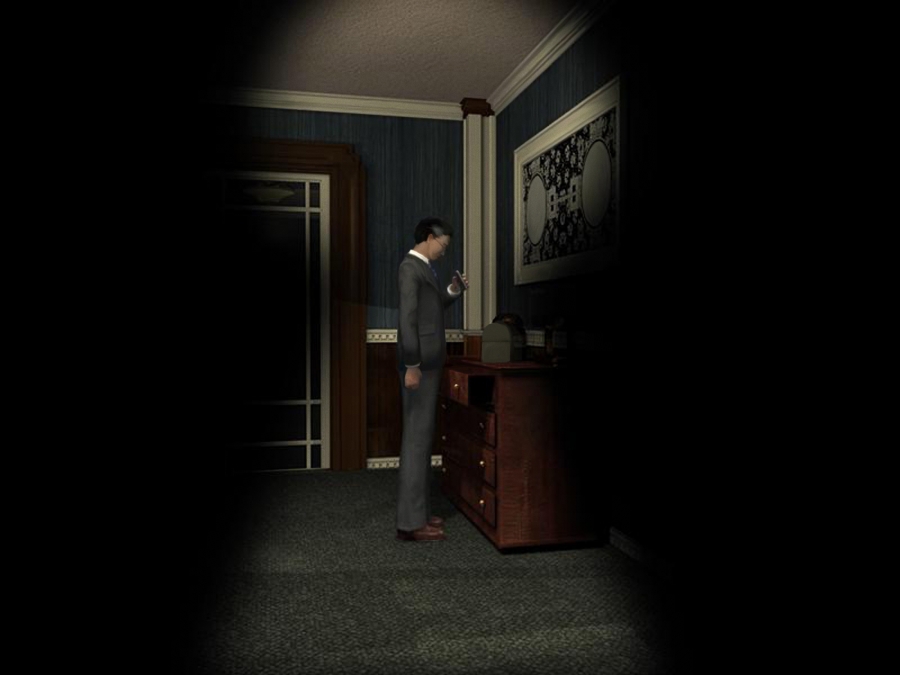
And Then There Were None features 2.5D graphics, combining pre-rendered backgrounds with 3D modelled characters. The open landscapes are worthy of special commendation, with considerable attention spent on the shifting spectrum of weather effects. Often as you progress through a time block, the sky will start to cloud over as a storm approaches, with rain starting to fall, and fog floating across the screen. The lapping or crashing of waves at the island's coves is again stunningly realistic, enhanced with perfectly placed ambient sound effects. The house interiors prove as good as the exteriors, capturing the clean lines of 1930s art deco style.
Unfortunately, in contrast to these backdrops, the characters themselves are rather less aesthetic. In the non-cutscene close-ups they actually look downright ugly, with blocky features and ridiculous sausage fingers. Disappointingly, they often look no more attractive (or realistic) than the characters from Sierra's Gabriel Knight 3 from almost a decade ago. The lip-synching is poor, and the range of facial expressions unsubtle and severely limited. This is problematic in a game where so much of the story is driven by the need to read characters and their motivations. The in-game animations are even worse, or sometimes non-existent, such as Narracott's laughable shovelling and apple-picking non-actions.
The limited character expression could have been fatal had it not been for the high quality vocal performances, which manage to inject a degree of life and enthusiasm into the rather wooden character models. Philip Clark as Judge Wargrave perfectly conveys the Judge's cold, calculating personality, while Carolyn Seymour as Emily Brent really captures the character's self-righteous bitterness. The other aural elements of the game are also strong, with well-chosen atmospheric sound effects and a musical score which, though subject to frequent repetition, is pleasantly in keeping with the game's mood.
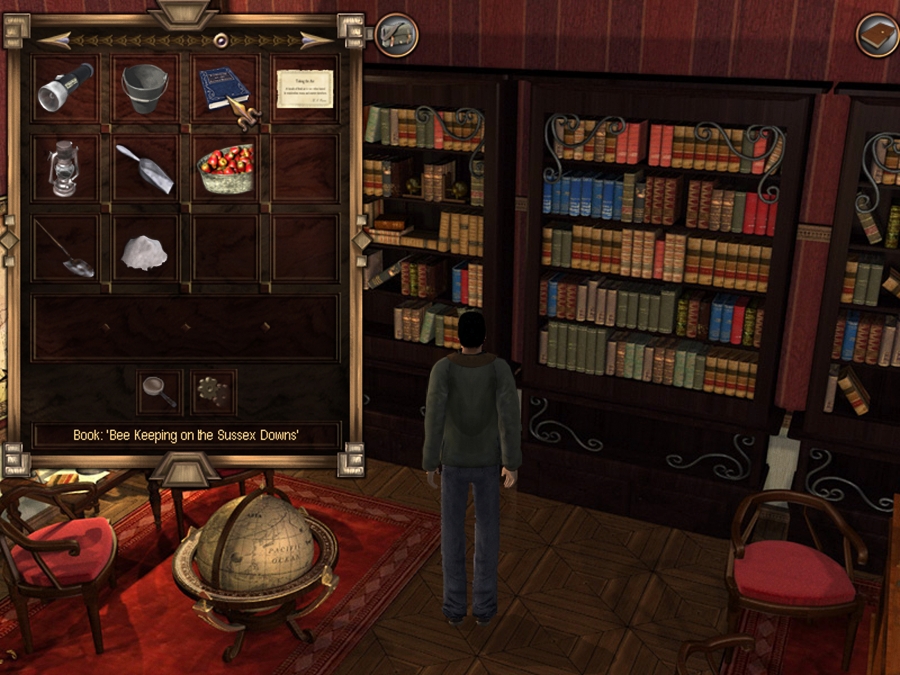
In terms of interface, And Then There Were None is an enjoyable return to old-school, third-person point & click adventuring. Along with the standard smart cursor and inventory, the game features a notebook that serves as a useful repository in which Narracott makes copies of important documents and records his observations. This proves a handy way to keep track of the characters, especially if you're not familiar with them from previous reading. The only potential problems arise from the difficulty of locating some of your inventory items, as you can only view twelve at a time and there are often several screens of inventory to trawl through. Furthermore, new items are slotted into the first available space in the inventory, causing problems when you collect a number of the same type of object. I would also warn gamers to pay attention to objects in the landscape, which although not revealed as hotspots, may still be used to solve puzzles.
Most of these core puzzles aren't too taxing, involving the accumulation and manipulation of inventory objects. There is some variety in puzzles, however, and those gamers left unfulfilled by Broken Sword will welcome the inclusion of not one, but two goat based puzzles! Narracott has several objectives in And Then There Were None; the main ones being to discover the murderer and to escape the island. A further sub-plot involves Narracott being challenged by U.N. Owen to complete a cryptic treasure hunt. As well as being able to listen at doors, and spy through keyholes, Narracott can also further his investigation by performing extraneous little niceties, which ingratiate him with the other characters. For these characters, it appears that trust is cheap, and can easily be bought by acquiring some out-of-the-way object (often requiring the completion of a few extra puzzles). The reward is usually some extra backstory or information, which although not essential to the plot, makes the characters' motivations clearer and adds a degree of replayability. This also varies the game's playing time, which ranges from short to medium, depending on how many of the non-mandatory tasks you want to complete. There are also several different possible endings, as well as the novel's original ending to discover, though only after you complete the game the first time. Unfortunately, the inability to skip the game's numerous and lengthy dialogues may discourage some people from replaying.
Sometimes the only difficulty in these puzzles lies not in solving them, but in identifying them. This is caused by the game's clumsy triggering system, which rarely flags up the tasks you need to complete to move onto the next time block. The fact that there is a degree of non-linearity in the game exacerbates this problem, giving too much freedom which occasionally left me frustrated and wandering through the rooms, looking for clues as to the possible trigger.
This inattention to player guidance is symptomatic of a wider corner cutting reality, evident in the endless recycling of the game's main musical theme, the now-infamous 'living-dead' bug (where the corpse of one of the characters appears while the character is still visibly very much alive), and the rather half-hearted animations. How, for instance, the guests are able to congratulate the butler on "an excellent meal" is beyond me, as despite the clinking of cutlery and glasses during the dining room cutscenes, no one actually animated any food onto their empty plates. Furthermore, although it is inevitable that that the game loses some of the novel's suspense due to the protracted playing period, little effort is made to translate the psychological impact of the murders into the game. I recognise that an already limited medium is further constrained by budget concerns, but characters just don't react authentically (or in some cases, at all) to the horrific events happening around them. Take the death of the first guest for instance. Pretty shocking. But the doctor stands with his back to the corpse and Judge Wargrave makes a real effort and stands up. How's that for psychological realism? I could forgive these faults if the game was innovative and pushing genre boundaries, but as it adheres firmly to a tried-and-tested format, these elements should really have been sharper.
And Then There Were None is an alternating enjoyable but frustrating game, which excels in several areas but stumbles in others. The provoking thing is that with a little more time and polish, the game could have been a classic, as many of the foundation elements are in place, with excellent writing and voice work, engaging backgrounds, and an interesting non-mandatory puzzle system. As it is, the game is a murder mystery whose inconsistencies pose as many questions as they answer--questions completely unrelated to the intricate thriller upon which the game is based. And Then There Were None is intended to be only the first Agatha Christie adaptation, so hopefully AWE Productions will solve a few of these design mysteries before beginning their next project, retaining all the positive elements of this one while correcting its faults. With the experience gained here, the franchise should be in capable hands going forward.

Despite its weaknesses, And Then There Were None is a game that will appeal to those Christie fans prepared to accept some liberties with the original text, while adventure purists will be glad of the game's comfortable interface and familiar gameplay. As a relatively simple adventure with a gripping story, the game may also serve as an appealing genre introduction for adventuring novices.
So that's the PC review. How did the Nintendo Wii port fare more than two years later? Read on to find out!
Nintendo Wii port
When the Nintendo Wii was first revealed to be remote-driven with a heavy emphasis on motion-sensing technology, the possibilities for a resurgence of adventures on home consoles seemed promising. After all, not only is the Wii controller ideal for simple point-and-click mechanics in a way that gamepads are not, but the notion of introducing a new level, new form of physical interaction to a largely passive experience seemed like just the kind of innovation that the genre sorely needs to be relevant beyond the diehard adventure community.
It took a while for any adventures to appear on the system, but now the early results have started to trickle in. One of the initial ports of existing games is Agatha Christie: And Then There Were None, and while the game proves a generally competent conversion of its PC forebear, it also demonstrates the dangers of taking risks with an unfamiliar technology.
The Agatha Christie mystery adaptations are intended as much for non-gamers as the hardcore adventure fan. And for good reason: sales of the Queen of Crime's many novels number in the billions worldwide, which is a little bigger than the adventure community the last time I checked. So the decision by JoWood/The Adventure Company to port one of its Christie titles to the Wii makes sense on the surface. What makes less sense is choosing to begin with what is arguably the weakest of the three games to date. And to add insult to murder, the notable failings of the original remain intact in the conversion, while adding some new problems of its own.
In terms of content, And Then There Were None is a carbon copy of its PC predecessor. There was no visible skimping that I could discern, leaving all cutscenes, voiceovers, and gameplay unchanged, right down to the multiple endings. Strictly on the basis of porting from one platform to another, then, very little has been lost in translation apart from the inferior graphics on a bigger screen. The point-and-click controls also function simply and intuitively, effectively switching the mouse for remote with the game none the worse for wear.
Where the game does noticeably stumble, however, is its attempt to integrate some motion controls throughout. For the most part, these are limited to infrequent activities, from turning wheels to scooping powders to pumping levers. Which is good, because the motion response is atrocious, and certainly not helped by the fact that the game leaves you to stumble your way through them with no direction. Early in the game, an info screen appears that tells you certain controls will be required but not explained. Umm… well, gee, thanks for the warning. Admittedly, seeing a big splash screen with new control instructions would be a bit of an immersion killer, but no more so than seeing your cursor suddenly disappear and having to fend for yourself. This would have been forgivable, maybe even commendable, had the controls behaved naturally, but the opposite is true. Repeatedly I simulated reasonable-seeming motions for the task at hand, but only once in a while did any on-screen action result, and even then completely out of sync with my motions. Rarely did I ever distinguish a proper cause-and-effect sequence, with random gesticulations eventually winning the day.
Much worse than these sporadic activities is the one that runs all throughout the game, which is the act of opening doors. All door handles need to be turned by twisting the remote right or left, and here again the response is just plain inadequate. Never mind that there's no point in it, as you aren't shown a close-up of the handle, and see no in-game response to your actions besides the standard scene shift to the next room, making it nothing more than tedious busywork. No, the real issue is that sometimes it'll work, sometimes it won't. Wait, make that "too often" it won't. Better yet, "FAR too often" it won't. Contributing greatly to the problem is that And Then There Were None has more repetitive door-opening than any other game I can think of (unless maybe the other two Agatha Christie games). If you think this is a minor quibble blown out of proportion, think again. Taking place in a mansion as it does, the game forces you to constantly check and re-check the same rooms over and over, and by the third or fourth murder, you might be having homicidal thoughts yourself the next time the uncomfortable remote twist doesn't open a door for you. I can live with the Wii's motion controls being used mainly as a gimmick, but if you're going to introduce them, at least do them properly instead of tripping over your own remote.
The other disappointment is that none of the game's existing weaknesses have been improved. It's a port, I know, not a remake, but the effort put into bungling the motion controls would have been far better spent enhancing the core game at least in small but useful ways. How about a zip-to map to cut down on the dreary trudging all over the island looking for arbitrary triggers, or some actual feedback to the many-part inventory combinations instead of blindly guessing your way through the forty-plus objects in your possession? If not that, maybe the ball pattern on the snooker table could change occasionally to reflect the apparently ongoing number of games being played on it. Still no? Well, at least outright errors should have been fixed, like certain hotspots being completely non-existent unless you have the correct inventory item in hand. I have played this game already, and I STILL needed to resort to a walkthrough because it didn't occur to me (again!) to try items on unhighlighted background scenery. I was… not amused. Apart from the latter issue, no single element is a big omission, but why even basic improvements to an already-underwhelming game weren't implemented ranks right up there with "whodunit" as one of the game's bigger mysteries. Keep what works, improve what doesn't. Seems a simple enough formula, but not one this game follows.
Between the identical content and missteps in the Wii-specific actions, there is no reason for anyone who's played the original to look twice at this Wii iteration. Kudos are due for at least trying to offer more than a straightforward point-and-click conversion, but it's unfortunate that the attempt was so poorly implemented, compounded by the failure to ensure the core game itself was up to the challenge. If you haven't played either version and the game appeals to you, I recommend the older PC version. Unless you're really intent on squeezing some point-and-click adventuring goodness out of your console, there's simply no benefit to spending more for a lesser experience.