
Review for Time Gentlemen, Please!
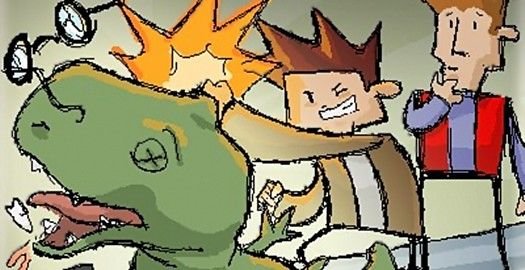


You might not think that time travel, dinosaurs, Nazis, and kittens have anything in common, and until the release of Zombie Cow Studios' Time Gentlemen, Please!, they probably didn't. However, all these seemingly unrelated elements--and a whole lot more--show up in the indie developer's first commercial game. The new adventure builds on the story of its freeware predecessor, Ben There, Dan That!, and the result often shows impressive technical and storytelling ingenuity, although some obscure puzzles, particularly raunchy dialogue offered only in text, and the occasional pathfinding issue could mar the experience for some players.
TGP's story begins where BTDT's left off, but a nicely done comic book-style introduction recaps the previous game's events. In a nutshell, London roommates Ben and Dan were suddenly kidnapped by aliens after dangling a coat hanger out of their apartment window in an attempt to get better television reception. The duo successfully navigated a series of otherworldly dimensions in hope of getting back to their normal lives, but in the end, the pair discover they have to make one more trek before they can finally go home.
The after-effects of Ben and Dan's prior inter-dimensional jaunting form the backdrop for TGP's plot, when they realize that the "aliens" who kidnapped them were actually their future selves in disguise. The duo then hatch a plan to go back in time using a priceless piece of technology you'll come across in the beginning of the game. In so doing, they aim to stop the coat hanger from being invented in the first place, thereby restoring the balance of space-time once and for all. Unfortunately for them, the device malfunctions and eventually falls into the wrong hands, and Ben and Dan spend the rest of the game trying to get it back while the fabric of the universe unravels before their eyes. Time-travelling conflicts certainly aren’t original, but this is such a novel take on the premise that I was interested in the game from the beginning. And despite its heavy comic emphasis, there is a definite sense of panicked urgency brought about by the "fate-hangs-in-the-balance" plot, a feeling that intensifies as you progress through the story.
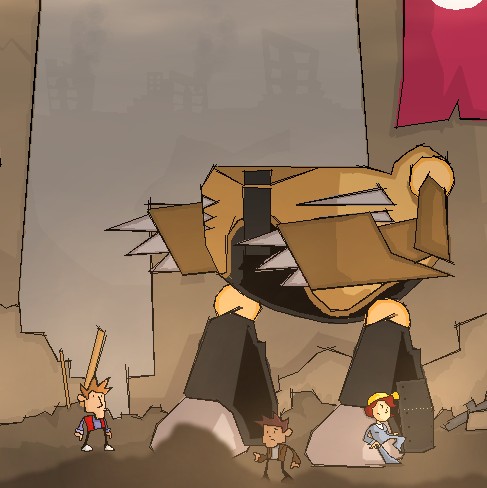
The game's ten major locations are quite diverse, including a dense jungle, a jail cell in the Tower of London, and even the game world described in a text adventure players come across in another location. It’s not just the “where”, however, but the “when”, as the locations exist in a few different timeframes--for example, during the final days of World War II or all the way back to prehistory. Together they feel eclectic and (purposely) mismatched, and help to underscore both the gravity and the absurdity of the situation Ben and Dan have gotten themselves into.
While the focus on time travel and multiple realities provides an intriguing setup, it also causes some of the game's problems. The plot is mostly linear, but it's not always clear what the immediate goal is. Because the universe is collapsing and the normal flow of time has been disrupted, things you do in one location can sometimes affect the situation in others in ways that aren’t intuitive, creating a sort of "butterfly effect." Because of this chaos theory-inspired structure, I sometimes found myself wandering around aimlessly, checking if things had changed in the other locations or if characters had anything new to say. Ben and Dan at times offer subtle hints through conversation between themselves and with other characters, and once I discovered a solution to certain problems, I sometimes remembered a line of dialogue or object description that alluded to that solution subtly. Still, players need to be on their toes and pay closer attention to their surroundings than they might in other games, and even then it may not always be enough.
The game's puzzles are mostly of the "use-X-on-Y" type, but there are some dialogue and item manipulation puzzles too. While the solutions are mostly “logical”, that word isn't used in the strictest sense, as sometimes they only make sense after solving a puzzle. For example, you’ll need to open a corked bottle at one point. Naturally, you don't have a corkscrew. However, according to "TGP logic," something that vaguely looks like a corkscrew will do the trick. Some challenges require the use of a time machine to return objects to a former state or "age" them to a later one, and there's also a puzzle that requires you to open a door by pressing buttons in a particular sequence.
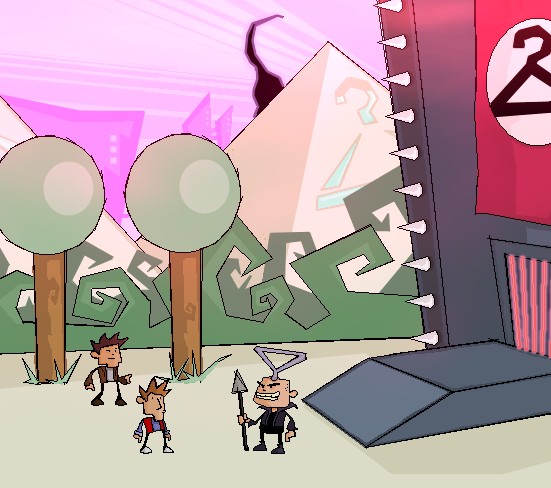
I figured out the solutions to most puzzles on my own, but had to seek help a few times. The game's more obscure challenges aren't necessarily unfair, but players have to be willing to think in unorthodox ways. This is certainly in keeping with the game's wacky premise, but I occasionally found them too obtuse--I'd think "That couldn't work, could it?" only to have the idea I brushed off as too implausible be the very solution the designers had chosen. Having said that, despite their far-fetched solutions, some puzzles are decidedly clever. For instance, Ben has to open a locked door by fooling its DNA sensor into thinking he is another character, and he and Dan get the genetic material from an unlikely source that we won't soon see again in a game.
The interface is very straightforward and remains largely unchanged from that of BTDT; players cycle through "walk," "look," "action," and "speak" cursors with the right mouse button and perform actions with the left. It all works quite smoothly, though having a separate pointer just for moving around is overly cumbersome. Also like its predecessor, TGP features a "Dan" cursor, which allows players to direct Ben's buddy to perform an action. The inventory is easily accessed through an icon bar that slides into view when the mouse is moved to the top of the screen. In an interesting touch, when selecting an item from the inventory window, the item "rips" off the screen (accompanied by an appropriate sound effect), leaving behind a silhouette of the item you just removed.
The game's graphical style also bears a natural resemblance to that of Ben There, Dan That!, and once again the simple but unique cartoony backgrounds and characters are vividly designed and seem to jump off the screen. Although it is limited to an 800x600 resolution, TGP packs a surprising visual punch: the AGS-powered game boasts some eye-catching special effects, from sheeting rain to moving shadows to flying electrical sparks, and they add an impressive level of polish to the otherwise raw, jagged-edged graphics. Similarly, the catchy digital music and realistic sound effects are well done and definitely help to immerse the player in the action, as metal doors clank shut and grandfather clocks chime thunderously. Even the in-game text is much easier to read than in BTDT thanks to a more eye-friendly color palette.
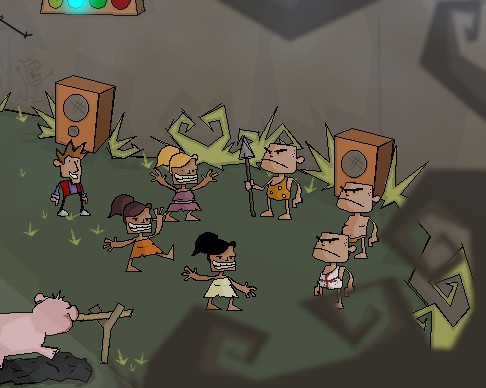
One guaranteed point of contention is that there's no voice acting in Time Gentlemen, Please!. While this may add to the game's old school appeal for longtime adventurers (and is completely understandable from a low-budget indie title), it will certainly prove to be a deal-breaker for others. And indeed, like any good cartoon, a strong vocal component would have nicely accentuated the humor and added more polish to the game. However, if you’re willing to overlook the omission, the lack of voices doesn't ultimately detract from the game's emphasis on its protagonists. The boys start out as the somewhat odd pairing they were in their first adventure--Ben takes the lead and Dan usually follows blindly behind him, only assisting his buddy by pressing switches or performing another menial task while Ben occupies himself with something else. In TGP, however, Dan's character is developed significantly. He repeatedly begs his pal for a chance to do something important, but Ben brushes him off. Finally, Dan gets to adventure solo for a brief period midway through the action while his partner is incapacitated, but flounders in confused, abandoned panic until the player helps him gain some self-confidence. Back together after that, Ben and Dan then agree to truly combine forces in the game's final scene.
The fifteen or so other characters--from a bored construction worker to a clown obsessed with sex education to Adolf Hitler--are fairly one-dimensional and utilitarian, usually serving as item recipients or clue-givers rather than fully-developed personalities. However, their dialogue does give them a distinctiveness they might otherwise lack: the Führer and his guards use an exaggerated German accent, and a young woman the boys befriend speaks (well, reads) with a heavy Cockney dialect, for example. Like the eclectic locations you visit, this unusual assortment of characters further highlights the bizarre undertones of the plot.
With such an emphasis on the main characters, it’s important to note that the game's dialogue and content are often crude and vulgar, as four-letter words, toilet humor, and sexual innuendo abound. Time Gentlemen, Please! is definitely not for children or the easily offended, but players who don't mind the subject matter will find plenty to laugh at. Some of it comes off as deliberately gratuitous after a while, and its impact might actually have benefited from a little moderation, but the crude humor is not so frequent as to seem stifling or overwhelming. There are other ways that TGP can make you laugh as well. Ben and Dan occasionally "break the fourth wall" by commenting about aspects of the game's design (such as referring to a character as an "NPC" and discussing "item collecting"). References to (and jokes about) history, modern culture, and more well-known adventure games are also thrown in. However, anyone who hasn't played Ben There, Dan That! would do well to check that game out first, as Ben and Dan make several references to its puzzles, locations and inventory items during the course of their latest escapade.
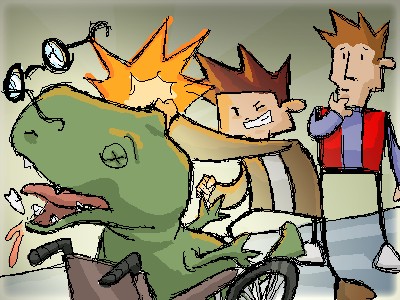
Aside from the more mind-bending puzzles, I only had one major problem completing the game. Though Dan mostly follows Ben around during their adventure, a few times Dan got stuck when he walked to a particular spot. When this happened, Ben couldn't move either, forcing me to restore a saved game. This issue seemed to be random and didn't hamper my experience beyond the occasional reload, but it was definitely annoying when it did happen, and it was fortunate that I followed the adventurer's credo of saving early and saving often.
Overall, Time Gentlemen, Please! is a definite improvement over Ben There, Dan That!, and it's an admirable achievement in its own right, especially for such a small development team. It's unapologetically retro, almost to a fault (and for some you can likely remove the "almost"), but the game's wacky storyline, laugh-out-loud moments, and respectable length--it took me almost ten hours to play through at a leisurely pace--make it a no-brainer for any fan of BTDT. The puzzles may sometimes be obtuse and the dialogue raunchy, and only players willing to embrace a subtitle-only game need apply, but those who can force themselves to think abstractly and see humor in lewd subjects will find the game well worth the minimal purchase price (a little over $5 as of this writing) from the Zombie Cow website.