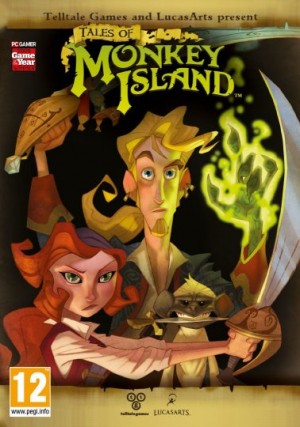

Telltale Games have long since established themselves as the masters of modern episodic gaming, seemingly the only developer who can understand and fulfill the basic tenets of an episodic format in the adventure (or any other) genre. Having cut their teeth on less established gaming franchises, Tales of Monkey Island: Rise of the Pirate God represents the conclusion of what has been by far the most anticipated, most recognized, and most closely scrutinized of any Telltale series to date—and when the dust clears and the credits and epilogue have rolled, it can only be considered a great success.
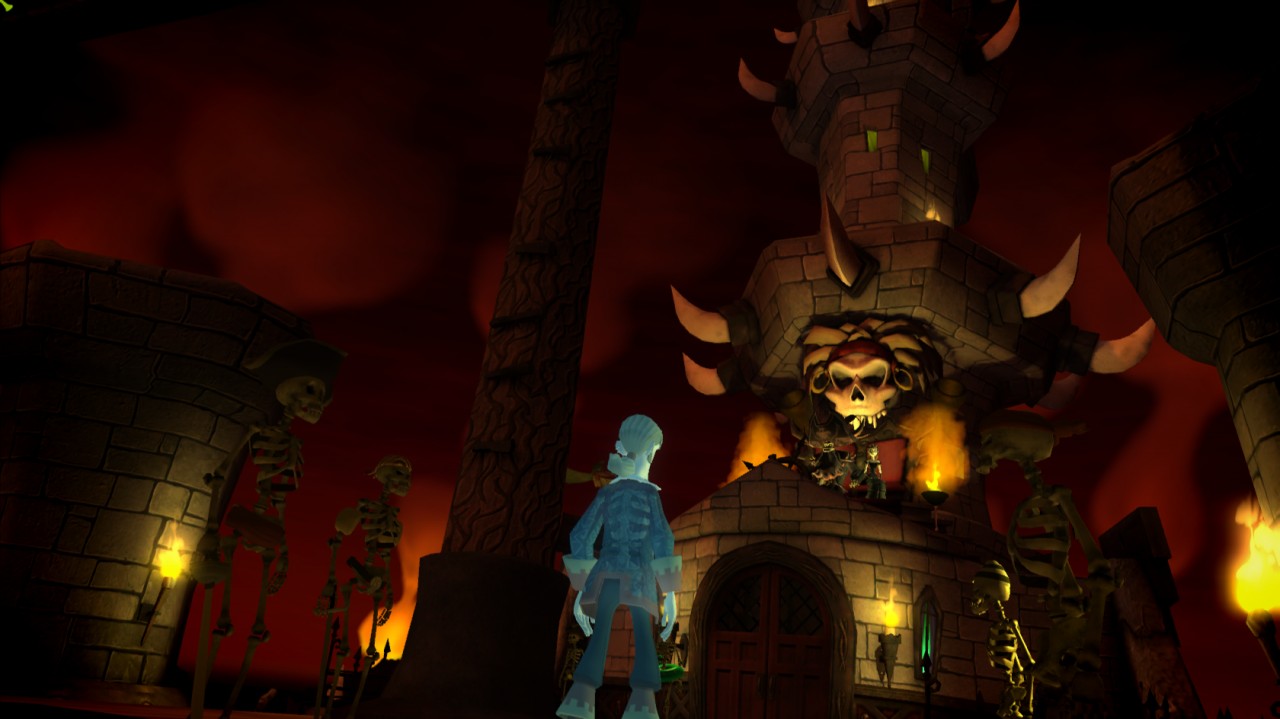
It’s difficult to get into specifics about the finale’s story without spoiling some surprises unnecessarily; obviously the cliffhanger in the previous episode leaves a great deal of uncertainty as to where Guybrush’s journey is going, but suffice to say that the game begins with Guybrush in a location and situation that is unique to the entire legend of Monkey Island to date. The story, of course, is ultimately leading to the grand-scale hero vs. villain confrontation that everyone playing these episodes has been anticipating all along. In doing so, some of the more amusing supporting characters from all the episodes make worthwhile return appearances and a couple of locations are re-used for some continuity. However, due to the world-changing events of the game, the setting is almost 100% original (or at least surreally reimagined).
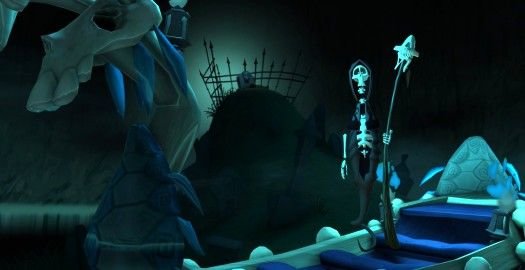
I have yet to find a Telltale game that couldn’t be described as technically superior to its contemporaries, and there is no exception here. Although the visuals this time are, by necessity, not as colorful and vibrant as other episodes, the animation is as fantastic as ever and the facial animation during key character moments is really impressive. It’s also easy to notice some improvement in the way the camera is handled—the jerky confusion of Launch of the Screaming Narwhal’s opening seems like so long ago. As the game takes on a more ambitious and epic tone, the music backs it up expertly with some truly great dynamic scores that enhance the urgency as the final confrontation unfolds. The voice audio production is also top-notch, with some great evil voice effects for the villains, and the return of Earl Boen (of Curse of Monkey Island fame) as the voice of the evil LeChuck will be a welcome treat for series fans.
The uneven puzzle design and mechanics that have afflicted earlier episodes are unfortunately still present. This time, the puzzles definitely err on the easier side and the game’s play time was quite a bit shorter for me than the previous episode’s as a result. In addition, the execution of the puzzles is sometimes a bit irritating, particularly when walking back and forth between the same two areas over and over again. One later puzzle, which is a response to the large spell puzzle from the fourth episode, slips into the mechanics of “go back to every room and pick up everything that’s not nailed down and you’ll figure out the use for the items later” when it seems that with some extra creativity, such an obvious approach could have been avoided.
In addition to issues with the puzzles, it’s tough not to take note of the game’s very subdued tone. This is understandable given the constricted setting and the surrounding events, but there is not a great deal of urgency or energy in the early stages of the game until some key cutscenes set the story on its final course. It’s a little disappointing that the game begins so quietly, coming off of such a momentous event that ended last month’s episode.
Ultimately though, it’s tough to put too much focus on the weaknesses of the game’s early and middle parts, because the ending of Rise of the Pirate God gets everything right. From the moment the game’s multi-step penultimate puzzle is solved and the final confrontation sails into view, the game moves forward at rocket speed, through a brilliant final puzzle sequence that is expertly directed and animated, involving many moving parts yet making perfect sense and never disorienting or confusing. Besides being a smart puzzle in its own right, it is also a moment of epic, majestic drama, preceded by an essential and sudden character turn, and then concluded with an extremely poignant and dare I say touching moment that sets up the game’s true ending. The entire final ten minutes had me emotionally connected with this game like I have never connected with a Telltale game before—and as a bonus, the epilogue ends on an absolutely perfect note, addressing the fates of the remaining essential characters and setting up an all-but-guaranteed second season.
The conclusion emphasizes how good those who oversaw this season were at getting the important things right. Guybrush Threepwood, here more than any other episode, feels like a genuine hero; LeChuck is finally a devious and truly credible villain; Elaine is the intelligent love interest who, of course, is indispensable to Guybrush’s victory as the story plays out; and the final conflict feels grand and epic in a way that the season as a whole has struggled to reach at times. I can’t imagine any fan not walking away from this episode feeling exhilarated and rewarded—and already excited for the series’ future.
Inasmuch as I weight the final portions so heavily in judging this episode, it’s also fair to view this episode not as an individual game (because clearly no one should ever play it as such), but as a summation of the series itself. In consideration of the entire Tales of Monkey Island season, the final episode really is as appropriate a conclusion as you could hope for. The epic scope of the season’s events is heavily emphasized here, leading you to walk away feeling like you haven’t just played a cute little Monkey Island side-story—you’ve played the true Monkey Island 5 in five parts. That is ultimately a very rewarding feeling for fans of the MI mythos.
I have been critical of some of the individual episodes this season, particularly the uneven design and tone issues (plus the blundering interface that I will never be convinced was a good idea), but like most great adventures, the final chapter and the full understanding of how events have played out puts a more positive spin on all the previous chapters as well. Whatever the minor failings may have been, Tales of Monkey Island as an entire work has been a comprehensive and grand story on a scale that might be able to compete with any previous Monkey Island game—not a statement I make lightly, but ultimately a reflection of how incredibly strong a final impact this game leaves and how well it ties everything together. In spite of this chapter’s sometimes bland early tone and uneven puzzle mechanics, Rise of the Pirate God and the series as a whole both come with my highest recommendation as a modern adventure genre must-play.
Tales of Monkey Island: Chapter 5 - Rise of the Pirate God
Platform: iPad, iPhone/iPod Touch, PC, Wii
Genre: Comedy
Developer: Telltale Games
| Territory | Date | Publisher |
Download |
December 8 2009 | Telltale Games |
Staff Writer
I don’t know, I personally thought the very end felt awfully rushed. Yes, there were some great emotional high points hit and a wonderful puzzle (not to mention that poignant bit you mentioned that hit me as hard as any story even i’ve experienced), but I felt like a few important questions were sort of brushed aside or answered haphazardly, particularly about Elaine’s behavior. Also, while I enjoyed most of the puzzles (easy difficulty notwithstanding), the return of the giant fetch quest puzzle, while sensible in terms of the story, was still incredibly annoying and really deflated the momentum that had been building so steadily.
Other than that, though, an excellent end to an incredible series that proved telltale extremely worthy of the legacy, and really showed off their abilities as storytellers. I can’t wait for their next project.
What can I say? I totally agree with this review and especially with the comments on the last 10 minutes. I finished the game yesterday and it is still playing in my head. I’m so glad I decided in favor of playing Tales of Monkey Island as I wasn’t too impressed with the early screenshots and the new look of Guybrush when I first read about it . In the end, after being undecided for awhile, I went in favor of taking a chance and bought it. I’m so very glad that I did, all 5 chapters were great! I’m already looking forward to more Tales of Monkey Island, if I can believe the Voodoo Lady, and what she hinted at in that final scene after the credits rolled.
“...you’ve played the true Monkey Island 5 in five parts.”
That’s exactly what I thought after finishing the final episode. Good review, too.
I really loved the whole series.It really felt like a Monkey Island game.
Please let there be a season 2!
– warsaw350125 on Dec 14, 2009 :“particularly about Elaine’s behaviorâ€
I totally agree (I’m not buying the story)
She’s back stabber, untrustworthy, disloyal piece of work
And at the end Guybrush takes her back! (a mighty pirate)
Elaine: Guybrush I meant to do it all, I had a plan
Me: yes right, sure you did
Guybrush: oh ok honey pumpkin pinny poo(or whatever he calls her [fool] )lets continue to leave happily ever after again
Me: well that will never happen, because you can’t trust a woman like that
They did a very Good job (destroying the whole brand)
They should have known that monkey island fans are going to think, we are not going to buy that story
Is 4 Stars indicative of a score for the whole series as a single game?
If not, what would that be?
i thought it was disappointing. the graphics are only good in that they are high res and there is cool camera movement. there is zero rich detail or grit or texture to things. everything looks like shiny clean plastic. the underworld was totally half-@ss’d. I just don’t feel like Telltale was equipped to really handle a proper Monkey Island. The puzzles were almost offensively easy and contrived, with the exception of the face-off contest and maybe one or two others. The locales were tight and empty, it didn’t feel like a world you were immersed in, it felt like a series of rooms with the minimum number of people and objects (sometimes jarringly out-of-place for convenience) to custom fit a story for Guybrush Threepwood.
Telltale is good at creating cinematic camera work and voice overs and a polished feel, but they haven’t made a real challenging GAME yet or a world that is a work of art, that really feels like an epic classic. Puzzles and environments seem to be the last thing they care about.
Ep. 3 was the best by far. Those writers should have done the whole series. Episode 5 was very disappointing in comparison, and the ending was very rushed and forced, and introduced all sorts of confusing story elements that seemed to be put there merely for convenience and tedium.
I’ll play a second season if they do it. But I’d much rather see Monkey Island return to its rightful home at LucasArts or Ron Gilbert. This series felt like a Telltale hijacking of Monkey Island rather than a true to form sequel.
While I have enjoyed the new Monkey Island series, this episode was one of the weakest; FWIW I enjoyed Episode 3 the best. In this episode, the empty after life was made even more tedious by the designers forcing you to visit and revisit the same few locations ad infinitum. The puzzles were not logical - even apply Monkey Island logic - and the constant retracing only added to the frustration.
As was mentioned above, Elaine’s behavior was never adequately explained. Personally, I would have enjoyed him dumping LeChuck and Elaine and heading back for Morgan.
“But I’d much rather see Monkey Island return to its rightful home at LucasArts or Ron Gilbert.”
You do realize that more people who worked on the original games work at Telltale than at LucasArts, right?
The episode was good and refreshingly different from the previous ones. I feel they could have developed the story a bit further at the end. I am starting to get tired of the episodic carousel. We need more meat than that.
I agree that the world seems (in all episodes) pretty empty. Take the location were Morgan is - there is a set of stairs and a mast to climb in one screen and there is absolutely nothing else! Since we can’t double click to skip to the next locations we are forced to travel the same location over and over!
I also liked episode 3 the most. Especially when I’ve put my trust in Murray =) That was the only time I’ve got an old time chuckle out of the game =) Otherwise it played on nostalgia to the limits. Morgan is an interesting character but all she seems to do is mention allusions to the old game.
In the 5th episode I felt that it had a wrong tempo. There was certainly enough cut scenes but we get to sit through a 10 minutes opening and
another 10 minutes when you solve La Esponja Grande quest but then there is a mere 30 seconds of an ending. I liked the return of the final battle when LeChuck kicks you around. It felt menacing a bit unlike the first episode when you can just walk around your mortal enemy.
All in all it was a good try and I enjoyed it a bit more than new Sam & Max (although the dialogue seems to better overall in S&M) but I doubt it will bring many new players to the franchise. Oh well, maybe thats the most it can be at the time. Lets hope they will improve further for the next season.
Whatever. I loved it! In fact, I’d replay it just for the story and humor—which I think is richer (oh no blasphemy!) than the older monkey island games—though part of that is due to enhancements in technology and what game companies are actually ABLE to do now (e.g. lot’s of animated close-ups, fluid camera moves, etc.)—which provide different avenues for the humor. It’s not onlyt about the puzzles but story as well. But speaking of puzzles - I thought they were just hard enough to feel rewarding but not enough to be frustrating.

Download