
Review for Laura Bow: The Dagger Of Amon Ra

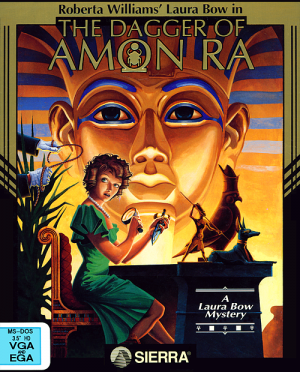

I think it began with the box. It always does. Laura on the front. And on the back, a man, murdered, standing inside a sarcophagus. Then opening the box and marvelling at the detailed museum brochure, the edutainment which will serve as copy protection and cleverly starts introducing some of the characters, like the arrogant archaeologist and the weird palaeontologist. Then, as the game starts, the pleasure of hearing the familiar clock chime once again, the boat, the murder, the music, Laura, so likeable from her very first lines, the train fleeing through the night, all of it coming together with perfect pacing. And, always, shouting at the top of my voice "Hello, New York, Laura Bow has arrived!" together with her. Oh, gosh... It was, it still is, all so engaging. What happened? I've always wanted to like this game. What went wrong? How could it look so good at first sight, and in the end fail so miserably? Questions, questions – mysteries which, unfortunately, are far too easy to solve...
Let's begin at the beginning. We had last seen Laura Bow in The Colonel's Bequest on a bright morning when she left Misty Acres plantation after solving a series of murders which had occurred during the night. A year later, having received her degree in journalism and curled her hair, she leaves her hometown of New Orleans to go to work as a reporter in New York, where her first assignment is to research the burglary of a priceless Egyptian artefact: the dagger of Amon Ra.
In the meantime, other things had happened as well. Roberta Williams, the creator of The Colonel's Bequest, gave over the reins of the new game to Bruce Balfour, retaining only a role of consultant to make sure the two Laura Bow games would feel alike. And the basics are indeed similar: one long night, a closed space, lots of murders. This time, after exploring New York a bit and learning more about the suspects, Laura finds herself at a fundraising party in the museum where the dagger was stolen, trying to get information. But the party is soon brought to a halt as one of the museum's curators is found dead, stabbed with a replica of the dagger. As the night unfolds, Laura will have to solve an ever-accelerating series of murders, on top of the "mystery of the missing letter-opener" (as one of the characters puts it) – and try to remain alive.
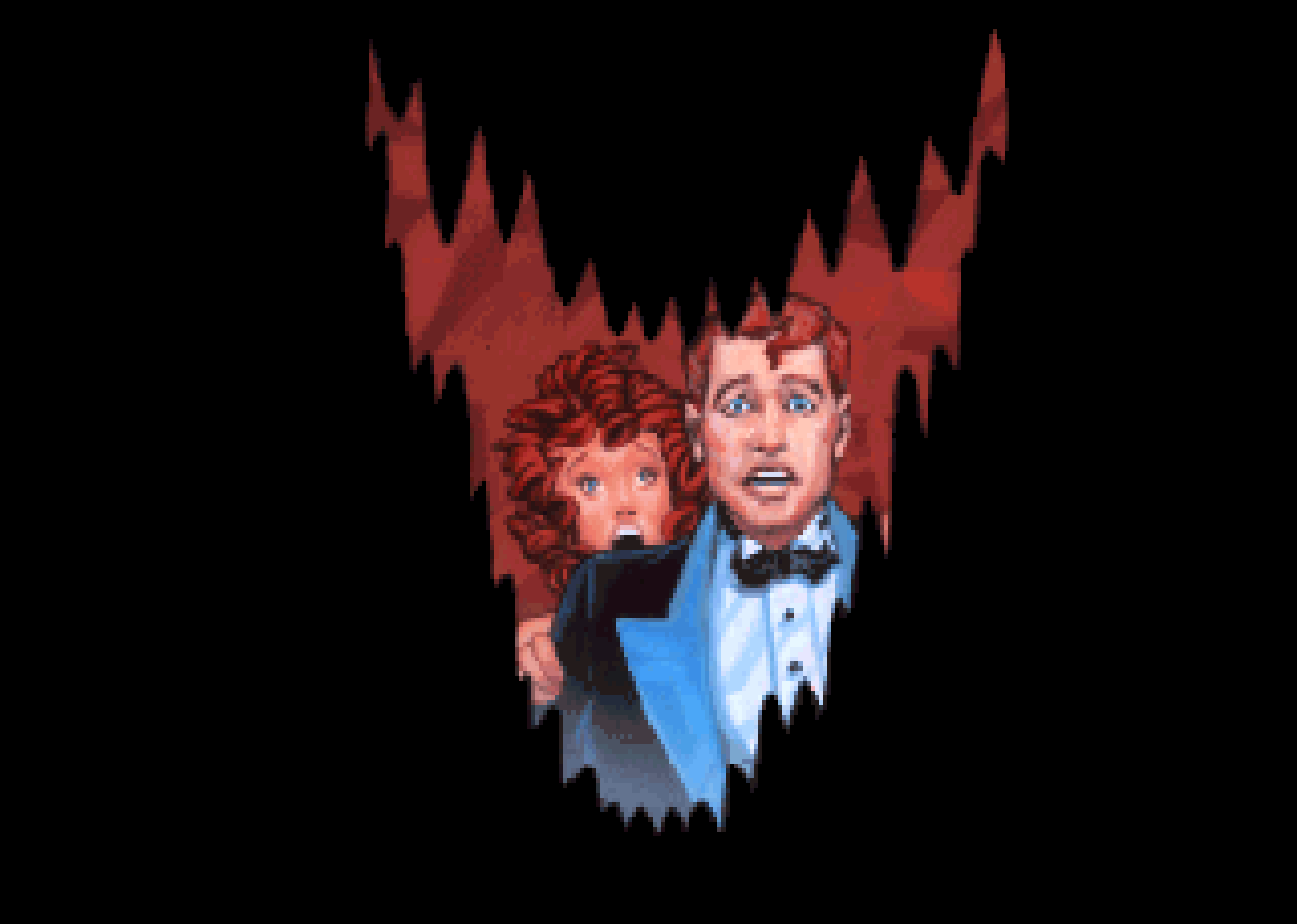
A slight twinge of disappointment is bound to occur fairly early on, when it becomes apparent that one of the few flaws of the previous game has been retained: the characters' personalities range between paper-thin and cardboard-thin. With suspects obsessing over the handful of interests they have been given, the conversations tend to get bland. I had a hard time going on listening to the French tart (yes, another one!) raving about all the "so beeg and so strrrong" men hanging around, or the spooky Greek palaeontologist directing all discussion towards death and scars. It's true that individual lines more often than not manage to be entertaining, but conversations never really rise above the prattle of soulless characters. Even the nice idea of having suspects of many different nationalities gives births to endless clichés. The game would have benefited from not having the British head of the museum end his lines with "jolly good" with the same depressing regularity as the German security chief begins his with "Achtung" – or rather, "Aktung", since hiring an actual German actor was obviously not included in the plans. The acting was in fact provided by the usual Sierra employees (such as Josh Mandel, also credited as a writer, Richard 'Cedric the owl' Aronson, Balfour himself, and Leslie Wilson, who does a great job as both Laura and the narrator) and is mostly all right. Alas, the tedious nature of the conversations is worsened by the fact that they are all grouped together during the first third of the game, and they use an awkward interface which requires a painful five clicks and two screen changes for each and every question asked.
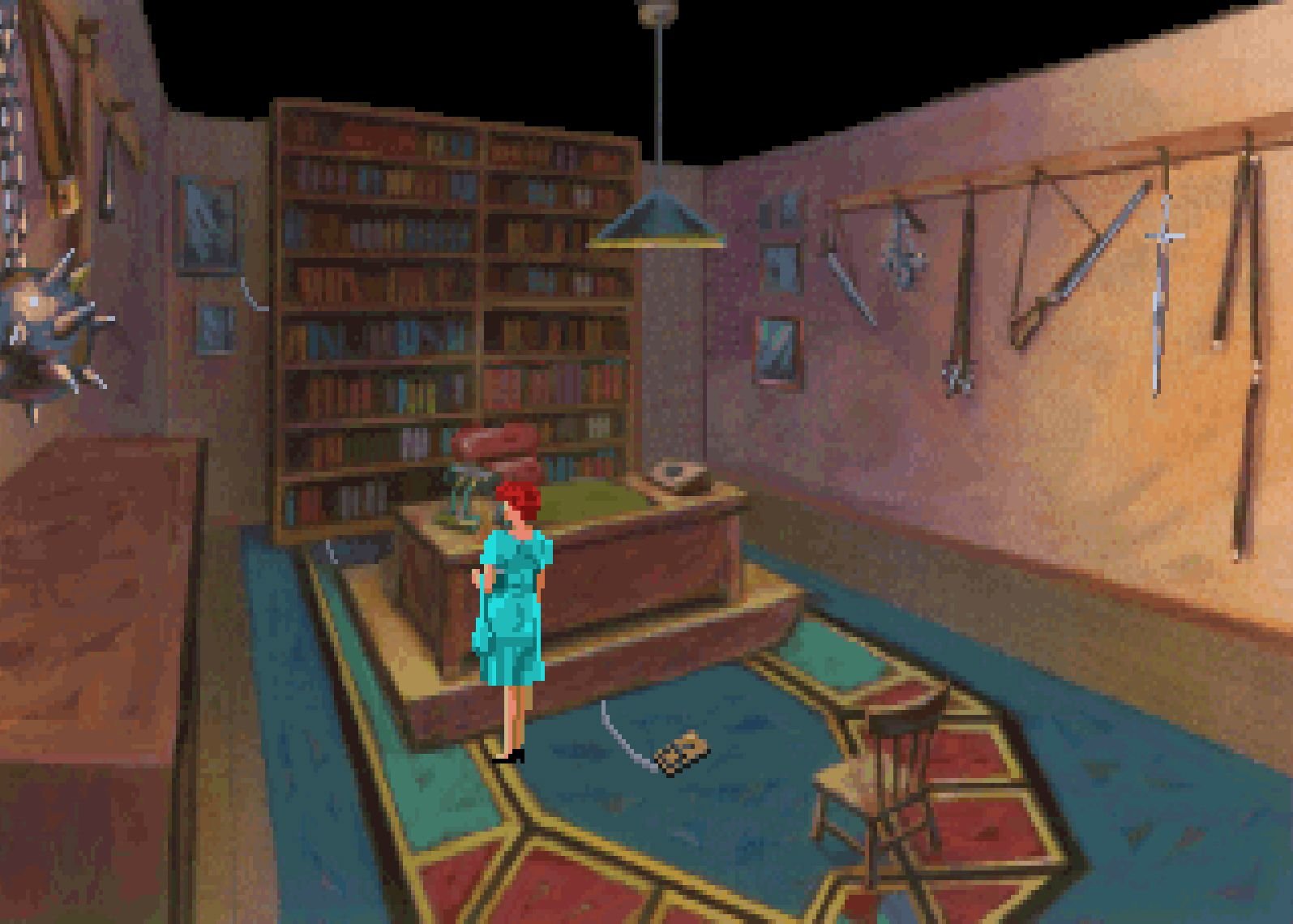
Thankfully, Laura's means of investigation are not limited to conversation. As incorrigibly nosy as she is outwardly naïve, she will leave no document unread and no door unopened – unless she's listening at it. Exploring the museum offices involves a bit of pixel hunting (and bookcase-searching!), though nothing unbearable. But the most original – and surprisingly enjoyable – way of gathering information is searching the bodies you discover; you are allowed (and expected) to examine and touch everything on and around the corpses in order to gather clues as to how the murders occurred and who did them.
Laura will also have to solve some traditional inventory puzzles to further her investigation – one of the many things that keep The Dagger of Amon Ra imbued with the familiar "Sierra" feel. The traditional icon-driven interface also returns (with an Egyptian twist), as well as brilliant lip-synch, the inability to have both voices and subtitles (something made especially annoying by the fact that, in a ridiculous fit of realism, the characters refuse to discuss the same topic twice), and ugly character sprites who walk (and dance!) with the grace of C3PO. Another such typical touch is the use of lengthy descriptions for everything on-screen, with a consistently high quality of writing – and a subtlety that the dialogue lacks. The mix of edutainment and wacky nonsense used to describe the museum's exhibits, or the dark irony which pervades the examination of the bodies, all of it with the narrator's perfect deadpan deliveries, make The Dagger of Amon Ra one of the wittiest games ever.
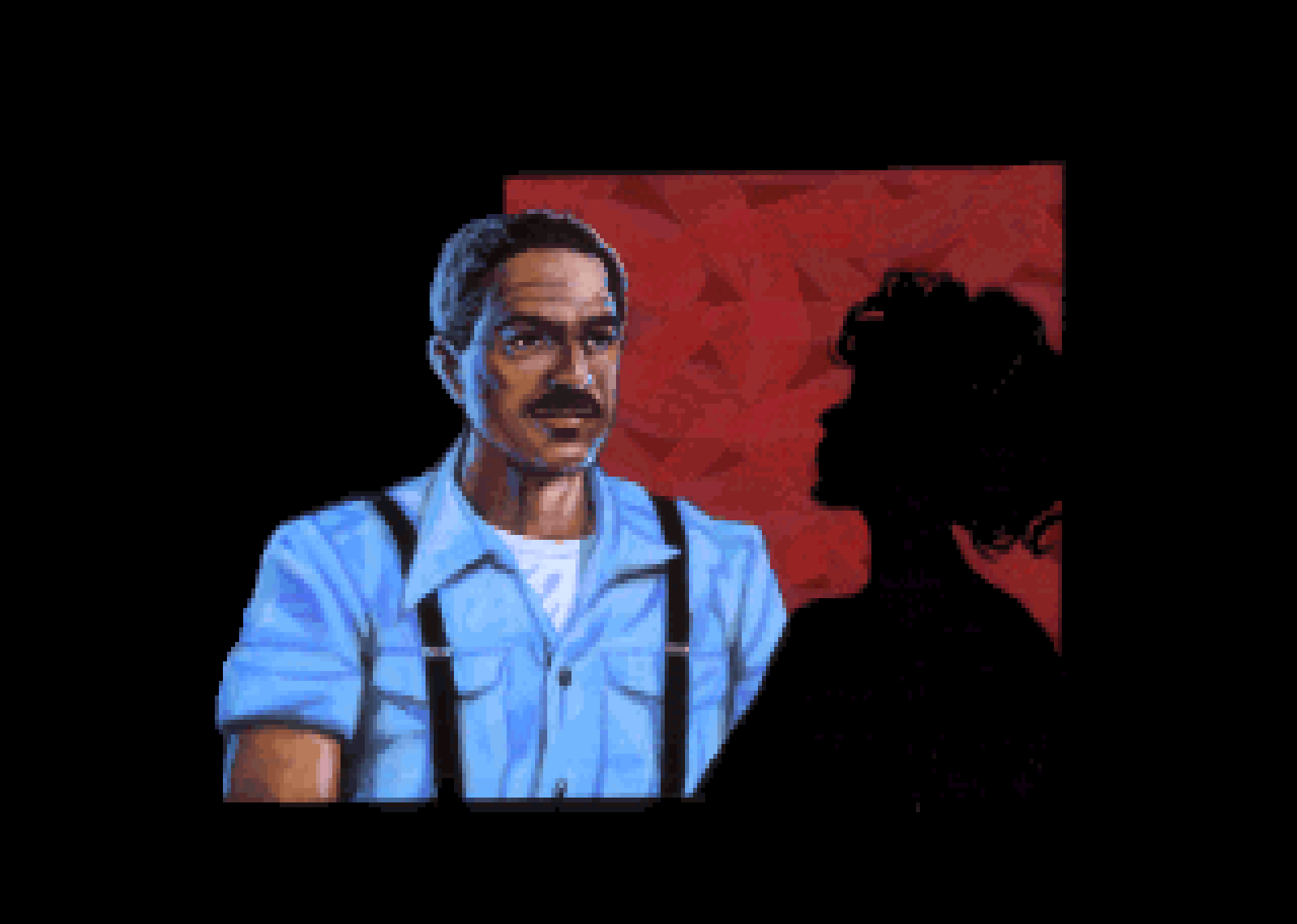
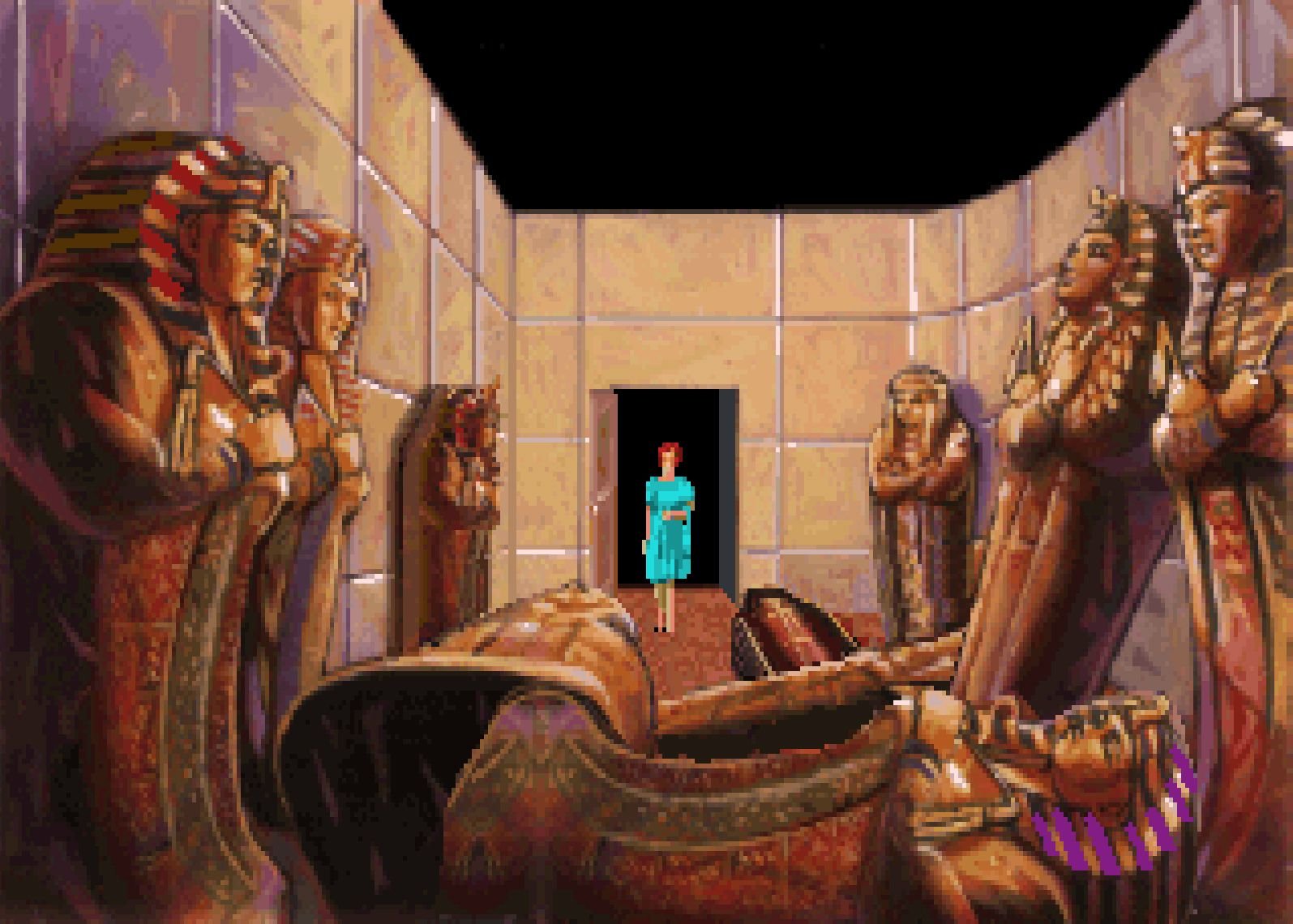
The graphics have an artistic feel to them which allows them to still shine despite their age. The setting of the screens is studied, and the use of large black areas left undrawn adds to the elegance and originality of the backgrounds and close-ups. This is especially striking in the murder scenes, which exhibit a deliberate aesthetization of the corpses, often stopped in death in an improbable composition. Aesthetic... and gruesome as well; the murders are brutal and cruel, and their (often unexpected) discovery is a startling experience.
The game is made all the more chilling by the music, wonderful pieces which add an uneasy tension to Laura's wanderings – but the game's score also manages to deliver some very engaging tunes more in the style of the roaring '20s when it has to. A third factor which will help get your blood running is the fact that Laura can die very frequently, and often unexpectedly. If you've played a Sierra game from this era, you probably already have an opinion on the "sudden death syndrome"; otherwise, you'll make up your mind fast enough. I therefore will not enter the debate, and just advise you to save early (the first death scene occurs on the second screen) and save often (there are reportedly eighteen different ways of killing everyone's favourite nosy reporter). To which I'll add: save on different slots, as the game sometimes produces corrupt, unusable savegames. And also: save while you can, as the CD version has a tendency to disable access to the save/load panel randomly (and usually at the most awkward of times) – after all, no Sierra game would feel complete without a handful of ugly bugs.
If only these issues were the defining factors of quality in The Dagger of Amon Ra. But graphics, music, bugs… like red herrings drawing the investigator away from the central mystery, the game's high production values (and not-so-minor quirks) threaten to distract me from the "secret of the failed sequel", which I meant to elucidate here. A first clue was already given, though. Did you catch it? Have you been wondering why all those people, including Laura, were spending the night in the museum instead of going home when one of the curators has just been found dead? If you have: congratulations, you have the makings of a real sleuth. And if you haven't, you can console yourself by knowing that this gives you a chance of actually enjoying The Dagger of Amon Ra. For the game provides no answer to that question. People get killed, but that never stops the characters from doing whatever it is they're doing. By the end of the game, there's a body in almost every room but, when asked about that, one of the characters just answers "Err... Murders? Oh, I guess somebody did mention that." What can I say? The game is chilling, and builds tension well, but the characters just don't care – obviously this would have required too great an alteration of their meagre psychological profiles.
And not caring about the plot is not something limited to the characters; it affected the designers too. Bruce Balfour and Roberta Williams seem to have thrown in every line, scene, and plot element that looked interesting, surprising, or simply fun to them, while neglecting to fit them all together into a cohesive structure – and often while failing to notice that what they were adding was just a tired cliché. Plot holes and inconsistencies abound, from the main plot itself to details of clothing; from the characters constantly contradicting themselves for no good reason to Laura being unsure what time of the year the story takes place. The game can't even keep track of where its characters are, some being nowhere in sight for most of the night, appearing only when needed, while others are literally in three places at the same time. While merely depressing in retrospect, this infuriating carelessness borders on insulting when you are wracking your brain trying to solve the mystery. It was fairly early on in the night, as consistency was once again sacrificed to introduce yet another unoriginal red herring laced with a bad pun, that I started having the nagging feeling that the whole game was just a bad joke made at my expense – a bitter doubt that would remain with me to the end.
Making a murder mystery that manages to be intellectually stimulating, while not frustrating those of us who don't have Hercule Poirot's little grey cells, is a daunting task. The Colonel's Bequest succeeded thanks to three design decisions: it involved a rather simple mystery, it allowed the player to reach a satisfactory ending without having figured out everything, and it then explained the central plot to the player while encouraging replays. The Dagger of Amon Ra chose to do the exact opposite. And it did not work.
The plot is quite complicated, with several branches, not to mention many red herrings, and some of the most vital pieces of information can easily be missed. Furthermore, the game concludes with a series of questions asking Laura to name the murderer(s) and give their motives, as well as the dagger's thief and other miscellany. Should you make a single mistake, even something as ridiculous as, say, selecting "fear" instead of "cover another crime" as the motive for this or that murder, you will lose, and the game will offer you nothing more for your failure than harsh words and the right to start again from the beginning – or to refer to a walkthrough. Should you decide to cheat, be sure to refer to something that tries to explain the plot, for the game will certainly not do it for you. Actually, to this day, the precise motives and circumstances of some of the murders remain largely mysterious to me. Why a game that has such a shaky grip over its plot should feel allowed to be so demanding is beyond me – and was an unforgivable design mistake, leading the player into hopeless frustration.
And yet, should you succeed, The Dagger of Amon Ra has a brilliant conclusion, one of those (few and far between) moments of grace when the plot's flaws manage to disappear behind the game's artistic qualities and witty writing, showing what this sad farce of a game might ideally have been. My, what a sorry mess... What a sad, sad waste of talent... What to make of this game? If you think you can play it as just a typical Sierra game, with great music and graphics, clever writing, and some fun gameplay elements, and are not interested at all in trying to figure out the plot, then please do give it a try. But if you want a good murder mystery that doesn't insult your intelligence with lazy design... Well, just replay The Colonel's Bequest.