
Review for Gabriel Knight 3

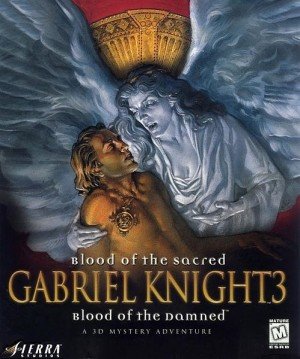

In January of 1982, a book entitled "Holy Blood, Holy Grail" was published. Challenging that the traditional, accepted view of the life of Christ was incomplete, the authors plotted a strange path connecting the mystery of a hidden treasure in the small French village of Rennes-le-Chateau to the history of the Cathars, the Templars, and the Priory of Sion. The book caused no small amount of controversy amongst Christians, especially considering that the book implied a deliberate conspiracy on the part of the Catholic Church to hide or recast certain portions of the messiah's story, most particularly the role of Mary Magdalene.
Springboarding off ideas planted in the storyline of The Beast Within regarding the famous "Black Madonnas" of Europe, the final episode of the Gabriel Knight Mysteries takes the threads of the Rennes-le-Chateau story and weaves a tale of bloodlines and those who would manipulate them for their own ends. Blood of the Sacred, Blood of the Damned's attempt to encompass 2000 years of recorded history into its game play is both its glory and its failing.
The story begins some months after the events of The Beast Within. Gabriel and Grace have recovered from their harrowing adventures and are finally beginning to act as true, equal partners. They are invited to a seemingly innocent weekend at the home of Prince James, the current Stuart heir. It is soon revealed, however, that the Prince's intentions are all business. He knows Gabriel's family history and, as a relation to the Wittlesbach dynasty, of the lost Wagner opera. He has a proposition for them. He has need of a Schattenjager.
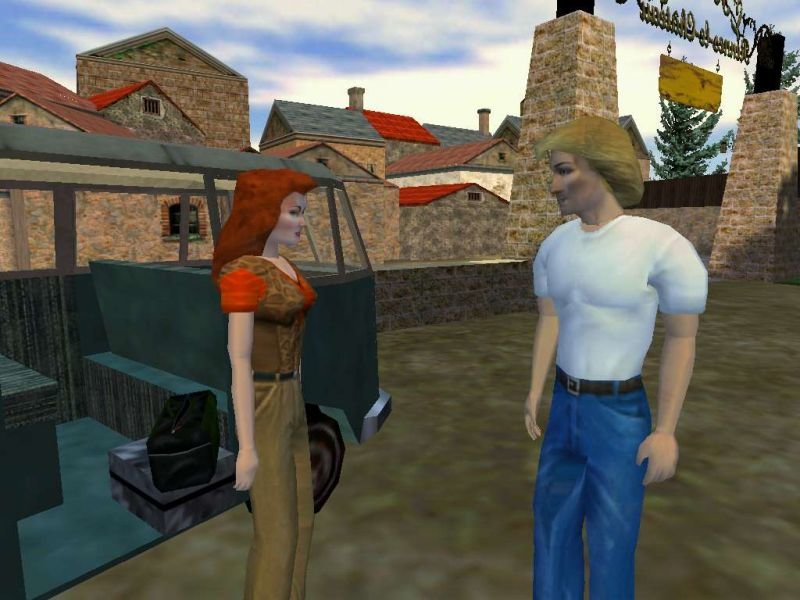
The Stuart family, it seems, is victim to a certain strange anemia, one for which medical science has no explanation. Nor is there any explanation for the strange holes that appear in the victim's neck. Prince Stuart is terrified that those responsible, the "night visitors", will come for his infant child Charles next.
The case almost immediately starts off on the wrong foot. Before the game even begins, Charles is kidnapped right under Gabriel's nose. Giving chase, he's led to a train by the two night visitors before being knocked out. On awakening, he finds that he's arrived near the village of Rennes-le-Chateau.
The story follows Gabriel and Grace as they search for Charles and the men who captured him. In the village, Gabriel finds a group of treasure hunters, all of whom seem to have something to hide. As he sneaks into their midst, searching for the lost child, Grace begins to slowly uncover a mystery that has been buried since the days of the Crucifixion, one hidden through the times of the Templars, the Cathars, and the Visigoths to the modern day. As they both continue to dig, both literally and metaphorically, they soon realize that everyone -- even the man who originally hired them -- has a secret agenda.
The game play takes place over three days, the shortest of any game in the series but still perhaps the longest and most complex of the trilogy. Each day is broken up into "time blocks" which can range from two to four hours apiece. While each block will end only when certain conditions are reached (much like the Days and Chapters of the previous entries), there are also optional events which can only be viewed if the player is in the right place at the right time.
While this design seems a good compromise, it can also be frustrating. Sometimes the actions required to complete a time block will be unclear -- especially during the first day when the player does not have access to the game's "hint" function, which informs players of what locations still require events to complete the time block. Also, since most of the game's locations contain multiple sub-locations (most particularly the village itself), it can be difficult to pinpoint precisely where to go next and the game play devolves into blindly visiting everywhere and re-examining everything.
Due to this design, several important subplots in the game are easy to miss. While not necessary to complete the game, players who wish to make sure they see everything will, again, simply have to revisit all available areas in case something new is available.
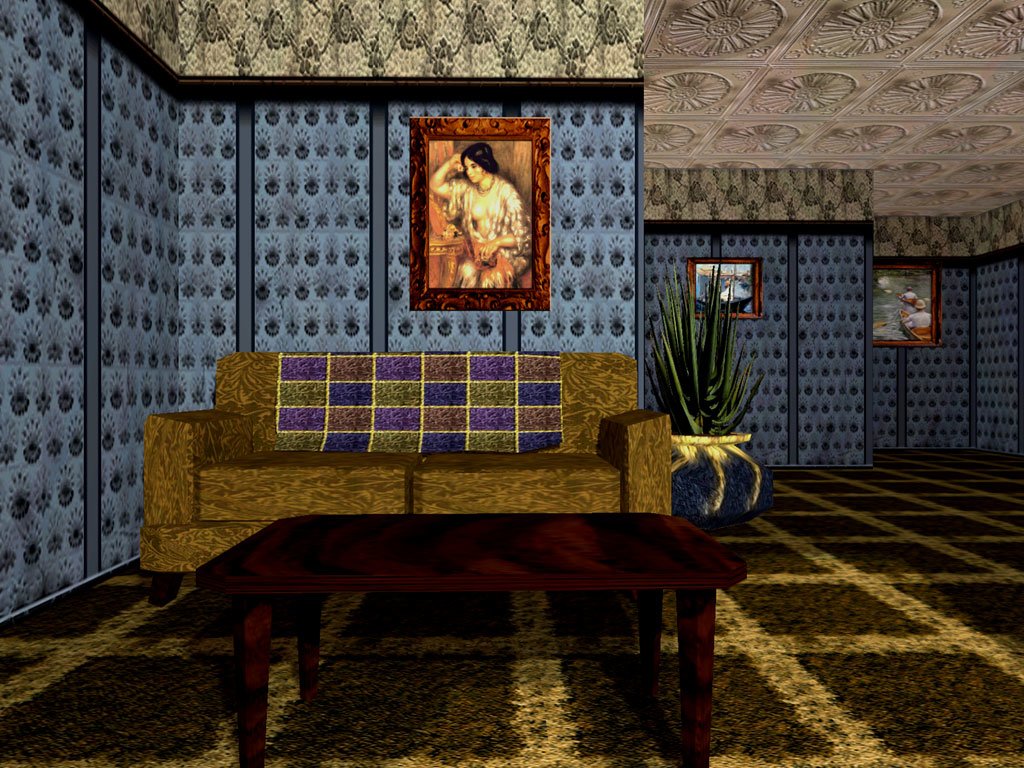
Blood utilizes an interface that seems a combination of the previous two games. Set in full 3-D, the player moves an imaginary "camera" around the scene rather than directly controlling Gabriel or Grace. Hotspots can be clicked, as in Beast, but upon doing so a series of iconic options becomes available, much like those found in Sins of the Fathers. Thus, clicking on a lamp might give access to the options to examine it, turn it on or off, move it, and so on. The combination combines the strength of both previous interfaces, giving the user quite a bit of control while still remaining straightforward and simple.
The 3-D locations set in and around Rennes-le-Chateau are lovingly implemented, especially the village's church. While the textures are sometimes muddied, there's a wonderful attention to detail in the design. Unfortunately, the sheer scope can also be overwhelming, and scanning over an entire 3-D field for hotspots can give new meaning to the phrase "pixel hunting".
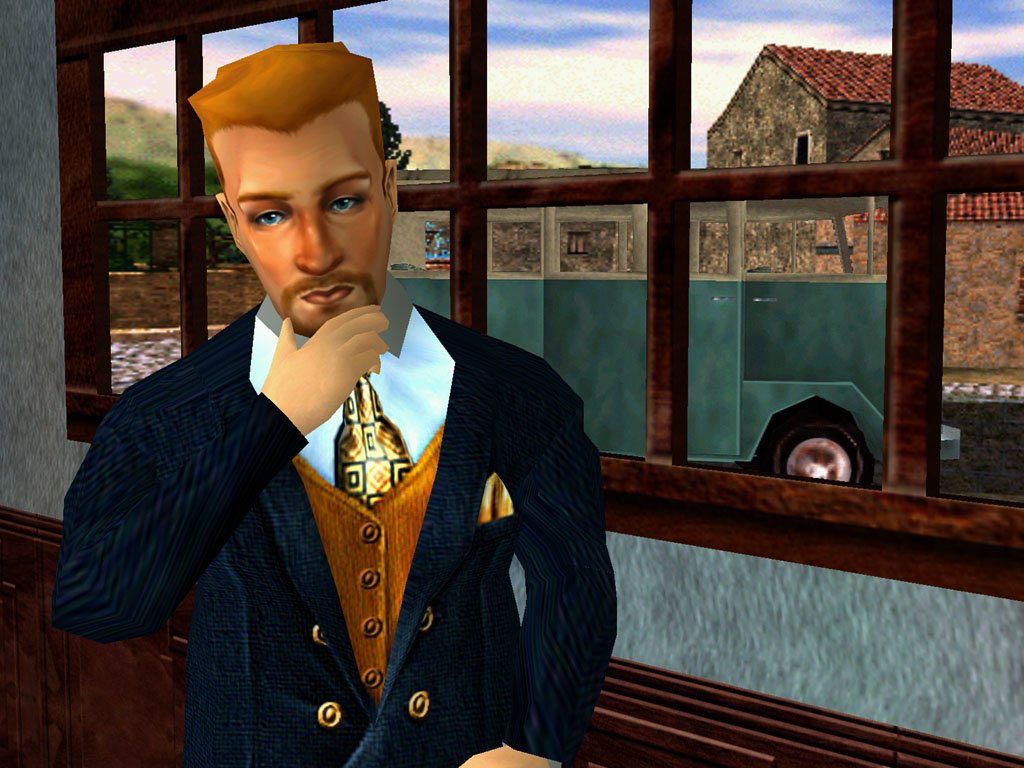
The character models don't work as well as the location models, generally having a clunky feel. This especially comes to the fore in the case of an optional puzzle in which the player must watch a complex handshake played out and then later repeat it. The roughly done hand models end up making this sequence much more complicated than necessary. However, all of the characters do have a unique look and all of their dialogue is lip-synched well.
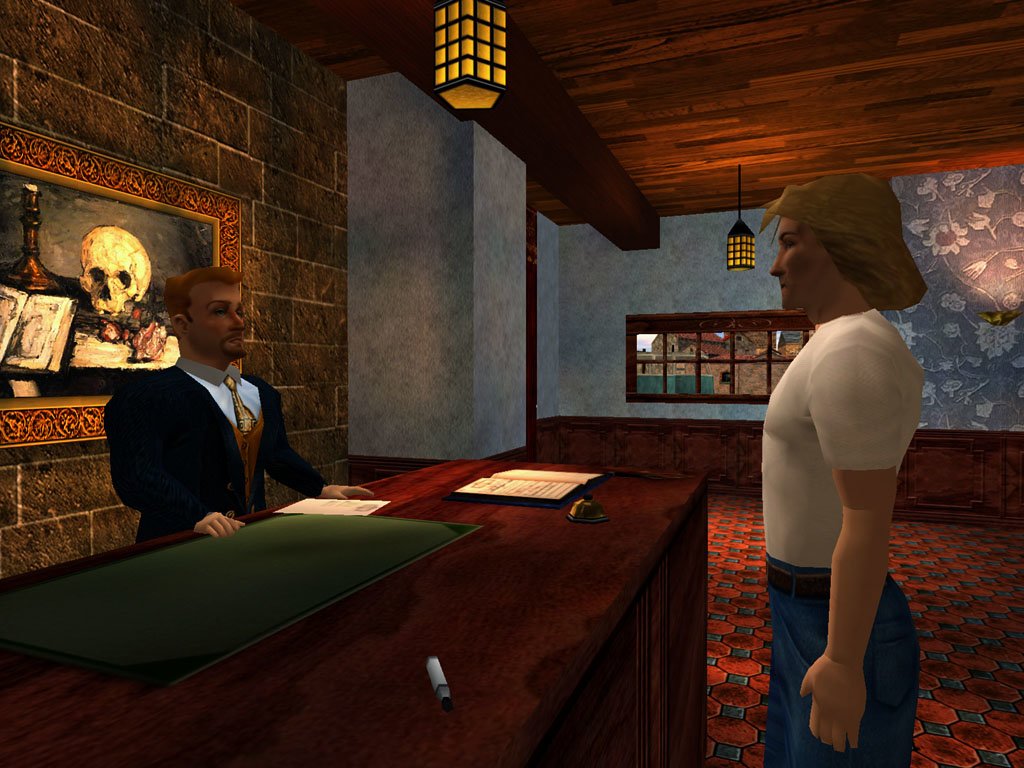
Tim Curry returns as the voice of Gabriel and his interpretation is as over-the-top as ever. The rest of the cast is generally good, with new voice actors filling in the roles of Grace and Mosley, who reappears after an extended absence in The Beast Within.
Musically, Blood is both the most complex of the series as well as the best implemented. The audio track is technically excellent, utilizing themes that have appeared throughout the series. Also, several sequences are scripted with the music in mind, with wonderful results. Particularly memorable is Grace's explorations of Chateau de Seres during Day Two, which uses a single theme which becomes more complex (and menacing) the further her investigations take her.
The puzzle design varies wildly. Late in Day Two, Grace learns of "Le Serpent Rouge", a pamphlet connected to the Rennes-le-Chateau mystery. Much of the game play story's later part involves solving a series of riddles embedded in its text with the help of SYDNEY, a computer system Grace designed. The entire sequence represents perhaps the best puzzle design ever to appear in an adventure game. SYDNEY is used to analyze diagrams and maps, translate passages from Latin and other languages, and perform cryptographic and anagrammatic functions, all towards the end of solving a fascinating over-arching enigma. Diametrically opposed to "Le Serpent Rouge" is a series of puzzles Gabriel must solve during Day One that involve Mosley and accessing a motorcycle that borders on the absurd. Illogical and downright silly, these puzzles are far from Jensen's best work.
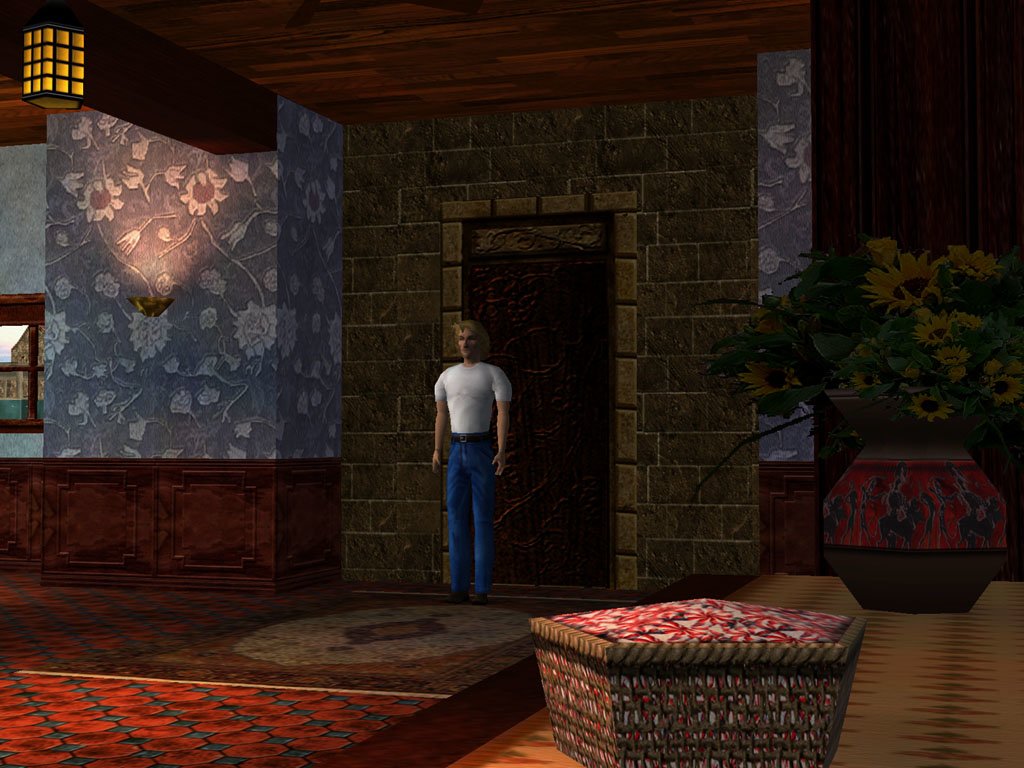
The rest of the game falls somewhere in between. Much of Gabriel's story involves the treasure hunters and, as always, his approach to investigation is something less than legal. Still, it's great fun wandering around the well-implemented hotel, breaking into rooms and rummaging through other people's belongings. Much of Grace's game play is taken up in the aforementioned "Serpent", though earlier there are some interesting segments touring around the valley, learning of its history.
In the end, Blood's storyline seems much more cerebral and, oddly, relaxed than its predecessors. Even though this case is just as dire as previous ones (a kidnapping rather than a murder), the tension involved in finding Charles takes a back seat until almost the end of the game.
In some ways, it seems as if Jensen simply had too much story to handle in three days of game play. Much of the back-story involving the valley's history and the conspiracy is handled via conversations between Gabriel and Grace rather than actual investigative game play. Worse yet, the final series of revelations are handled via a narrative cutscene.

Still, the story Blood of the Sacred, Blood of the Damned attempts to tell is epic in every sense of the word. Spanning centuries, its final resolution ties the various disparate threads of the valley's history, the treasure hunters, the "night visitors" and even the Schattenjagers themselves together into a cohesive and believable whole. The game's final cutscene is a wonderful work of art, and left me sad that a true conclusion to the series will never be reached.
While its design contains some serious issues, Blood is ultimately a success. Its highs far outnumber and outweigh its lows. From the perspective of a game, it contains one of the best designed puzzles in adventure gaming history. From the perspective of narrative, it is one of the most ambitious productions ever attempted. While it may not always reach the heights it targets, the final Gabriel Knight Mystery is a vast and impressive example of the art of adventure games.