

Telltale Games - Wallace & Gromit interview
Wallace & Gromit are no strangers to adventure. Already the pair have shared A Grand Day Out, tried on The Wrong Trousers, and narrowly escaped A Close Shave, to name but a few of their previous exploits. But the experiences of the mild-mannered inventor and his longsuffering canine companion in a series of animated shorts (and one feature film) by Aardman haven’t been Grand Adventures until now.
All that is about to change, of course, with the release of Telltale’s four-part episodic series starring Nick Park’s beloved claymation characters. With the season's launch closing fast, time was running out for an early look into the new gaming world of Wallace & Gromit, but the chance to try out a playable demo of the debut episode recently was just the grand opportunity we were looking for.
Somewhat surprisingly, at first glance there appear to be more differences than similarities to Telltale’s previous Sam & Max and Strong Bad series. Behind the faux-plasticine exterior, however, lies… well, even more surprising differences! Thankfully, beneath all the changes remains the same unmistakable level of quality and style that we’ve come to expect from these episodic pioneers.
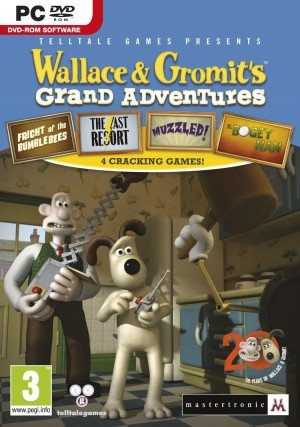
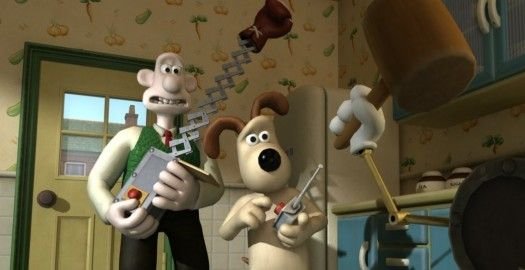
Regrettably (if entirely understandably), Grand Adventures is not done using real clay and stop-motion, but rather an adapted form of the same 3D engine behind the company’s other games. The good news is that the bright, colourful graphics are delightful in their own right, with a wide range of resolutions available (including widescreen support) making the visuals quite crisp, with plenty of detail but just enough “flaws” to give it an intended hand-crafted feel. On the one hand, you can admire the wood grain in a curbside bench or the brick texture of the town homes on West Wallaby Street, and yet also pick out distinct “fingerprints” or pockmarks in the characters where the imaginary sculptor has gotten a little careless. It’s a nice touch that provides an effective balance between an otherwise-polished presentation and the human element that fans of the animated shorts are used to.
But never mind the graphics, right? Even from here, I can sense a first hint of public angst over the unknown involvement of Peter Sallis, the wonderful voice actor behind Wallace’s TV persona. So does he reprise his role here? I’d love to soothe people’s minds with a resounding “Yes!”, but since I can’t do so honestly, I’ll have to settle for an unequivocal assurance that his replacement here does an excellent job. I’m not crossing my fingers, biting my tongue, or covering my “but” (so to speak). It’s true. So true, in fact, that I had to verify with Telltale that it really wasn't Sallis just to be sure. Rest easy in knowing, then, that Wallace’s shy nature and absent-minded brilliance still shine through the vocal delivery here.
Where the changes really start to become apparent is in the control scheme. To date, Telltale has made exclusively point-and-click offerings, but Grand Adventures alters that, primarily to accommodate the simultaneous development for the Xbox 360 through Live Arcade. But before anyone goes off on a tangent about dumbing down for consoles, the game nevertheless plays out like a fairly traditional adventure. The keyboard is used to navigate the playable character, including both Wallace and Gromit at various times, but this is as easy as moving them directionally from a camera-relative perspective. Super-simple stuff, particularly at the relaxed pace of the characters on screen. There were some minor control issues in the demo I played, but improvements are still being made before the finished episode’s release, so these are likely to be eliminated before then.
Control within each screen, meanwhile, remains a mouse-driven exercise of highlighting relevant objects and interacting with them accordingly, either through the contextual default action or applying appropriate inventory items. The demo's interface included an interesting and rather unusual blend of onscreen icons and active hotspots, but this too is being fine-tuned before release, so any early details I could offer are still subject to change for the better.
Telltale is also considering adding gamepad support to the PC version, which I strongly (ahem!) encourage, though for the purpose of this demo, the option was as yet unavailable. Even so, for anyone concerned about the shift to “direct control”, rest assured that any such fears are unfounded. This is no shift to “twitch” gaming for consoles; if anything, it’s rather a shift back to the simple keyboard mechanics that once dominated the genre long ago.
While dialogue has featured prominently in other Telltale games, Wallace & Gromit takes a much different approach. You can still speak to other characters like the paranoid war vet, Major Crum, or the uppity neighbour, Felicity Flitt, but there are no dialogue trees to choose from, limiting the options for conversation to objects in the immediate vicinity. True to his character, Gromit never says a word, while Wallace does make observations about his surroundings, but always with his usual British reserve. As such, these Grand Adventures look to be less like “comedy” than simply charming, whimsical fun. Gromit’s understated expressions into the camera are still priceless, and Wallace’s zany contraptions will no doubt yield plenty of opportunity for welcome sight gags as the series progresses, but the tone of the new pair will certainly be different from the wisecracking banter of their episodic predecessors.
The demo offered only a small sampling of play, from a short tutorial helping Gromit win a chess game through a few basic inventory puzzles to further Wallace’s new beekeeping venture, before ending in a climactic high-speed (luckily, Gromit can drive) rescue of Wallace from a giant queen bumblebee (it just wouldn’t be a Wallace invention if something didn’t go disastrously wrong, after all). Just as you'd expect from the start of a new series, none of the challenges could be considered difficult, but they were clever and enjoyable, and there were even a few optional tasks to do. The darn demo even had the audacity to end on a cliffhanger. The demo!
And you know what? It worked, as I’m now more eager than ever for the full Grand Adventures, and you should be too. With four episodes in all, each with its own zany standalone premise, there's plenty to look forward to – not as plenty as six episodes or five, but four will certainly do in a pinch. Fortunately, it won’t be long now, as the series debut is coming soon, though an exact date still hasn't been determined. In the meantime, since we don’t want to leave you hanging, read on as we take you even further behind the scenes for a tag team interview with Telltale Games.
Adventure Gamers: First of all, I'd like to offer you congratulations for taking home some major hardware in the first-ever awards presentation here at Adventure Gamers. I understand you've been similarly recognized elsewhere, but we all know The Aggies are where the real glory is. Well done!
Dave Grossman (design director): Thanks very much! We are honored and pleased -- even game developers need validation. Especially game developers. And Adventure Gamers has been with us since the beginning, so you can say you knew us when.
Dan Connors (CEO): Thanks, we really respect Adventure Gamers so we're very proud to receive this recognition from the site and the readers -- it's a pretty discerning audience. This has led me to finally forgive Evan for his review of The Mole, the Mob, and the Meatball.
AG: Okay, enough resting on your laurels. Time to look ahead to your next highly-anticipated "grand adventures". So, why Wallace & Gromit?
Dan: Because it's a great franchise with a lot of integrity. It's obvious that Aardman has poured a lot of love into the franchise, so it gives us a strong base to work from.
Dave: Plus, we love Wallace & Gromit! They're great characters, at once hopelessly loony and yet filled with richness and deep human emotion. They have a kind of soul that many other mainstream media figures lack. Also, think about what usually happens in their films: They cleverly solve some sort of problem, only to get themselves into much bigger trouble, which they must then resolve through additional cleverness. Is that perfect for adventure games, or what?
AG: It is perfect, you’re right. But it's also a curious choice based on the importance of dialogue in your previous games. There are probably fewer words in all the W&G shorts combined than a single Telltale episode to date. How do you approach the transition to a property where words are at a premium?
Andy Hartzell (lead designer): That's a good question. You'll find that Wallace & Gromit's Grand Adventures relies less on snappy one-liners than Sam & Max or Strong Bad's Cool Game for Attractive People. And in keeping with the Aardman brand, there's more physical comedy. But a Wallace & Gromit adventure game will never be quite as kinetic as the claymation originals. Ultimately we found a compromise between Aardman's hyper-physicality and Telltale's signature hyper-verbosity. We've surrounded our two heroes with a supporting cast of sharply-drawn characters. They tend to bring out a more talkative side of Wallace. (And did we mention that Gromit is now voiced by Eddie Murphy...? Kidding, kidding.)
AG: That's not the only key transition you're making, as W&G represents Telltale's first foray into direct control. Why that move?
Dan: Well, it's also our first Xbox Live Arcade game, and we really wanted to design something that would work well on an Xbox controller.
Dave: Our approach is a hybrid of direct control and point-and-click, a sort of "direct and select" that involves a familiar direct control for moving the character, and a directional popping-from-spot-to-spot method for pointing his attention to things and people in the environment.
We've adopted this for a few reasons. One is that the game was designed from the beginning for Xbox Live Arcade, and we wanted to do something that felt intuitive and natural using Xbox controls. It also improves our cinematic options, in that we can do a lot more with the camera if we don't have to worry about giving the player enough floor space to click on to move the character around. With direct control, that problem disappears and we can frame shots so that they actually look good. And there is some thought that direct control connects the player more strongly to the character on screen, though that seems to depend somewhat on the individual.
AG: Do you see direct control as simply another means to the same end, or does it create some fundamental gameplay differences for W&G? If so, what kind?
Dave: The basic idea is largely similar to our other titles, i.e., most of the gameplay revolves around interacting with other characters and combining different ideas to come up with creative ways to resolve situations. The direct control does feel more active since you're not always waiting for Wallace to walk to where you clicked, and it has added a certain physical component to the experience, in that you tend to be much more aware of where your character is located relative to everyone else. Once in a while this will be important to a puzzle, but more notably it has helped us to make the other characters more lively and organic, in terms of when and how they react to your presence. Which is kind of cool.
AG: After releasing Strong Bad's Cool Game for Attractive People on the Wii, what was it about the Xbox 360 and Live Arcade that seemed the best fit for this series? Was the decision to bypass Nintendo this time because the Wii couldn't handle the new series technically, or was there something about the SBCG4AP experience that made you want to look elsewhere this time?
Dan: We have been evolving step by step on the distribution side, and from a business perspective, it was very important for us to be on XBLA. It's the most mature of the console platforms, and it certainly allows us to be extremely detailed with our environments and characters, which is important to us and to Aardman. We had a great experience with WiiWare on Strong Bad's Cool Game for Attractive People and they will be in our future plans. But in order to be a successful digital publisher, we need to be on every platform. It's part of the company's charter to keep adding new platforms to our repertoire.
Dave: This was not about bypassing any particular platform for any particular game; it was all about figuring out the best way to get our games onto as many downloadable channels as possible. We were planning Wallace & Gromit at the same time we were planning SBCG4AP, and we wanted to build one of them for WiiWare and one for XBLA. Which one went which direction wound up mostly being about the humdrum issue of how art styles affect file size -- the elaborate clay look for Wallace makes big files, while the smooth cartoony style of Strong Bad makes smaller ones, and the download limit for XBLA is larger. So it was just easier to do it that way than the other way around. We think both platforms are excellent, and the hanging-out-on-the-sofa-in-the-living-room environment that they provide is perfect for our brand of episodic content.
AG: Are you tailoring the W&G games in any other way to appeal more to the typical console gamer? Or will these be pretty traditional adventures like your previous series?
Dave Grossman: Well, there's no "jump" button. The episodes all end with a fairly high-energy scene, just like most of the Wallace & Gromit movies, but even those parts are all about being clever and creative instead of dodging around some kind of a boss fight. Reflexes are not required. What we expect console players to respond to is a comfortable, sofa-based interactive story experience, with controls that are intuitive and familiar. Also, there are achievements, though in some cases these are a bit silly.
AG: As I'm sure you know as well as anyone, part of the Wallace & Gromit charm is the fact that it's done with claymation. What kind of challenge has it been to simulate the look and feel of the W&G shorts?
Peter Tsaykel (art director): We're huge fans of Aardman Animation. Instead of just creating CG versions of the Wallace & Gromit characters, we approached the production by trying to make the game feel like an Aardman-style world. Of course, no one outside that studio can truly animate like Aardman, but we did our level best; our animators really studied Wallace and Gromit, and worked hard to stay in-character and on-style. With a lot of consultation from Aardman, we were able to replicate many of Wallace's facial expressions and mannerisms -- and add a few of our own. On the system side, our engineers revamped our lip-synch tech to really emphasize that trademark style of oval-mouthed, toothy dialog animation. We even rewrote our rendering engine to really bring out the surface textures of characters and environments. Finally, we slowed things down a bit and gave the animation a bit of stutter to really push a hand-animated, filmic look rather than the quick, smooth computer-interpolated animation commonly seen in games.
AG: What is the design arrangement between Telltale and Aardman for this series? Is writing and development largely in your hands, or is there a lot of ongoing input and communication with them?
Andy Hartzell: Nick Park selected a writer named Tristan Davies to be our editor and Aardman liaison. Tristan has worked directly with Nick on Wallace & Gromit comics, audio books, and other projects. He has a pretty intimate knowledge of the characters and the rules by which their world operates, and he's proved to be a great guide.
Dave: Which means, basically, that writing and development is largely in our hands, AND there is a lot of ongoing input and communication -- with Aardman in general, and with Tristan specifically in the areas of writing and design, in which he keeps us honest and on track. He also helps us sound more British than we otherwise would.
AG: Do you think there's a tangible difference between "British humour" and American? (Besides us spelling the word correctly, of course.) If so, how do you bridge that gap while handling a distinctly British franchise?
Andy: Yeah, I think there's a difference, but it's harder to pin down than people think. When people over here talk about British humour, they're usually talking about dry wit, or the sort of poker-faced absurdism you associate with everyone from Oscar Wilde to Monty Python. There's a bit of this quality in Wallace & Gromit, but really they fit into a different tradition.
To get in the right frame of mind for making Wallace & Gromit games, we watched things like Passport to Pimlico and other Ealing comedies of the ‘40s and ‘50s. These are movies about provincial folks triumphing over the system, and they're an acknowledged influence on Nick Park's sensibilities. Also comics like Beano -- good old lowbrow knockabout comedy. We didn't so much worry about "bridging the gap" between British and American tastes. We just wanted to be as true as possible to the Wallace & Gromit brand of comedy. Judging from the number of American Wallace & Gromit fans, it's a brand that travels well.
AG: What would you say are the keys to successfully pulling off episodic gaming? Spicy Horse and GameTap pulled off a nice little run with American McGee's Grimm a while back with a slightly different release model, but apart from that, to date Telltale is still the only developer to make episodes really work. What's the ancient Chinese secret?
Dave: Planning. And talent. And also planning.
Dan Connors: If we told you it wouldn't be a secret, but I will say this: You get good at what you focus on. Our internal studio has been built from the ground up to do this. Every decision we make, from staffing to workflow to QA testing, is based on hitting a monthly schedule.
AG: Your monthly release schedule clearly hasn't changed, but internally how has Telltale evolved its own episodic approach since the early days of Bone… (Which, I might add, we'd still dearly love to see continued!)
Dave: It wasn't until Sam & Max that we instituted the elaborate, overlapping production approach that allows us to release episodes as often as we do. The basic philosophy has not changed since then, but we have been tweaking the specifics with every series. We've taken a few cues from television, using a Writers Room process for design, and having different directors for different episodes. We're also constantly improving our tools. And the people who use them.
Dan: We also take feedback on our games to heart, and have tried to keep improving the episodic experience so that people will be engaged in our series. I think by the end of Chariots of the Dogs, people were very interested in what was going to happen next -- there was a huge build-up towards the finale. That's the type of experience we set out to create.
AG: To those who aren't already Wallace & Gromit fans, why should people be excited about their Grand Adventures? What's going to blow us all away and make this series special?
Andy: Beautiful visuals. Funny characters. Absorbing puzzles. Stories with lots of unexpected twists and turns. A completely immersive, cinematic gameplay experience.
AG: Wow. Even in point form, that worked on me. Well, that and the demo, which certainly showed you’re well on your way to achieving those goals. And looking even farther ahead, what else is in store from Telltale?
Dave: We've decided to launch our offices into space, in order to make more room for employee parking and improve the view. Beyond that, we're not telling.
AG: Sounds like a bit of a commute, but so long as those great games keep coming, enjoy the launch! And thanks to all of you for the insightful answers… except for Dave there, at the end.