
Jane Jensen interview
There are few names in the world of game design that inspire instant recognition and enduring fan loyalty. Jane Jensen is one of those names. Really she needs no introduction, except for those new to the genre, as the highly acclaimed writer and designer has been out of the adventure limelight for the better part of a decade. Before that, though, she was responsible for creating one of the most beloved game franchises of all time in the Gabriel Knight series, not to mention important contributions on other Sierra titles including EcoQuest, Pepper's Adventure in Time and King's Quest VI. Along the way, Jane has also penned several books, and through Oberon Media has been instrumental in bridging the gap between adventures and the puzzle-based casual games market, most recently in Death in Scarlet, the debut PC mystery based on James Patterson's popular Women's Murder Club.
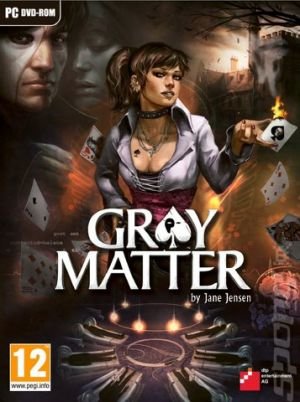
What most of her fans have been clamouring for, of course, is another full-fledged adventure, a wish soon to be fulfilled by Gray Matter. Not as soon as originally hoped, mind you, as the game has already experienced two serious setbacks in its turbulent history. The good news, however, is that the game once again looks to be back on track and in better hands than ever. So with a little extra time to fill before the release of one of the most hotly-anticipated adventures in recent memory, we managed to flag Jane down to share her thoughts on issues past, present, and foreseeable future.
AG: Thanks very much for taking time out of your busy schedule -- and apparently a rather eventful one, at least where Gray Matter is concerned. The most obvious question in light of the development changes announced recently is, how is the game coming along?
JJ: There’s a strong new dev team on it and a new producer. So it’s promising, but it’s too soon to have seen a lot of actual progress in the builds.
 AG: You've been very active in casual games at Oberon Media the last few years, but it's been a long time since you've been involved in development of a full-length adventure. How has that transition been for you? A bit like riding a bike?
JJ: The main difference is that casual games have a short timeline and lite budget. So things happen very fast. You have a month to do the design, in another month you’re seeing weekly builds and in 5 months you’re shipping. A big adventure game takes a lot longer all the way around.
AG: Obviously the process is different this time around than it was in your days at Sierra. What's it like to work on a game when physically distanced from the rest of the development team? Is communications technology largely advanced enough to bridge that gap?
JJ: It just seems to be the norm now. The casual games are also done with a remote team and I work from home every day. Of course, you miss being able to just get up and walk over to someone’s desk and have a conversation, but it doesn’t ultimately impact the process as much as you might think. I have emails in the morning – art to check, builds to play, questions to answer. And I try to get through them all that day so that when the team comes in during *their* day, they can keep working. I expected more cultural differences and problems, because I write the design and everything in English. But those have been minimal as well.
AG: On top of the geographical separation, there are presumably language barriers to deal with, and throw a German publisher into the international mix as well. Has that presented any additional challenges for you personally, perhaps that you weren't expecting?
JJ: Everyone goes out of their way to accommodate my mono-lingual self. There are differences in terms of business practices and expectations, but these haven’t impacted me as much as the dev teams.
AG: This is the second time that Gray Matter has gone through a pretty significant upheaval, the first resulting in the outright cancellation of the game at The Adventure Company a few years back. Have you started feeling the project might be a little snakebitten?
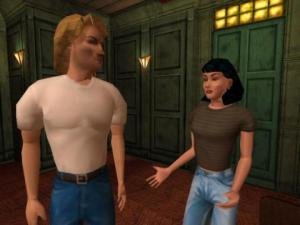 JJ: I dunno. I’ve seen it happen over and over in game development that the first project with a team or publisher is very hard. Even with casual games there’s a lot of ‘I don’t know if we can do this on time, I don’t know *how* we can do this’ on the dev team side. And it takes forever for things to kind of move past the frozen stage and get rolling. Then you cross a hump where you’ve done everything ‘new’ there is in the project and now it’s just repetition and things speed up. Ideally you would then turn around and do another similar project with the same group and, hey, it’s actually easy! GK3 was a really drawn-out, difficult development because we built an engine from scratch and also were doing 3D animations for the first time. I think that project was 3 years in development. And that was with a dedicated publisher and me on site constantly. So I guess what I’m saying is, yes, Gray Matter has had difficulties, but they aren’t so much more than I’ve seen on other projects. Given the fact that this project is being done with a new, overseas publisher and has had to switch dev teams, it’s not all that surprising.
AG: I'm sure it's a sensitive subject, but is there anything you can tell us about that ill-fated first attempt to make the game? And what exactly happened with Tonuzaba that led to the recent development change?
JJ: I think the bottom line was that the developer and publisher just couldn’t come to terms on how a project should be done.
AG: Not to suggest that you had unlimited freedom and budget at Sierra, but I expect you have some tighter restrictions for Gray Matter than the Gabriel Knight games. How has that impacted you as a designer?
JJ: I don’t feel Gray Matter has been subject to any tighter restrictions. The publisher wants a full, Jane Jensen adventure game and that’s what we’re doing.
AG: That's very encouraging. There are very few game designers whose reputation alone creates high expectations, but Gray Matter claimed the #1 slot in our Hype-o-Meter even before we knew much about it, mainly on the basis of being "a Jane Jensen game". You didn't create the label, of course, but to someone who isn't familiar with your previous work, how would you describe what that means? What can people expect from a Jane Jensen game?
JJ: Probably a good, entertaining story with historical and mystery elements and a gothic style. The puzzles are well-integrated so that you feel that you ARE the character uncovering the mystery. At least, that’s my goal.
AG: Is there any concern that the Gabriel Knight games have set the bar so high for yourself that it will be tough for a new game, a new (potential) series to measure up? Not necessarily in terms of quality, but many Gray Matter players will have followed Gabe and Grace over three much-loved adventures. Now you're asking people to start all over with new characters, new storylines, and that same attachment and affection won't be there from the start.
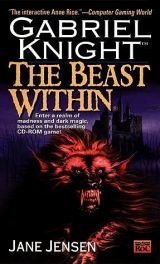 JJ: I understand the question on a logical level, but not really on an emotional one. I have a number of favorite authors and directors and they’re always doing new things. I mean, Stephen King hasn’t just written Carrie sequels. I’ve done other things since GK. I’ve written two books, Millennium Rising and Dante’s Equation, which were all new characters and plotlines. Plus lots of casual games. So I guess it’s not new for me to, well, do something new. I do get that people are very attached to Gabriel and Grace specifically and want another game in that universe. I would love to write another story with them and have several concepts for the next game. But it’s just not on the table at this time.
AG: Since you've stated that you intend for Gray Matter to expand into a series of its own, as a designer, do you welcome the liberation of starting over with all new ideas, or do you prefer to continue with established foundations and continue to build on those?
JJ: It’s fun to start something new, but it’s also wonderful if you can create a foundation, characters and a universe, that really ‘work’ and are worth revisiting time and time again. I enjoyed that with GK and would like to have it again.
AG: And speaking of established ideas, I won't pester you with questions about the current incarnation of Sierra, but do you think there's any kind of realistic chance of seeing another Gabriel Knight adventure? Either by convincing the publisher there's a market for such games, or by prying the property from its so-far-unrelenting clutches?
JJ: I have so much else going on, I just don’t put a lot of mental energy or effort into that. I think it’s possible, but not likely.
AG: I've read that you have other ideas in mind for more Gabriel Knight adventures. I won't ask you to share those (though you're welcome to if you want!), but what about the larger story arc with Gabriel and Grace? Do you have the whole picture plotted in your mind, or were you just planning to let things evolve as they may? The end of GK3, which I won't spoil for others, certainly suggested you had at least the next phase in mind.
JJ: I have a bit of the ‘future’ in my head, maybe through the next game. But not the entire arc. I prefer to let it develop organically. For example, I didn’t plan the end of GK3 but when I was working on the design, it just came out and felt right. So now I’ve got them in a pickle that I’d need to resolve if I ever revisit that world. And I basically know how I would resolve it in the next game but beyond that is not really formed.
AG: Is there one particular game you've made that stands out above the others as one you're most happy with, or proud of? Or is that a bit too much like asking a parent to name their favourite child?
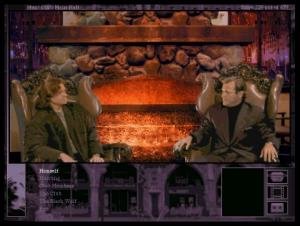 JJ: All 3 of the GK games are ‘favorites’ to me for different reasons. GK1 because it was the first, I love origin stories and New Orleans. GK2 because it’s got a cool gothic-Bavarian-werewolf thing and it was fun to pull in the Ludwig and Wagner history. With GK3 I’m really pleased with how the complex Rennes-le-Chateau mystery was woven into the plot and I think Le Serpent Rouge is my favorite puzzle of all time. Looking back from here, I’d probably pick GK2 because the live action brought so much to it. I think it’s unfortunate that we no longer use live actors.
AG: Two of the Gabriel Knight games were also made into novels, which certainly speaks to the depth of the stories in those games. What was the process of adapting a game into a book like? And how does it compare to writing a regular novel, which you've also done twice? For that matter, how does writing a game compare to writing a novel? Do you prefer one over the other?
 JJ: The story building process is very similar between the games and the books, though when I know the story will become a game, I’m more conscious of trying to think of puzzles even while I’m working on the plot line. Also, for a book you have unlimited freedom to go anywhere in the world and have a billion locations, special effects, etc. Dante’s Equation, for example, could never be produced as a game. It would cost a fortune. Game stories need to be more contained. The actual process of writing is very different, though. A novel is challenging because it’s just your word on the page. You have to keep the reader entertained and sucked in -- and unannoyed -- just with your prose. So that’s really tough. You worry over every word. With a game, you’re writing a design for the team which will then get translated into a production so the challenge is more about getting the art and production right rather than the fussing over the actual “words”.
AG: How would you say that working at Sierra helped shape you as a game designer?
JJ: Oh, I’m sure I wouldn’t be a designer if it weren’t for Sierra. First, they gave me games that I could admire, games that made me want to be a designer. They gave me the chance to design, and I was able to mentor with very experienced game developers like Roberta Williams.
AG: How about your experience with casual games in recent years? Has that impacted your approach to Gray Matter at all?
JJ: Yes, it has changed me as a designer. I’m more conscious about keeping things approachable, not making things difficult or obscure for the glee of it. I’ve spent time watching “real people” try to play games, which is very enlightening. It’s been a good thing.
AG: How do you address the concern of people who think this more accessible approach represents a "dumbing down" of the genre?
JJ: I just don’t think “good” equates to “hard”, whether it’s literature or games or movies. As a writer, it’s my job to reach an audience. Look at someone like Spielberg. He’s as approachable as they come, that doesn’t mean he’s not good. Or take a look at ‘difficult’ writers like Thomas Pynchon (Gravity’s Rainbow) or Umberto Eco. How many people have actually made it through their books? Do you have to be obtuse and hard to read to be respected as literature? That’s just not my goal. I want to grab people by the throats and give them a thrill. Similarly, I just don’t buy that a game has to be hard to play or that you need to wander around for hours without knowing what to do or have to resort to a cheat sheet in order for a game to be “good”. GK2 was one of the most popular games I did and that game had a very simple interface and puzzles because of the live action.
AG: Is there such a thing as a happy medium on the issue of difficulty?
JJ: To me the game needs to have a great, rich story, fun puzzles, it needs to flow smoothly from start to end and at no time be confusing so that you stay wrapped up in the experience rather than the process. You need to get to the end and cheer – or cry. If a hard-core gamer can’t enjoy a game like that, so be it.
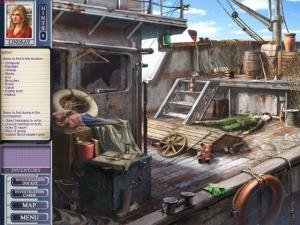 AG: You're also involved in the Women's Murder Club games, based on James Patterson's novels. What exactly is your role in that series?
JJ: I’m writing the design – stories and puzzles -- and acting as creative director throughout the project. James Patterson has been great to work with. He has full review over everything.
AG: You've talked in the past about bridging the gap between strictly puzzle-based casual games and full-length narrative driven adventures. Will this game be another step in that direction?
JJ: It definitely is. It’s the most adventure-game like casual game Oberon has done.
AG: At the risk of some rather blatant gender stereotyping, what is it about both today's adventure and casual games that you think appeals so strongly to women? And if you really want to go out on a limb, why do you think they don't appeal so much to men? There are exceptions on both sides, of course, but just speaking generally.
JJ: I have a very simple view of these things. People like what they like. We have far too many choices these days to settle for playing a game just because it’s there. If you look at stats of the book industry, something like 80% of all fiction purchasers are women. Guys, not so much. The casual game numbers are similar for puzzle games—80% female. Why? Lots of sociologists have studied why boys like trucks and girls like dolls. All I know is what I like myself and that’s the kind of thing I create. If I’m trying to reach an audience, it’s most likely going to be an audience that thinks the way I do.
AG: Have you played any other recent adventures lately? Do you think the quality of today's games measure up to the "golden era" which you helped to create?
JJ: I really haven’t. I’ve just been too busy. I do more playtesting of casual games. I miss the classic, Sierra-LucasArts adventure games a lot.
AG: Your past games have shown a meticulous degree of research. Can we expect the same from Gray Matter? In which areas did you do most of your research for the new game?
JJ: Oh, yeah. This game has a lot of real life research in it. Mainly in the areas of stage magic and neurobiology. Very fun stuff. Really! The mind is a fascinating thing.
AG: I've purposely avoided asking many questions about the contents of Gray Matter, as we'll no doubt be hearing lots more about the game in the coming months. But is there anything you want to tease us with? What is it about Gray Matter that really inspires you and will undoubtedly excite players when the game is released?
JJ: That’s such a big subject. I guess if I were to give a minimal answer it would be that Gray Matter has a sense of things not being what they seem, of reality being a little bent. There are several twists and turns that I think people will enjoy. I hope the game gets out there soon so that I can see what people think of the story.
AG: Well, the sooner we stop pestering you with questions, the sooner that will be! We can't wait to see it next year. Thank you again for taking the time to share your thoughts with us.