
Review for Agatha Christie: Murder on the Orient Express

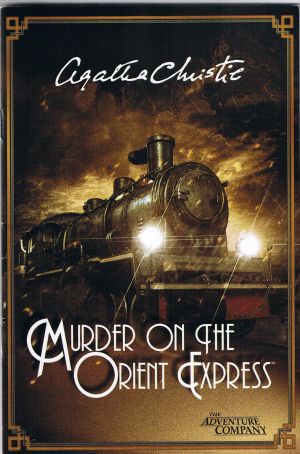

Agatha Christie was born in 1890, and by the time she died in 1976 she was the bestselling author of all time, with 66 novels to her name, and over 2 billion copies of her books sold. With this kind of pedigree, you'd think there would be adventure games galore adapting her stories. But this was not the case, with only one prior attempt until AWE Games released And Then There Were None in 2005. While that game provided a decent telling of Christie's story, the game suffered from a few key issues that kept it from being the game it should have been. And now, a year later, we have AWE's second attempt at bringing Agatha Christie's work to the computer screen with the release of Murder on the Orient Express.
Like many of the stories written by Christie, MOTOE starts off simple and then spirals into a series of twists and turns until you're left breathless at the end. With twelve passengers traveling aboard, including famed Belgian detective Hercule Poirot, the Orient Express is en route to Paris when it's abruptly stopped by an avalanche that has blocked the track. The next morning one of the passengers is found dead, and everyone is a suspect. It's a classic premise, and anyone who's read the book (which is conveniently packaged with the game) knows that it ends with one of the best twist endings to ever occur in a mystery novel.
There are a few hurdles right from the start in trying to adapt such a well known story as an adventure game. First is the fact that anyone who has read the book already knows the ending to the story, as well as many of the clues along the way. In order to get around this, AWE and writer Lee Sheldon have worked in the book's original conclusion, but added yet another new surprise for those familiar with the story. They also changed up some of the clues along the way to keep suspense intact.

Another obstacle is the fact that Poirot is considered a mystery icon, along the lines of Sherlock Holmes, and having such a brilliant detective wandering around looking for clues and baffled by puzzles would not suit the character of the man who prefers to employ his "little grey cells". The developers decided to bypass this issue by creating a brand new playable character for the story. Antoinette Marceau is a train company employee and amateur detective, who has been assigned to accompany the great Poirot and attend to any needs that he has. During the avalanche, Poirot is injured, and so Antoinette must become his eyes and ears, helping him to solve the mystery. This is a great way to bring the player into the game without denigrating the character of Poirot, who becomes a sort of built-in hint system for the player.
I was a little disappointed when I first booted up the game and watched the opening cutscene. The graphics are nicely designed, but the compression used on the video causes the animation to look washed out and blocky. I had hoped that this was a one-time thing, but the movies continue to be noticeably pixelated throughout the story. And this is a shame, because the in-game graphics are absolutely wonderful.
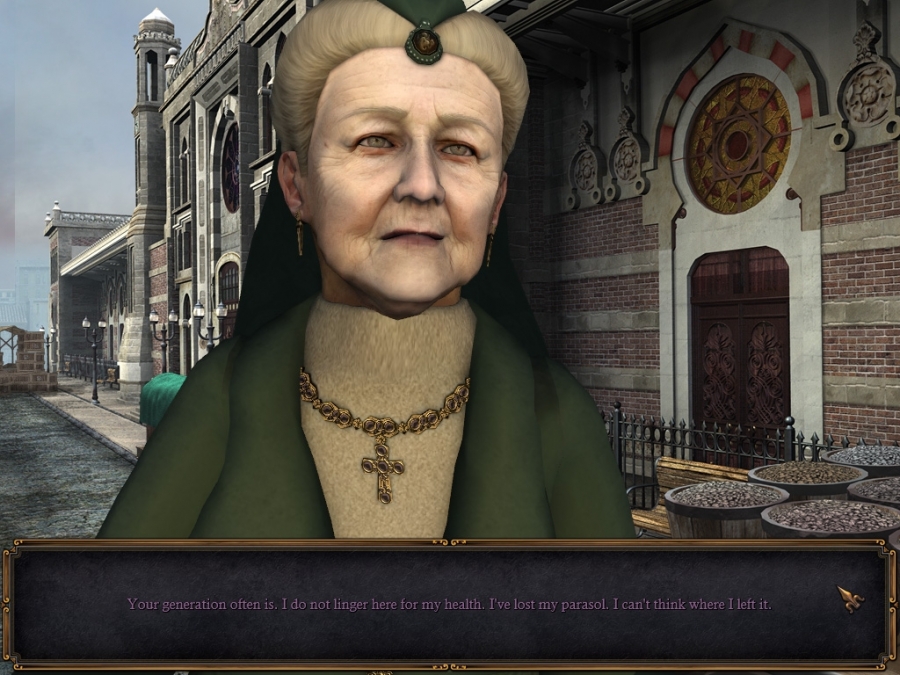
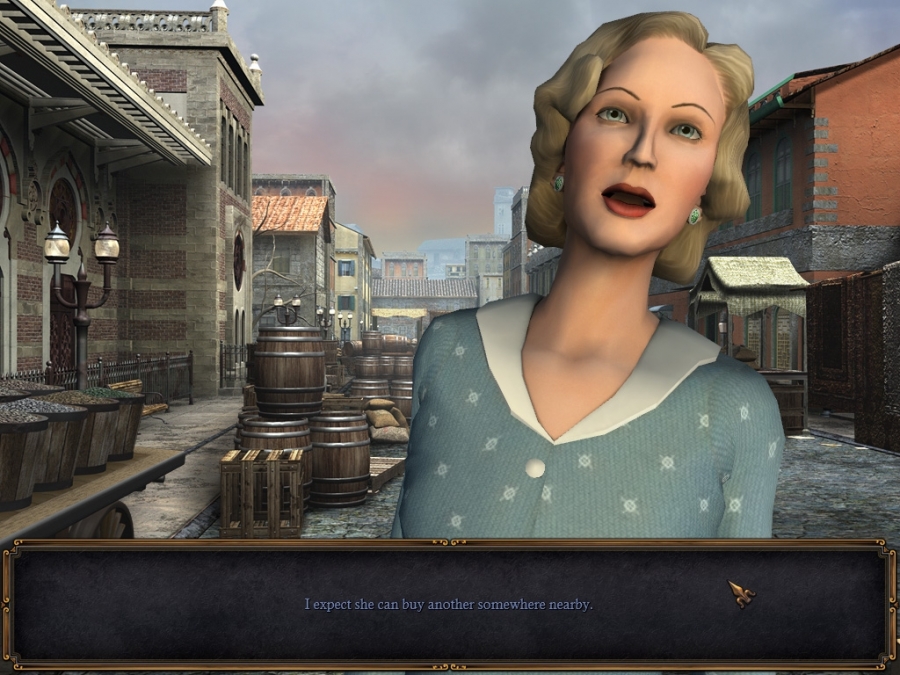
The characters are some of the best that I've seen in recent adventure games. Each has a unique design, and the costumes are perfect for the timeframe of the game. There are some nice ambient touches to the characters as well, such as Antoinette shivering when she's cold, or folding her arms or brushing things off her clothes when she's just standing still waiting for you to decide what to do next. AWE has also done a great job with lighting the game, creating a very soft glow to the scenes, which gives a much more lifelike look to the characters. Some of the animation of the characters seems a little wooden at times, but this is a small thing that does little to detract from the game.
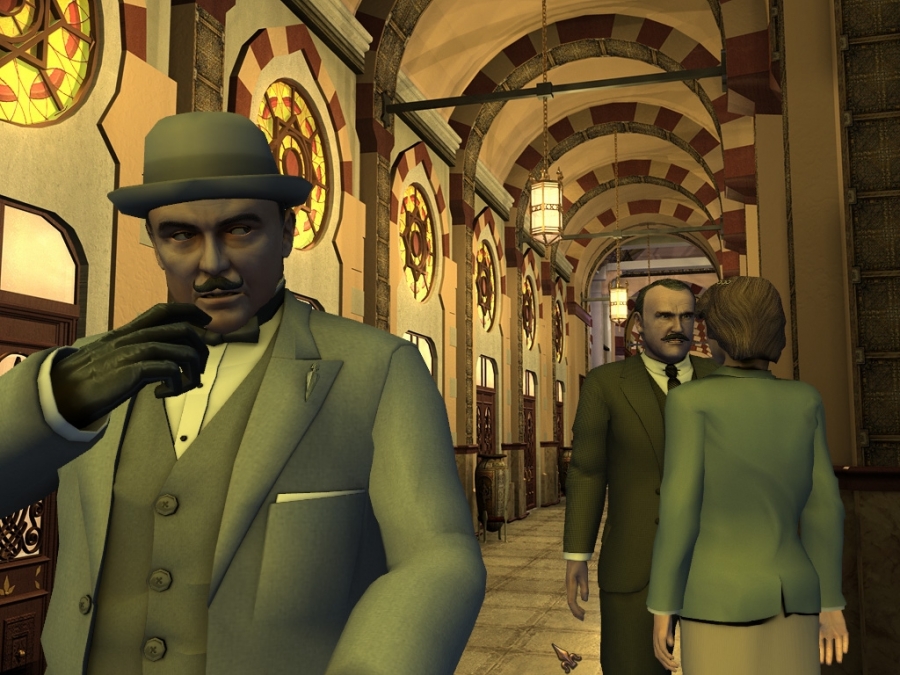
Background graphics are great as well. I was a little concerned at first, considering the fact that the entire game was going to take place on a small train. With such a confined area to traverse, in an environment that would naturally feature rooms that all look alike, how would the designers manage to keep things looking different and fresh as the game went along? Well, they managed admirably for the most part. The train setting is wonderfully decorated, and is exactly what you would imagine a luxury train from the time to look like. And in the introductory scenes before you board the Orient Express, and the rare times that you venture from the train after departure, you'll be treated to gorgeous stations and snowy wilderness, complete with snowfall and blizzards. Add to that the cinematic quality the game provides, with exterior shots peeking in on Antoinette updating Poirot, and movie-like camera changes during conversations, and you've got a visually impressive game on your hands.
There are some graphical weaknesses, though. The train, while nice looking, suffers from never having a lived-in look to it, and going into the dining room again and again, only to see characters still sitting in front of the same empty plates seems rather strange, and had a tendency to pull me out of the game. Granted, these are small things, but definitely detract from an otherwise great looking game.
Music in MOTOE fits the game perfectly, with a score that sounds like it belongs in a movie from the 1930s. It blends perfectly into the background of the game, coming to the forefront at key moments to draw your attention.
As mentioned earlier, the brilliant but eccentric Poirot is one of the most well known characters in mystery literature. And when it came time to bring his character to television in Agatha Christie's Poirot, the role was given to actor David Suchet. Over the next eight years, Suchet made the character his own, to the point that it seems an Agatha Christie mystery wouldn't be complete without his voice anymore. Luckily, Suchet reprises his role in the game, and it adds a wonderful sense of familiarity for anyone familiar with the series. The other voices are also very well done, with the exception of a few somewhat stereotypical accents, and all are well acted.
Navigation in MOTOE is easily mastered. Clicking on a location will cause Antoinette to walk to that location, and double clicking on the edges of the screen will cause her to skip automatically to the next screen. To aid in working your way through the train quickly, there is a map of the train cars at the top of the screen that can be clicked on to automatically travel to that section of the train. This is a nice touch that makes moving back and forth much easier.
With navigation made so simple, it's a shame that the inventory interface can at times be so convoluted. There are several distinct interface screens, and while the examination, scrapbook, and passport screens are tidy and helpful, there are several other problems. The main inventory is functional enough, but with 80 slots covering five screens, and no way to discard unwanted inventory, expect to do a lot of scrolling before you're done. That's not nearly as frustrating as the separate inventory combination interface, however. That's right, rather than go the tried and true adventure game route of just dragging one item on top of another, or at least allowing combinations on the current screen, in MOTOE you have to go to a separate screen entirely to combine your items. A cumbersome inconvenience at best, this process becomes downright tedious as time goes on, particularly as some combinations involve more than two items. And since there is no feedback other than success or failure, a certain degree of trial and error is guaranteed. The end result is far too much clicking back and forth before all is said and done.
Fortunately, there is enough investigation and puzzling throughout the game to take your mind off of this. The majority of the game will be spent hunting for clues and interrogating your fellow passengers, but there's also a healthy dose of fetch quests, and even a sliding puzzle box for those that think they belong in every adventure game.
Once again, however, there are problems that appear as you progress. First is Poirot's involvement in the story. Although injured, he is there to help, and if you need assistance you can visit him in his compartment for advice. But when you really need his help, you'll often find that going to Poirot only gets you a canned response about how you need to retrace your steps. Poirot will also "speak" to Antoinette in a sort of detective's intuition throughout the game, telling you when you are heading down the wrong path with a course of action, usually in a joking manner. But the fifth, sixth, or even tenth time that you hear the same snide response from him, you will most likely just turn down your speakers and continue on your way.
Secondly, while the puzzles and investigations are interesting at first, they begin to get repetitive over time. The first time you find a fingerprint is a great moment, but finding out that you're missing one fingerprint and scouring the entire train over and over again trying to find it is not, especially when there is no rhyme or reason for where to look for them. You expect to carefully inspect a crime scene, of course, but seeking them on random objects throughout the train amounts to little more than pixel hunting. There was also an issue that I ran into where I missed a fingerprint, and at a certain point in the game lost access to the location that contained it. This required me to load a save game from quite some time earlier and replay through a few hours in order to get it. Again, the mantra "save early, save often" comes into play, but no game should require it with design failures.
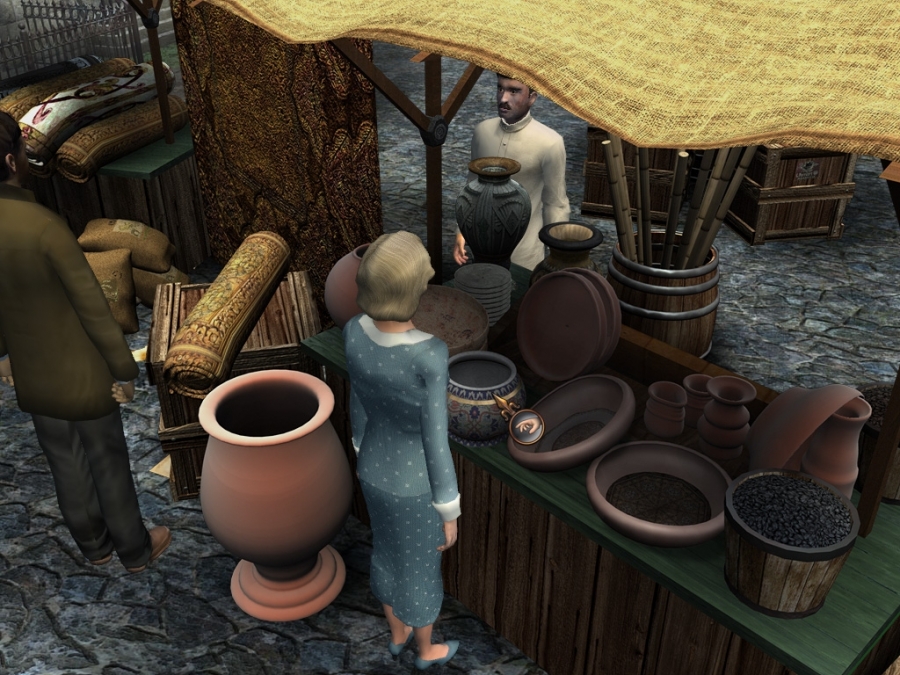
Another issue that rears its head occasionally is the fact that the game tries to be open ended, but it quickly becomes evident that the developers meant for you to take on tasks in a certain order. There were a too many few times where I started a conversation with a character and began talking to them about parts of the story that I hadn't experienced, or about items that I hadn't found yet.
The game's finale is handled well for the most part, nicely balancing player involvement with the appeal of Poirot's obligatory ingenious summation. Yet while I applaud the developers for creating a new ending in concept, in practice the addition felt a little too contrived for the game's good. Most gamers can expect to reach this point in around 8-10 hours with few problems, as there aren't an abundance of puzzles and for the most part the pace is reasonably brisk.
On the strength of its original story, combined with lovely graphics, an interesting cast, and voice acting that really brings each character to life, overall the game provides a decent adaptation of a timeless whodunit. It also represents a marginal improvement over And Then There Were None, though unfortunately the experience is once again weighed down by some questionable design decisions and poor implementation, making it feel at times more like an exercise in busywork than a thrilling adventure. Of course, Agatha Christie fans will need no convincing to pick up this game, and Murder on the Orient Express is still worth playing for anyone interested in taking part in one of the most engaging murder mysteries ever written.