
Review for Broken Sword: The Angel of Death


Ask any good smithy, and he'll tell you how difficult it is to re-forge a shattered blade. And heck, forging is the easy part. Then there's the grinding, annealing, quenching, and tempering for refinement. It's a long, meticulous process that still doesn't guarantee an end result that matches the quality of the original.
In many ways, this is the challenge faced by the Broken Sword developers in crafting new games. Debuting a decade ago now, the original Shadow of the Templars (inexplicably known as Circle of Blood in North America) is still considered by many to be one of the finest adventures ever made. Since then, fans have followed the exploits of unwitting American hero George Stobbart and sassy French journalist Nico Collard through two more daring adventures. But with the 2003 release of The Sleeping Dragon, the "trilogy" had drawn to a bittersweet close… or so we thought at the time.
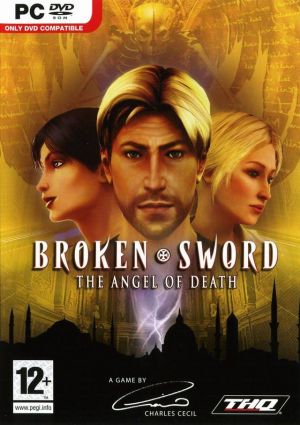
Back by popular demand a mere three years and a developer downsizing later, a new Broken Sword installment has now arrived in the form of The Angel of Death (titularly speaking, of course). So does the new game manage to carve a swath worthy of its acclaimed predecessors, or has the series finally started to show signs of stress and fatigue from one too many battles against genre indifference and ancient conspiracies? To cut to the chase: it's a little of both. Or maybe a lot of both. Broken Sword 4 is indeed a solid iteration that longtime fans will find comforting and enjoyable, but it's noticeably raw this time around; the edges not as sharp, the handle a bit unwieldy, and suffering from a general lack of polish.
After a dramatic opening that will remind people -- and not for the last time -- of Raiders of the Lost Ark (albeit with nary a whip or Nazi in sight), the game picks up with George in New York City. Set a year after the unbelievable events of the previous game, reality has bitten poor George hard since we last saw him. Now an unemployable lawyer scraping by as bail bondsman and needing twenty dollars just to call himself broke, George arrives at his office to discover a blonde knockout named Anna Maria waiting for him. Desperately needing his treasure-hunting skills and protection, Anna Maria's plea for help is cut short by several Mafia thugs storming in, clearly intent on depriving her of an ancient manuscript in her possession and quite possibly her life. And so, with barely a token protest, George immediately finds himself caught up in another danger-defying, globetrotting high adventure with Anna Maria by his side.
Wait… who? If you're doing a double take wondering what's wrong with this picture, your eyes aren't deceiving you. Continuing the trend from the coy early marketing of this game, there's absolutely no trace of Nico until well into the story. In fact, before long the game starts to feel more like a Broken Sword spinoff adventure than a proper sequel. While George has dominated screen time in previous games, there has always been a sense of a shared adventure between the two which is noticeably lacking for a significant portion of Angel of Death. Imagine a Gabriel Knight game with Grace out of the picture, or a new Tex Murphy with no Chelsee, and you get the idea. Even in support roles, they are integral to player familiarity. And while not an inherently bad thing for a series to branch out, in this game it trades in the previously-established rapport, witty repartee, and sexual tension with Nico for a fairly generic female cohort who's content to follow George with quiet admiration.
When Nico finally appears, the game suddenly finds an inspired momentum that really emphasizes its earlier absence, though not one it's able to maintain. Fortunately, Nico stays more or less for the duration, and even becomes a playable character for one lengthy section. Still, the treatment of her role is representative of some uneven storytelling thoughout the game. Another questionable aspect is the handling of the background story itself. True to Broken Sword form, Angel of Death involves a legendary artifact that threatens the world as we know it, and the unlikely conspiratorial groups seeking to either discover or conceal it. The premise is sound, if not altogether original, and it lays the groundwork for what proves to be an interesting yarn full of inevitable twists and turns throughout travels to Istanbul, Rome, and several parts of the U.S. The drawback is that the story is doled out only incidentally, making it more difficult to feel very invested in it. Without giving away any key surprises, the main motivation here becomes the pursuit of Anna Maria, and details of the larger adventure are only revealed when the two trails intersect. The difference is perhaps subtle, but it adds up over time. There are also some pretty significant plot holes along the way, and a rather skimpy ending that will leave many dissatisfied, though the Broken Sword games have frequently required a generous suspension of disbelief (and expectation) in these areas, so that's nothing new to fans of the series.
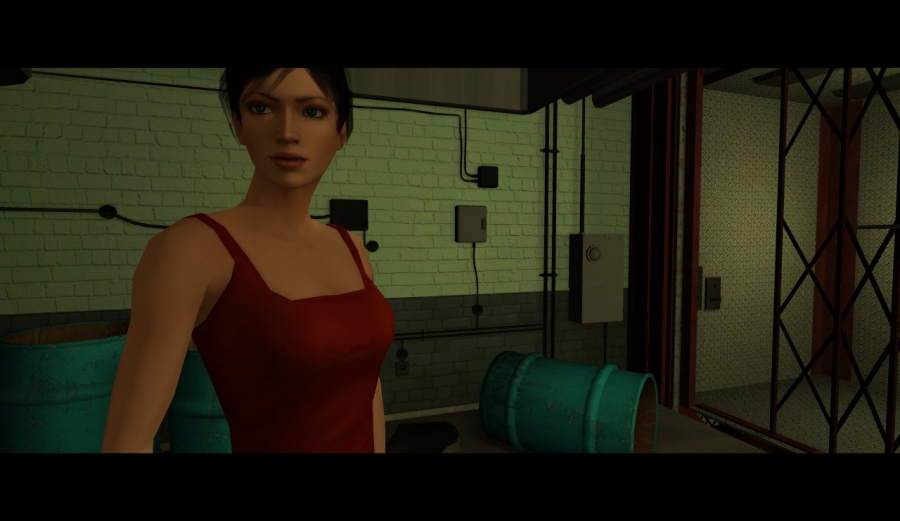
The writing itself is another mixed bag. At times the dialogue and characterization are excellent, while at other times entirely forgettable. George himself is the highlight by far, as his characteristic humour is back in full sarcastic force, along with his plain ol' likeability. It's obvious that the writer(s) truly know George by this point, making his portrayal seem as natural as it is effective. I laughed out loud more times at George's comments than I often do with more blatantly "comic" adventures. Thankfully (and rightly), these amusing moments are introduced sparingly enough that they never detract from the overall serious nature of the plot. There are a few other interesting characters as well, from the pink glove-wearing, action movie-loving priest to the Nico-infatuated street bum, along with a welcomed cameo from a previous Broken Sword character. However, not everybody fares as well, getting the job done as plot devices but offering little else. Of the major characters, Anna Maria's personality is surprisingly bland and never serves as a suitable foil to George during their time together. Perhaps more disappointingly, even Nico seems to have lost some of her spunk, or at least isn't given enough opportunity to show it.
Any character is only as good as the voice acting behind it, of course, and this is an area where Broken Sword has always excelled. Angel of Death is no different, as the voice acting is consistently strong from top to bottom. Again headlining the cast is George, as Rolf Saxon returns for a fourth go-round, adding a crucial consistency to the series. While enjoying a quality performance in its own right, longtime fans will also bask in a feeling of fond nostalgia from the first moment you hear him speak (heaven help Revolution if Saxon's agent ever realizes how vital he is). The only questionable role in the game might belong to Nico, now played by the fourth voice actress in four games. Then again, Nico always seems to generate some debate, possibly owing to an unfamiliarity that we never experience with George. Personally I've found her quite acceptable every time out, including this one, but I'm hardly a stickler for accents.
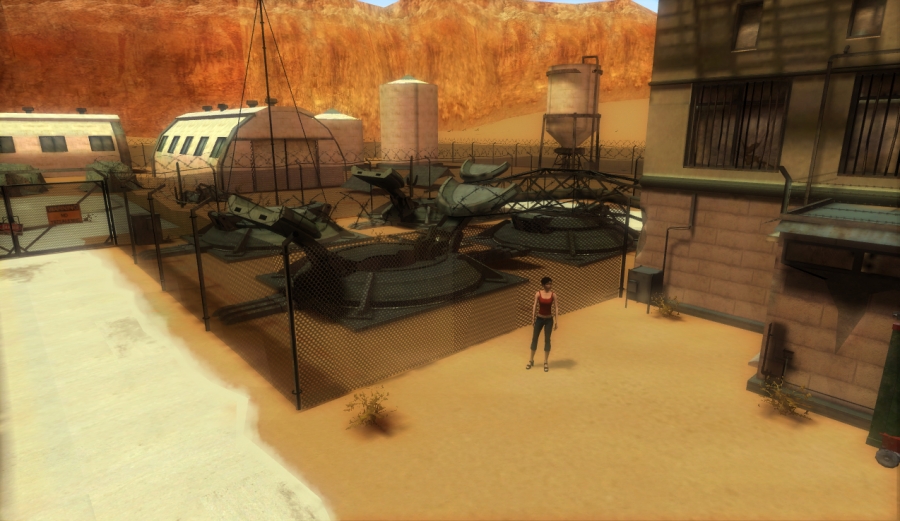
The rest of the production values follow the now-familiar refrain of some good, some bad. The orchestral soundtrack is varied and pleasant, playing unobtrusively and sporadically in the background where it belongs. Visually, the game once again is rendered in full 3D, and while the graphics are closer to eye candy than eyesore, they certainly never dazzle. The environments are sparse and not very detailed, which gives the presentation a fairly dated feel. Character models have been spruced up somewhat from the previous game, and they're nicely designed, but they are still a bit blocky, and little touches like hair are done very poorly. In a genre that is still reluctant to use 3D on a consistent basis, these issues might be easily overlooked, but they certainly don't measure up to the higher industry-wide standards, so your appreciation or criticism may depend greatly on personal experience.
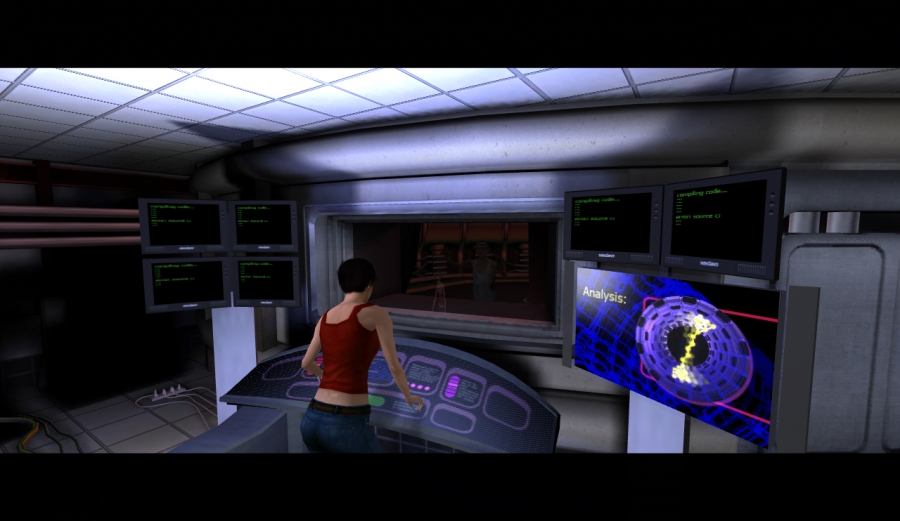
Less excusable are the many obvious corners cut in animating the game. From things like drawers magically opening a foot away from George's outstretched arm to Nico repeatedly walking through George during a particular conversation, it's pretty clear that the developers (at Sumo Digital this time, as BS4 is the first game in the series to be outsourced for production) didn't have enough time or budget to iron out all the wrinkles that they must have known existed. This is a shame, as it leaves players with the impression of a shoddily-produced, rushed game that it really doesn't deserve on the whole.
Quite apart from technical issues, the artistic component of the graphics has undergone something of an evolution in Angel of Death. Gone are the vibrant colours of yesteryear, and replaced here with a fairly muted palette. Presumably the developers hoped to distance themselves from a more "cartoony" look, but in doing so ended up with a fairly drab looking game, compounded a few too many times by the choice of locations. It could just be me, but I'd have envisioned a trip to the Vatican leading to something a little more exotic than a factory.
One of the obvious benefits of 3D is the ability to incorporate a more cinematic use of cameras. Occasionally this flexibility is used to good effect here, like players guiding George past a would-be captor from an overhead angle. However, a fairly glaring omission occurs during dialogues. As any Broken Sword fan knows, conversation is a significant part of the game, and yet the camera in Angel of Death remains completely static while people talk. While hardly alone among adventures, watching the same fixed screen for several minutes on end is a major waste of the potential to make these verbal exchanges more dynamic. Still, this complaint is secondary to the way the cameras are integrated with the control scheme.

Ah yes, the controls. After BS3's controversial move to direct control, the control scheme of the new game has perhaps generated the most attention from longtime Broken Sword fans. News that Angel of Death would revert back to its point-and-click roots was received delightedly by many. Even better, an alternate direct control option was also promised for those who enjoy a more tactile experience. Win-win for everyone, right? Sure, it would be, except that neither scheme is implemented particularly well. I'll start with the direct control option, because there isn't that much to say about it beyond: it's virtually useless. Completely gone is the excellent gamepad support from Sleeping Dragon, and even the keyboard option has been pared down to a scheme that's barely functional. Again using an awkward camera relative control, it's now only possible to move the characters with the keyboard, as the mouse is needed for all interactions. Whatever benefit there might have been for navigation is negated by constantly forcing the player to move in diagonal directions, and if required to use the mouse anyway, it's likely that most players will end up choosing to use it exclusively simply out of convenience.
The encouraging upside is that for the most part, the point-and-click option works quite well -- just not as well as it should. Thanks to the (otherwise laudable) dynamic cameras as you move about the environment, you'll find yourself at various times becoming disoriented or clicking constantly to keep the camera moving a few paces in front of you. This assumes that you're running, of course, though by default the game seems intent on making you walk. Most interactions cause the game to reset to walking speed, so you'll continually find yourself switching back to a run. Wisely, the game uses the mouse wheel for this, but it's still a pointless adjustment to impose, as there are precisely zero places where a slower pace is necessary or even preferable. Far better to remove it entirely or at least reverse the default speed from walk to run.
Interacting with the environment is a generally intuitive combination of left/right mouse clicks and context-sensitive smart cursors, though even here there are some frustrations. Hotspots can be needlessly small and are slightly misaligned on occasion, so even when you clearly see the object on screen, it can be difficult to pinpoint the active hotspot associated with it. This is made worse by the camera's tendency to slowly "drift" even after you've finished moving. For the many players who are simply glad to be back behind the mouse for this installment, such factors are small concessions easily embraced. Still, it's difficult to overlook the trouble implementing a simple control scheme done better by its own predecessor ten years earlier. Other easily-preventable issues also exist, such as the inability to skip spoken dialogue or determine when some dialogues are exhausted, which guarantees you'll have to sit through various exchanges multiple times. Again, this slightly mars what is otherwise a very user-friendly, icon-driven dialogue system that Broken Sword fans will appreciate.
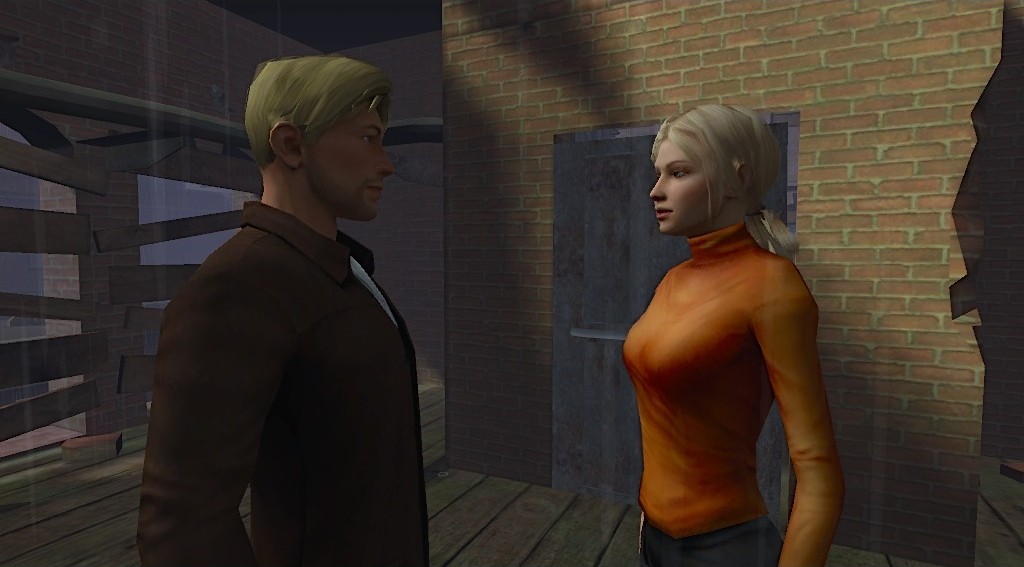
Going hand in hand with the reversion of controls is an adjustment of gameplay in Angel of Death, also due to overwhelming feedback from the last game. Nowhere to be seen are the split-second reflex events this time around, and crates are only used for more practical purposes. In general, the game offers a nice variety of puzzles and challenge, so you may find yourself going from an incredibly simple inventory puzzle to a complex series of valves to an insidiously difficult multi-stage riddle at any given time. Occasionally the challenge is amplified rather arbitrarily by things like never discarding items from a bloated inventory (after dragging around a salami for the fifteen hours spent playing the game, I was sure I could almost smell it), and the linear nature of the game rigidly involves doing specific things in the right order. At times this bogs down into what I call a "rush hour adventure" consisting of stop-go-stop-go-wait-go-stop, but for the most part the pace is commendable, the clues clever, and the obstacles diverse. An exception to the latter is a computer hacking mini-game that requires safely routing signals on George's handy new PDA. It's a very stimulating mental exercise that changes just enough each time to require new strategies to overcome. I enjoyed these a great deal at first, but they eventually wore out their welcome with sheer volume, perhaps around the time the game imposed a time limit on one.
That's right, there are still important elements of timing in Angel of Death, although none are measures of dexterity. Quite a few puzzles involve real-time activities, making their solutions as much a matter of when they're performed as how. The goal is to create an atmosphere of tension without the punishment, so time allotments are extremely generous, and failure has no particular consequence. Included in the mix are several stealth sections. Unlike in BS3, however, these are typically more puzzle-oriented, so you'll be thinking your way through them as much as sneaking. Still, you can and most assuredly will get caught until you've gone through enough trial and error to work out a solution. Fortunately, when this happens, the game simply drops you back at a reasonable place to try again. While the added stress may still not appeal to everyone, it definitely adds a layer of immediacy that's lacking in most adventures.
I realize the criticism has mounted here, so let me reiterate clearly that Angel of Death is a pretty good game. But like any good game with high expectations, explaining why it isn't a great game requires some elaboration. Actually, if there's a single word I'd use to describe BS4, it's "erratic". What the Broken Sword series has always done well, it generally does well here. So fans of the previous games hoping for another ambitious adventure with its eminently likeable, tongue-in-cheek protagonist will find precisely that, with a healthy dose of intellectual challenge along the way. And those put off by the abrupt shift of focus in BS3 can rest assured that it is indeed much closer in spirit to the first two games than the third. Yet it makes enough mistakes in the process to disrupt its own rhythm, and outside of George, it seems to lack an intangible spark that I've felt previously. For experienced Broken Sword players, I can certainly recommend the game, though not without some caution. If you're new to the series, I wouldn't recommend making The Angel of Death your first foray into the world of Broken Sword. The other games are still widely available, so play those, come back, and you'll be willing and able to embrace the new game, self-inflicted wounds and all.