
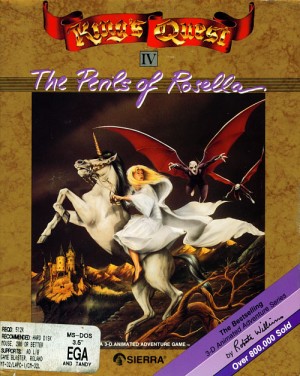
Review for King’s Quest IV: The Perils of Rosella


Can a video game make you cry? Industry professionals have been batting this question around for years. Some even paid a lot of money for a research firm to do a formal study on the issue. Every time it comes up, I'm puzzled that they even need to ask. Of course video games can make you cry. Syberia, Grim Fandango, and Final Fantasy VII are some of the titles players consistently cite as having a very real emotional impact. I've even been known to shed a tear while gaming, myself—and not only out of frustration.
According to industry lore, King's Quest IV: The Perils of Rosella was the first such game. In fact, Sierra based the game's marketing campaign on the premise. By today's standards, the positioning of a King's Quest game, with its fairy tale puzzles and corny humor, as the epitome of tear-jerking gameplay may seem downright laughable. At the time, however, KQIV broke new ground, both with its female protagonist and its relationship-driven plot. It may not have withstood the last two decades as the emotional powerhouse that Sierra claimed in their ads, but the game did explore interpersonal relationships with a depth that few, if any, games had up to this point.

King's Quest IV opens with a hauntingly pretty theme accentuated with what truly sound like a flute and a harp. This is the first of Sierra's games to have a fully-orchestrated, music-card compatible soundtrack, developed to show off the Roland-MT 32 sound cards that were top of the line at the time (1988). The game's extended introductory cutscene starts off literally where King's Quest III left off: King Graham is throwing his trademark adventurer's cap out to Prince Alexander and Princess Rosella, bridal-bouquet style, with the hope that one of them will catch it and carry on the family questing tradition. Before the cap can land, tragedy strikes, with Graham clutching his chest and falling to the floor. He is transferred to bed, where his family stands around him, fearing the worst. The feathered cap lies forgotten in the throne room where it landed.
Lest you think I'm spoiling big chunks of gameplay here, we're only halfway through the opening cutscene! Advances in technology allowed for a longer, more cinematic introduction than in previous KQ installments, complete with close-ups and accompanying mood music. Likewise, this is the first King's Quest game, and one of the first adventure games in general, to have extensive in-game cutscenes.
Overcome with emotion, Rosella runs from her father's bedside to weep in the empty throne room. (She's such a girl.) Right on cue, an equally blonde fairy named Genesta appears in the royal family's trusty magic mirror with a proposition: she'll help Rosella save Graham's life if Rosella will do her a little favor in return. Rosella agrees, and is poofed away to Genesta's homeland of Tamir in a cloud of smoke. Genesta greets Rosella on a beach, flanked by two fairylets whose presence is never explained--I like to think of them as Genesta's posse. Genesta tells Rosella where she can find a magic fruit that will cure her father. In return, Genesta needs Rosella to retrieve her magic talisman, which was stolen from her by the evil fairy Lolotte, who lives in the mountains to the east. Without it, Genesta will die, and Rosella will never get back to Daventry to save King Graham from certain death. Oh, and here's the kicker: our unwitting heroine has exactly one day and one night to make all this happen. This is where Rosella is left to begin her quest, dressed like a peasant girl so as not to arouse suspicion, the clock literally ticking away.
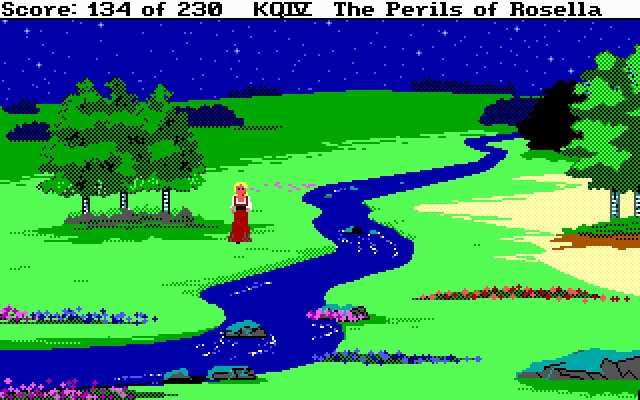
King's Quest IV was the first game in the series—and the first Sierra game, period—to be made with the SCI (Sierra Creative Interpreter) engine. (A few other versions of KQIV were developed as well... more on that in a bit.) The engine allowed for 16-color, 320x200 resolution graphics that were significantly more detailed than in the previous KQ games. Perhaps because less is left to the imagination, the characters are a little worse for the wear. Alexander has mysteriously grown a none-too-flattering mustache in the few minutes that passed since the end of KQIII, Rosella's looking very 1980s with her feathered hair and purple eye makeup, and all the characters have a reddish skin tone that suggests they've been spending too much time at the tanning salon. These nitpicks aside, the game is graphically leaps and bounds ahead of its predecessors, and hints at the beauty that is to come in the next few KQ games. I like to think of King's Quest IV as a bridge from the primitive earlier installments to the more robust point-and-click gems that find themselves on many adventure gamers' "best of" lists.

Roberta Williams, the game's creator, worried that the female protagonist would alienate male players, but in the end the character's gender has little effect on the gameplay. Players will still find themselves exploring a grid of countryside, putting found items to good use, and occasionally falling down a flight of stairs, skirt and braids flapping in the breeze. Although KQIII may have been more innovative in its structure and use of magical spells, King's Quest IV is still a well-designed game, with a number of obstacles standing in Rosella's way as she attempts to solve the dual quests of saving her father's life and getting Genesta's magic talisman back to its rightful owner.
The puzzles are primarily of the "go fetch" variety—nothing new to fans of the series—but they're more sophisticated than before. Obtaining the fruit that will save King Graham requires a chain of discovering items and swapping them for other items until you finally have what you need to get through a dark, treacherous cave, cross a murky swamp, and subdue the poisonous snake guarding the prize. On top of this, Lolotte catches you snooping and sends you on a series of errands to prove you're not Genesta's spy. Although this gameplay is rather rudimentary, it's also good old-fashioned adventuring.
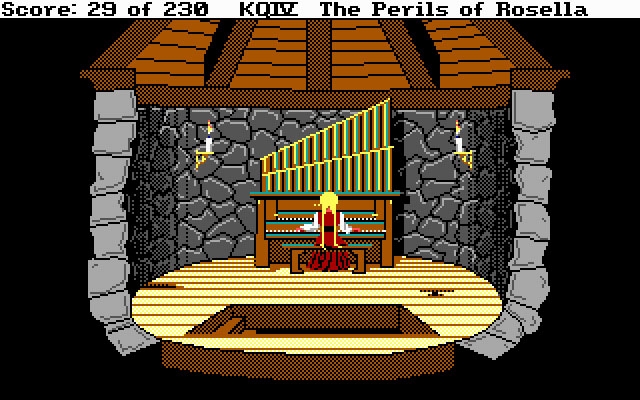
The puzzle solutions once again rely on familiarity with common fairy tales and folklore, such as "The Frog Prince" and "Snow White and the Seven Dwarfs." I found all of KQIV's puzzles to be logical, and their complexity showcases a continued evolution in gameplay throughout the series. In other words, if this were King's Quest I, Rosella would find the magic fruit in a tree and the talisman stuck inside a hollow log. Because it's King's Quest IV, she has to do a bit more work to achieve her goals. Running with the game's underlying themes (and in some ways exploiting its female protagonist), many of the puzzles have a strong emotional element to them. For example, one extended sequence involves finding cherished trinkets to put the souls of an entire family of unhappy ghosts to rest. The demands Lolotte makes of Rosella, the first in particular, require doing something you know is morally wrong, and if you're paying attention, the game makes you feel pretty bad about it. Although it never struck me as too cutesy or overt, thematically much of what happens in this game relates to compassion for other people and creatures, and how love can be used both as an advantage and as a weapon.
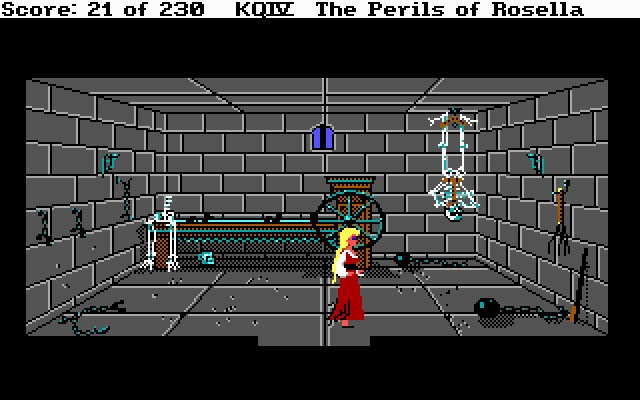
In spite of its sophistication compared to the previous KQ games, KQIV has a few potential dead ends. Death is also a real possibility, particularly as you make your way through a series of dark caves and when you climb up and down twisting staircases, although it's not as omnipresent as in King's Quest III. Don't forget to save your game often.
King's Quest IV is the second game in the series to boast a "real-time structure," although it's not quite as strict as in KQIII. One minute of our time equals about six minutes Tamir time, and you can see what time it is by looking at a grandfather clock inside one of the houses in the game. If you get up and walk away from your game, time will continue to tick away while Rosella stands idle, and if you leave it sitting long enough the game will transition from day to night. Those who hated sitting around on KQIII's pirate ship will be thankful to hear that once you've finished all of the tasks you need to do during the day, nightfall is triggered automatically, regardless of what time it is in Tamir. The game's timed element theoretically means that day could break before Rosella completes her quests, resulting in a game-over scenario, but in the dozen or so times I've played this game it's never happened to me, and I've never heard complaints about it from anyone else, either.
The game uses a text parser, but unlike in the earlier AGI (Adventure Game Interpreter) games, the SCI version of King's Quest IV pauses while you type. This can be good in time-sensitive situations, but it cuts off the music, which annoyed me every time it happened. The game's more detailed graphics mean more rocks and trees to walk around, more little ledges to tumble down (which thankfully only incur the "bumped head" animation, not instant death), and the above-mentioned shift from day to night. Admittedly, except for a different colored sky and a replacement of clouds with stars, the nighttime screens don't look that different from the daytime scenes, but the concept of a day-night cycle in an adventure game was cutting-edge when KQIV came out. My one complaint about the game's added detail is that the trees at the edges of screens often make it difficult to see where Rosella has entered.
King's Quest IV's copy protection is once again manual-based. It's not integrated into the game as in KQIII; instead, before you can start the game, you're asked to hunt down a specific word in the manual and type it in. As a kid I used to find this word-hunting kind of fun, dork that I was. It's lost its glamour now, particularly because in the King's Quest Collection, the manual text was replaced with a simple list of all the words you need to enter.
As I mentioned earlier, the SCI version of King's Quest IV is the most popular version, but it's not the only one. I originally played the game on the Apple IIGS, and although it had slightly better detail and music than the previous King's Quest installments, it was based upon the AGI engine, not SCI. (King's Quest IV was to be Sierra's last Apple IIGS game, so they didn't bother porting the SCI engine to that platform.) I learned later that Sierra also made an AGI version of King's Quest IV for DOS. KQIV was meant to be the flagship product for the new SCI engine, but the AGI version was made alongside it in case customers had problems with the SCI version. There is conflicting information floating around about whether this AGI DOS version was ever available for purchase, or if it was only sent out by Sierra tech support when a customer couldn't get the SCI version working, but in any case, it had a very limited run and is considered rare.
Here is a screen from the Apple IIGS version (which is identical to the AGI DOS version, as far as I can tell), along with its SCI counterpart:
So, can a computer game make someone cry? No question, yes—but King's Quest IV probably isn't that game. Eighteen years after release, its graphics and story will not be enough to drive most gamers to tears. Even so, it's a game worth playing, both because it (once again) broke new ground in the genre, and because it's a decent quest with some well-designed and entertaining puzzles. This is the first King's Quest game I'd recommend to a new player who's looking for a good story but is wary of older games. The most annoying elements of the first three installments have been significantly minimized here, and gameplay-wise and structurally KQIV is solid. The storyline may not have lived up to its full potential, what with its one-dimensional depictions of good and evil and its predictably happy ending, but KQIV remains one of the first adventure games to tackle emotion and relationships, and for that it deserves credit.