
Review for Crime Stories

_capsule_fog__medium.png)
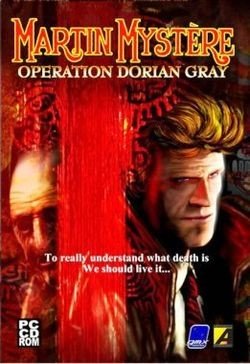
[Note: Crime Stories is the North American title of the adventure released in 2005 as Martin Mystère: Operation Dorian Gray in the UK. This review was originally run at that time, and has only been altered to reflect the updates in the new version.]
In Crime Stories, Alfredo Castelli's renowned comic book character has finally made the transformation from printed page to PC adventure game. How successful a transition was it? Meticulous care was clearly taken by the game's developer, Artematica, to include all the details that aficionados of the Martin Mystère series would appreciate. However, while the game is graphically pleasing, and the cast of characters keep things lively, there are a few problems that sadly negate a complete thumbs up to the overall game experience.
Having previously been impressed with the clever newspaper-styled manual from the UK version of the game, I was expecting a little letdown in this department. I'm pleased to say how wrong I was, as this time the game comes with a "Department of Justice" notepad that includes a short black-and-white comic that introduces several of the characters and plot strands from the game. Whatever it is about Martin Mystère that elicits more inspired manual design, I wish it would catch on elsewhere.
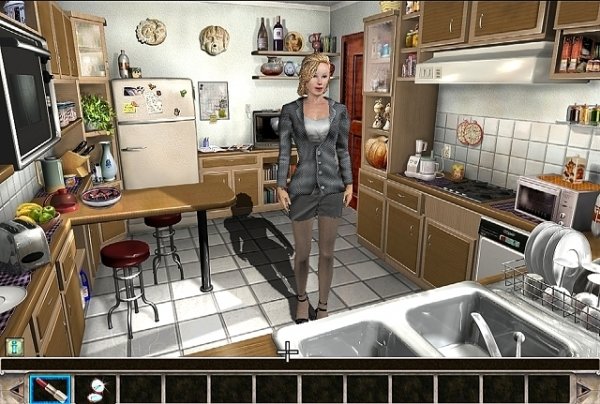
The game itself begins with an appropriately enigmatic cinematic and in-game sequence where Martin is awakened from slumber by a phone call requesting help in a murder case of a famous research scientist.
From here on, Martin is left to unravel a rather convoluted story involving treachery, high art, archeology, and the history of civilization — all revolving around particular implements of an ancient Aztec ritual, and breaking the seal to the secrets of eternal life! This plays out in a way that questions the moral and physical implications of the power of eternal youth. Martin is thrust into the middle of all this with some pretty heady plot twists that are executed nicely and not at all easy to predict.
The format of Crime Stories is that of the typical third-person, point & click adventure. The game is played in widescreen mode, which is to say there are black bars across the top and bottom of your playing field. I've bemoaned the lack of full use of screen real estate in previous reviews, but I grudgingly admit that as with watching a DVD movie, after a while you simply don't notice. The bottom bar is where the inventory appears when accessed by clicking on the floating "i", while a new icon has been added to the top bar for more intuitive access to the main menu.

The default crosshair, when moved over an item, will bring up an interaction menu that is thankfully pared down to include only three icons: a "talk" bubble (for NPCs), a "view" magnifying glass (default), and a "use" hand (for active hotspots). Once your cursor is on an item or NPC, you can cycle through available actions by right clicking.
There are eight save slots you can use, presumably to match the eight "acts" of the game. I'm a big fan of unlimited saves, but eight worked well enough. The Options menu allows you to toggle subtitles off or on, and there's an Extra option where you can revisit cinematic scenes and various artworks.
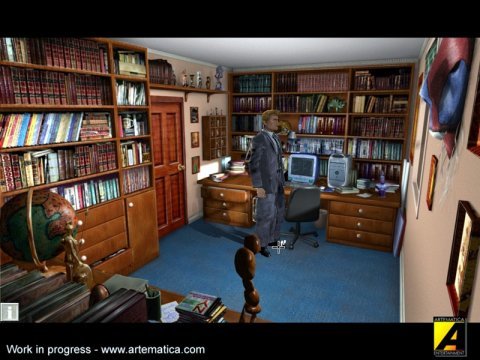
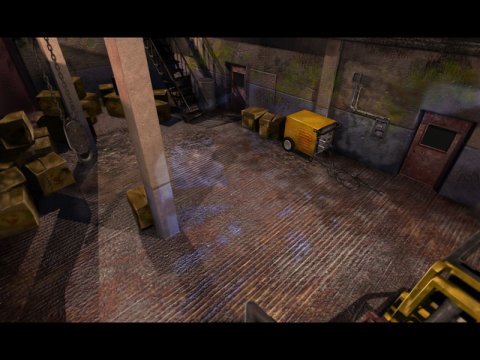
Graphically, for therein lies first impressions, this game offers a plenum of eye candy. One of the finer attributes of adventure games that other genres often scrimp on (of course there are many notable exceptions), are diverse environments rich in detail. Never mind the cycling formulaic terrains of snow, forest, desert, and metropolis. Those are great, yes, but give me that small, eccentric study where books are falling off the shelves and motivations are stained in ink under sheaves of paper on a mahogany desk. In Crime Stories, there are plenty of said intricacies, and Artematica lets the player appreciate the finer details of these environments with an affluent and vibrant palette.
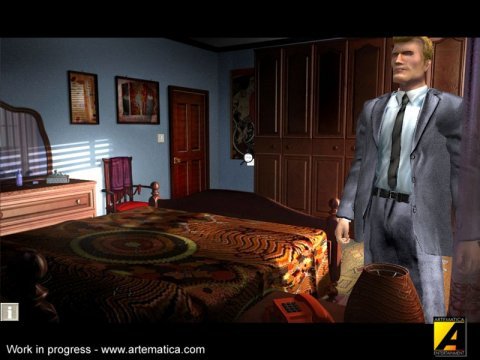
Your exploration will take you from the tidy rooms (laundry room notwithstanding) of Martin's estate to the mansion of our murdered scientist, and on through a museum and various jaunts that will require boarding a plane to villages and archeological digs across the ocean. Each of these scenes is meticulously pre-rendered, with our characters in fully-realized 3D.
It would have been nice if Martin had more than a single-gait walk to get through these environments, however. There are times when walking just doesn't seem appropriate, but thankfully few times where he has to traverse the entire screen. On the plus side double clicking on the exit icons usually causes an immediate transition.
Game characters include Martin himself, a rather blocky bloke with a chin that could crush walnuts, his lovely partner Diana (his "other half") who is also briefly playable, and his Neanderthal pal Java, who probably does crush walnuts on his chin. There is also a multiplicity of other NPCs with which to interact, and here's one area where this game shines. Each character attempts to keep the larger-than-life aspect of the comic book style intact.
The music in Crime Stories is thematic, always in keeping with the environment, and never under or overwhelming. Care seems to have been taken to prevent a swelling score from interrupting or drowning out important dialogue, which is an annoyance in some adventures games I've played. In Martin's estate, you will enjoy light jazz, which is appropriate for our man-about-mystery's easygoing nature. The museum features a thoughtful musical prose, while Mexico has a samba-like refrain, and ancient caves have ambient symphonic riffs, to mention a few. Some of these themes will keep you lingering to appreciate them through another sound-cycle, and others will motivate you to hurry your character's puzzle musing. However, they are all cohesive and effective vehicles for mood setting, and the variety is appreciated.
The game's puzzle resolution is primarily inventory-driven, and while dialogue will often play a role in puzzle solving, there are no dialogue-based puzzles. Inventory items can be combined to achieve the necessary result, and this player recommends always viewing an item immediately after it has been added to inventory. Not only does this get Martin's verbalized take on it, but you'll want to file away the information for future use, as you'll find this is critical.
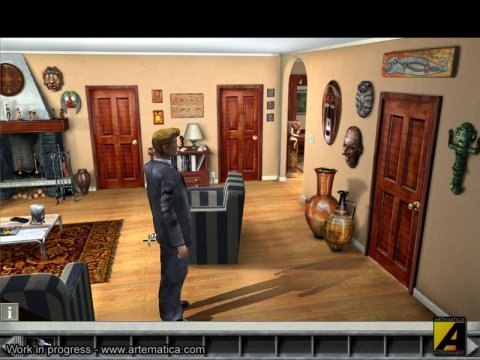
The puzzles themselves are of light to medium difficulty, and there wasn't a time when I felt mystified to the point of frustration. Demystification can often result from making yet another round of your environment. Be sure to scrutinize all items, as being hasty can result in a missed hotspot or clue. Throughout Martin's esteemed career, he has prided himself on collecting artifacts and rare antiquities from each of the cases he's investigated, so naturally his estate is full of them, and many of them can be examined. The only items Martin will verbally describe, however, are those added to inventory; the rest are text description only.
Also be sure to exhaust all dialogue trees with any NPC you come in contact with. As a matter of course, some of these are game whey — specifically with Java, whose means of communication are limited to various grunts and groans. Others, though, will provide the clues you need to move along Martin's adventure.
At one point, you'll encounter a titillating club scene, where a scantily-clad pole dancer provides some clues and the basis of a puzzle solution. Yeah! I'm of the opinion that games and movies need more club scenes. Pole dancing, as a given, is under-appreciated. It provides just enough segue — a sort of bathroom break for the mind — to keep things refreshing and on pace. (I am, of course, being facetious, in case it doesn't translate well to written word.) While the UK release felt this suitable for a starting age of seven years old, this version carries a Teen rating, which is probably a little more realistic in all respects (difficulty included).
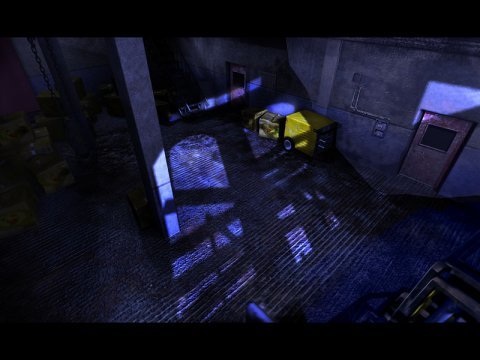
Much more cannot be revealed about the story, as any hints may reduce the surprises that culminate in the end game sequence. The tale is satisfyingly complex to pique interest and follow through from beginning to end, and that in itself, combined with what has already been mentioned, merits a four star rating. Too bad there are some serious detractors that prevent this in my final score.
Technically, the game has some flaws that can be attributed to a lack of appropriate beta testing and editing, including translation errors and misappropriated effects. At times, characters speaking to one another won't even be looking in the right direction. Meanwhile, apparently Martin has acquired some Jedi training in all his eclectic experience, since when he half-bends to acquire something on the ground or a table, it will instantly appear in his hand. These same issues were complaints I had originally, and it's very disappointing to see that they still haven't been addressed in the many months since. What a wasted opportunity to provide a cleaner, more polished product.
The voice acting, on the other hand, has been completely overhauled. Unfortunately, the change has not drastically improved matters in an area that really allowed for it. The obvious goal of the new recordings was to "Americanize" the characters. It's hard to argue with that logic in a game set in New York City, so gone are all the British voices from Operation Dorian Gray, and replaced in Crime Stories with more natural sounding accents. On the whole, the quality of the acting has been improved, but the most blatant flaw managed to somehow carry over into the new version as well. I'm talking about how the lines are often carried out: as literal lines of on-screen dialogue. For example, if I came up to you and said: "Hello, how are you this most…beautiful day in which we…both are to be wed by…an officious justice of the…peace?" Aside from the fact that I just proposed to you, would not those pregnant pauses be annoying? This page break pacing literally kills any tension in the story, and the attention of the player.
With subtitles on, you will also notice something especially grating. Unfortunately, particular care was taken to transcribe every vocal noise a character makes. You know, those things that we all have a habit of saying through the course of conversation, such as "uh, um, ah, pfu…" Pfu? Yes, I don't recall using that one either, but this game does. It's like they were thrown in as an afterthought to increase word count in the manuscript: "Give me placement of ten more "Pfu's" and that's a wrap!"
Also frustrating is that the cursor will often disappear after interacting with or selecting an item, and will require you to click on the screen somewhere to bring it back. It's not really a disappearing act as much as it is a delayed reaction within the programming, yet it's enough to feel like a bug.
Crime Stories certainly has a charm about it, infused by its characters and locales, along with the gripping story that binds them. It's enjoyable to play, but feels, at least at times, like playing basketball with a bum knee might. You have fun, yet the pain prevents you from playing at your full potential. Similarly, this game has lost some of its potential within the framework of its annoyances.
The game may be enough to be a worthy investment of time (it took me about twelve hours of concentrated play), depending on your level of tolerance to things that make or break your game face. It has been my experience that most adventure gamers are quite forgiving, but often detail-oriented. Crime Stories would ask all of us to ride the line somewhere in the middle. While most of us will be glad to do so, we will also exit the game with the sentiment that just that much more would have made for a far better experience.
And for those who don't agree, well... Pfu.