
Adventure Architect: Part Five
Forming a design team, and storyboarding the game one location at a time
It turns out I'm not a very good listener. Here I am, five or six months into my first adventure game design project, and I've ignored the most frequently repeated words of advice for any first-time adventure game designer—I didn't "start small." Then again, I knew before I'd even decided on a story or setting that I'd probably end up ignoring that mantra anyway.
I wanted my game to be different than most other amateur efforts. Thanks to Adventure Game Studio and a few years worth of computer programming classes in high school and college, the most difficult technical obstacles were already out of the way before I started. But I knew from the very beginning, even as I worked alone on the game's storyline, that making a professional quality game would take more than just myself, no matter how committed I might be.
Recruiting a team is a tricky thing for a first-time game designer, though. The amateur gaming community is full of people who formed a design team for a game that wasn't far beyond the "cool idea" phase. I've seen it happen so many times that I know the pattern by heart. Someone posts a message online looking to form a team to work on an "awesome" game idea. Volunteers flock to the project, only to discover that the game really is just an idea. The team gets bogged down sorting out the details of the storyline, or—worse yet—produces a lot of artwork and animation that then has to be thrown away because the storyline is completely rewritten two months later. The next thing you know, team members start to disappear, and the project slowly fades away.
That's not what I have in mind for my game, though. Some readers have asked why I spent month after month of pre-production time working on the storyline and characters, detailing every possible action and reaction I could imagine. The answer? To make sure that when the time came to form a team, I'd be ready to hit the ground running. And, after more work than anyone should ever have to do without getting paid, the moment finally arrived.
Working from a project management model that I learned during my time in the editorial department at Marvel Comics, I decided to divide the production of the game's visual elements into four positions: layouts, pencils, color separations, and animation. With the story outline and in-game locations already established in my design dossier, I began work on the layouts myself. This position is a natural fit for me as the game's creator, because it allows me to apply my creative vision to each game location, keeping in mind its relationship to individual puzzles and the wider game itself. I chose to work in a mostly linear fashion, breaking the game into four acts and determining which locations would be necessary for each act.
I began with act one, which is essentially a brief prelude that sets the scene for acts two and three (the heart of the story) and act four (the endgame). As I discussed in the third installment of this column, the game opens at a crossroads in the hills above the town of Old Sierra. I knew that there would be an abandoned gold mine nearby, and that the hero would need to find a way to sneak in, discover the mine's secrets, and then escape. Working from this basic premise, and bearing in mind that the goal of the opening act is to lay the groundwork for everything that will happen in acts two, three, and four, I decided to set the puzzle difficulty at "low" to allow for maximum character discovery and interaction with the game environment.
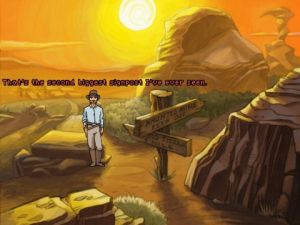
Next I began to sketch out the first few screens in a continuous background shot to get a feel for their relationship to each other. One of the benefits of having planned much of the game in advance by this point is that I could also include visual elements like Vulture Rock in the background scenery, to give the game a visual consistency that wouldn't have been possible with a haphazard approach. At the same time, I decided upon the first puzzle—the hero needs to reach a back entrance into the mine that is, unfortunately, out of his reach—and its solution: He builds a ladder with the available materials scattered around the area. This puzzle meant that I needed to populate the area with everything the hero would need to reach the solution.
Artwork by Josh Roberts (layouts) and Frankie Washington (pencils)
(click on the thumbnail for a closer look)
I suppose the easiest solution would have been to actually provide a removable ladder on one of the screens, but I didn't want to make it that easy. I also wanted to force the hero to interact with a character or two before entering the mine, just to help establish the backstory involving the town of Old Sierra and the hero's specific quest. To do that, and to force exploration of the game environment, I chose to spread out the required puzzle elements across several screens. This is a much more linear puzzle-and-location formula than I'll use for the rest of the game, particularly for the two middle acts, but it seemed to be a natural approach for the first location, which I knew would be limited to just five or six screens.
With the first puzzle and its solution established, and with a solid idea now of how to approach additional areas and puzzles, I was able to easily sketch out the first five game screens. And at this point, I was also ready to bring on another artist to turn the rough layout sketches into polished pencil artwork. I pitched the project to a local artist named Frankie Washington, and soon was able to bring him on board as a background artist. Frankie and I also worked together on designing the principal characters in the game—a crucial step in determining the overall look of the game itself.
After we completed the first screen, I posted a scaled down version of the image online at the Adventure Game Studio Critics' Lounge. There I stumbled upon my first real stroke of luck. A few of the board's visitors took it upon themselves to apply different coloring techniques on top of the pencil work, and I was more than a little impressed with the results. After a day or two of consideration, I contacted one of the artists—a college computer science student by the name of Dan Lee—and discussed my project in greater detail with him. Soon, he became the third member of the design team.
Artwork by Josh Roberts (layouts), Frankie Washington (pencils), and Dan Lee (colors)
That was about four weeks ago. Today, we're finishing up the color work on the area outside of the abandoned gold mine (consisting of five screens and one puzzle), finalizing the pencil work for the interior of the mine (eight screens and six small puzzles), and beginning the layouts and puzzle design for the next portion of the game (acts two and three).
Next: Contributors Wanted—Dead or Alive!