
Review for Phantasmagoria


Once upon a time, in the land of Serenia, a luxuriant green valley surrounded by azure mountains and covered by a pale sky, there was a shabby magical shop, run by a long-bearded wizard by the name of Crispin…
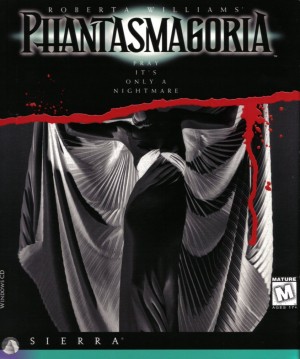
No, wait, that is the wrong game. This is an adventure from the pen of none other than Roberta Williams, but this time around you will do without Cedric the Owl, King Graham and the royal family of Daventry. And if you think that a Roberta Williams game automatically means an enjoyable trip through a colorful world, perfect for parents and children alike, you’re in for a very big surprise with Phantasmagoria. Williams had already shown herself eager to write dark and unsettling stories – her debut adventure, Mystery House, and The Colonel’s Bequest were clear signs – but with Phantasmagoria she totally raised the bar, deciding to shock players and grab them by the throat with a disturbing story about a lonely woman fighting powerful malevolent forces.
If the premise doesn’t sound shocking today, that is largely because of Phantasmagoria. The historical value of this game is indisputable, since it opened the way for a lengthy succession of games that borrowed heavily from its style, its graphical presentation, its storytelling gimmicks and more. Many of those games overtook Phantasmagoria both in quality and in success, because Roberta Williams’ sixteenth adventure is far from perfect. Nevertheless, without it we might never have experienced masterpieces like The Beast Within in the years to follow.
Phantasmagoria is a milestone in at least one other regard: nowadays it’s pretty common to talk about appealing to the casual market, but Roberta Williams did it first, with this very game. Phantasmagoria, for better or worse, put PC gaming on popular magazine covers and TV newscasts, creating unprecedented media coverage that convinced even many non-gamers to go out and buy the game. And the reactions back then were generally enthusiastic. Even Entertainment Weekly declared that the game was “one of the surest signs yet of computer games approaching the quality level of movies.”
What is so outstanding about the game, then? What magnificent qualities attracted the attention of serious journalists and gossip columnists alike? For the experienced adventure gamer, the answer is disappointing: there’s nothing so outstanding about the game, which is actually mediocre in terms of plot and unsatisfactory in terms of gameplay. The hype for such an average adventure was due to the scandal that caused a moralistic crusade by some concerned parents and stores which refused to sell the game.
Phantasmagoria casts the player in the role of Adrienne Delaney, an attractive thirty-something novelist with a handsome husband, Donald, and a fairy tale-like life. The happy couple has just rented an old, extravagant mansion in New England because Don, a renowned photographer, has chosen the wooded estate as the perfect place for his latest photo session. The only problem is that, during the 19th century, the mansion was home to an eccentric illusionist, Zoltan Carnovash, whose wives (he had four of them) had the inexplicable habit of mysteriously disappearing without any trace, and even now there are rumors in the nearby town that the house is cursed. Adrienne and Don knew nothing of this when they purchased the manor, but it took only a nightmare and some extremely vivid hallucinations for Adrienne to start realizing that something is very wrong with the place.
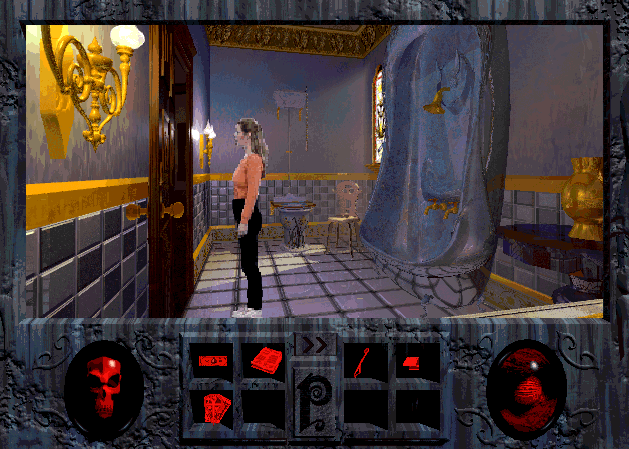
In fact, something terrible did happen in the mansion almost a century before, something as twisted and corrupted as Zoltan himself, whose haughty, flamboyant and petulant personality is embodied in every brick of his eccentric manor. Adrienne soon finds herself entangled in an old story of unfathomable secrets and dark magic, trying not only to save her husband’s soul but to solve the gruesome mystery buried underneath Carnovash Manor. What ancient evil did Zoltan awaken in his search for power? How many lives has he sacrificed for his ambition? The truth lies in a grim, eerie mausoleum, as well as in the memories of the only person still alive who had the chance to meet the old magician himself. Adrienne will have to unearth those secrets quickly, however, because Zoltan’s curse is affecting Don, and her only hope for his salvation may be a long-forgotten, perilous ritual.
As for that scandal, through the course of its seven acts, Phantasmagoria manages to show veiled bits of female nudity, sex scenes, gruesome deaths, tortures and abuses, splatter details of blood and bowels, and eventually a “rape” scene with a strong emotional involvement. It’s this last issue that stirred up outraged reactions which claimed that an explicit scene of domestic violence was not only dangerous but also immoral. The reality is that this infamous scene is one of the most poignant moments in the whole game. Whilst the haunted house plot is fairly superficial and stereotypical, the relationship between Adrienne and Don, who becomes perverted by the house’s malevolent influence, is wonderfully and even tactfully depicted. That particular scene helps to deepen the theme of their star-crossed love, showing the strength of Adrienne’s affection toward her husband even in the face of the twisted curse that is slowly destroying him. Unfortunately, this is pretty much a standalone case, since the other aspects of the plot and the writing feel utterly contrived. I think Roberta Williams felt more comfortable with the light-hearted, fairy tale atmosphere of King’s Quest, because her ventures into the darker corners of the human soul often show an overly heavy reliance on abused clichés, thus hampering the emotional impact of her horror and mystery stories.
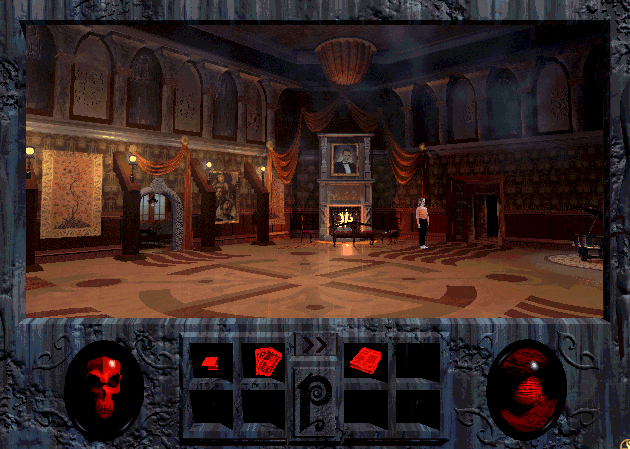
Like the other FMV interactive movies produced by Sierra, Phantasmagoria uses the enhanced version of Sierra Creative Interpreter, known as SCI2, with only one notable difference: like King’s Quest VII before it, the game ditches the icon-driven interface in favor of a context-sensitive cursor which automatically selects the most appropriate action for all eligible hotspots. This streamlined interface is often held up as proof of how little challenge FMV games are capable of presenting the player, and while for many interactive movies this simply isn’t true, Phantasmagoria does indeed pose little to no difficulty for the experienced adventurer or newcomer alike. On those rare occasions where you might need help, the adventure features an in-game hint system which clearly doesn’t understand the meaning of hint: clicking on the icon immediately presents the player with an evident solution instead of a subtle clue.
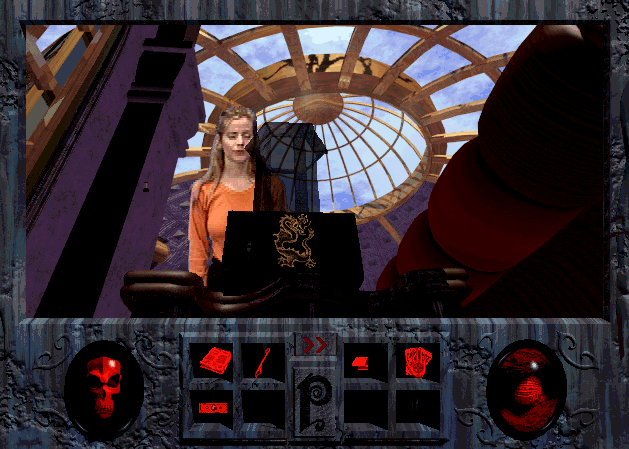
The ease of the game isn’t due to its interface issues, however, but rather its uninspired puzzle design. Puzzles are few and far between, and they never require creative thinking from the player. Unfortunately, when they do pop up, they often feel contrived and trivial: for example, early in the game, Adrienne discovers a loose brick blocking a passage, and she must unrealistically use a particular object to open up a hole big enough for her to fit through, even if she has a perfectly good hammer right at hand. Another good example is the classic “paper under the door to retrieve key” puzzle: after a good deal of frustration, I found out that there is only one particular item capable of pushing the key out of the lock; one that’s very well hidden and retrievable only after a certain moment in the game. This kind of linearity serves no other purpose than lengthening the game without adding any real value to it. When dealing with interactive movies, I’m all for well-integrated obstacles that don’t stifle the pacing of the story. Still, I want to be challenged and I want to think about the situations. Certainly I don’t want pointless puzzles solvable with a mere click or two whose sole purpose is to atone for the lack of any other gameplay.
Okay, so the story is quite banal, the writing often stereotypical, the gameplay flawed, and I’ve yet to mention some of the most over-the-top, tacky acting of all time. The lines themselves are far from brilliant, but they’re made substantially worse when spoken with such an exaggerated emphasis that they become utterly laughable. With the exceptions of Robert Miano, who gave a real charm to his flamboyant Zoltan, and Golden Globe winner Stella Stevens, who is a perfect chatty antiquariat with a penchant for saucy gossip, the majority of the cast – from a sleazy real state agent awfully portrayed by Geof Prysirr, to a dingy tramp with fortune-teller ambitions, acted by the always dreadful V. Joy Lee (who also had a quick cameo in Phantasmagoria II) – delivers an unbelievable, even ludicrous performance. Victoria Morsell (Adrienne) and David Homb (Don), while not as bad, are nevertheless quite uninspired themselves.
By now you must be thinking: is this game any good? In some ways, yes it is. First of all, the last two acts are thoroughly captivating, making up for the relative dullness of the early ones. The seventh act in particular not only manages to be touching but also concludes the game with one of the most powerful, breathtaking finales I’ve ever experienced: the gameplay suddenly becomes complex, with a string of difficult, challenging timed sequences where the pacing is frantic, the atmosphere thick and really frightening. The horror that in previous chapters felt somehow insincere, in the last portion of the game suddenly becomes vivid and real, and I almost had to turn on the light and quit for a while to catch my breath.
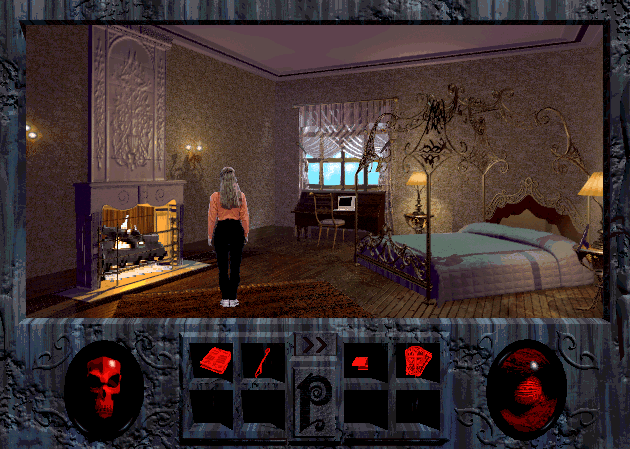
This feeling is enhanced by the musical score, orchestrated by Sierra veterans Mark Seibert and Jay Usher, which is eerie and spooky through the whole game but in the end becomes, with its unnerving choir and dark, rumbling percussions, so tense and vibrant that I felt the urge to turn it down to ease my nerves. Furthermore, the graphic design may have aged badly, but back in 1995 when the game was first released, its distorted geometries and sparkling colors added a strange, unsettling mood to the gaming experience, drawing the player into what feels like a baroque, grotesque nightmare. Even today, some of the landscapes and especially the lusciously rendered upper rooms of the mansion, with their violent red, unsettling shadows and arcane machinery, stand out like thrilling sets for a horror story.
On a personal level, I like Phantasmagoria a lot, even if the story is stereotypical and the gameplay simplified to the point of being almost superfluous. I like it not only because of its historical importance, but also because – clichéd or not – it was successful in scaring me, like a good horror movie should always do. It may not be original or profound, but it was ahead of its time both in production values and the courage with which it tried to approach mature, sensitive themes. Today, especially when compared with the better interactive movies that followed it, Phantasmagoria is clearly a flawed gaming experience, but with the right expectations of what to expect, it remains worth playing and being enjoyed for what it is: the first of its kind, and an effective classic horror story in the end.