
Review for Diabolik: The Original Sin

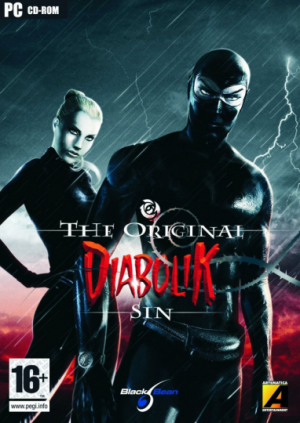
Although a name not widely recognized around the world, Diabolik has been around for many decades, an achievement that has finally earned him the distinction of his own adventure game. Inspired by the fictional French master of disguise Fantômas, and created by sisters Luciana and Angela Giussani, Diabolik made his first appearance in 1962 with the publication The King of Terror, and he has been a key figure in Italian comic books ever since. For those who don’t know who he is, Diabolik is a handsome and perilous man, a thief with a knack for expensive technological devices and a consummate womanizer, although in the end he remains ever-faithful to Eva Kant, his soulmate and partner in crime. In the early books, Diabolik was depicted as a ruthless and cruel criminal, and he and Eva were capable of doing anything to accomplish their goals. Over the years, however, their motivations became more ambiguously portrayed – like a modern day Robin Hood, but without the whole “give the loot to the poor” thing – and they were shown stealing mainly from enriched malefactors, mafia lords and corrupt politicians.
Though still qualifying as more of an anti-hero than your typical game protagonist, it’s in this new form that the charming thief stars in his first adventure, Diabolik: The Original Sin. The game begins abruptly, initially putting the player in the role of Eva, who awakens in a cold, damp cell with no recollection of what brought her there. As soon as she frees herself from the rope tying her wrists, the door bursts open and three massive thugs enter the room, dragging a man’s lifeless body inside. They throw it on the floor and exit without a word. Cautiously, as a pool of blood widens underneath the body, Eva approaches it to see the dead man’s face: it’s Diabolik!
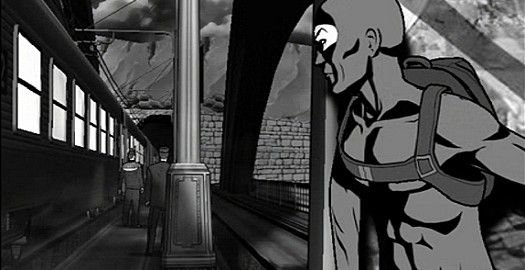
After this shocking prologue, the adventure takes players back 72 hours, and through the course of the game’s seven chapters, we discover what happened to Eva and the thief to arrive at this point. The cinematic opening shows Diabolik recklessly driving his Jaguar as a voiceover explains that Eva has been kidnapped by a mysterious man, who – in exchange for her life – has asked Diabolik to retrieve a priceless painting, the titular “Original Sin”. The artwork, to be carried on a high-security train during its transfer to a museum, is protected by well-trained guards, armed to the teeth. If Diabolik fails to retrieve the painting before the train leaves the station, the kidnapper has threatened not only to murder Eva, but also to blow up the train. This is no easy task, but Diabolik is not your common pickpocket: after creating a diversion to sneak onto the train, he disguises himself as a guard and starts his frantic race against time.
This is only the beginning of the adventure, and the ensuing story treats players to spectacular explosions, breathtaking pursuits and well-planned coups de théâtre. The Original Sin, in fact, is just one piece of a larger conspiracy leading to a mysterious organization known as The White Rose, which appears to be connected with a once-noble family whose head is an old foe of Diabolik. When the symbol of a white rose is discovered on the train, the thief realizes that retrieving the painting won’t be enough. The only solution is for Diabolik to penetrate The White Rose’s secluded sanctuary, a medieval castle atop the misty village of Denvon. Somehow, though, his enemy seems to be always one step ahead of him, but even knowing what lies in front of him is nothing but a trap, Diabolik must confront it to save Eva.
The plot is tightly paced and as suspenseful as any recent Hollywood spy thriller, like the Jason Bourne series or the newer James Bond movies. It nicely blends together typical genre conventions with an effective noir atmosphere, mindful of old classics like Double Indemnity or Alfred Hitchcock’s The Man Who Knew Too Much, and it offers a compelling, exciting climax coupled with an extremely satisfactory ending. Unfortunately, the writing isn’t as good as the story it supports, thus hampering its impact, particularly during the early chapters. Although Diabolik’s thoughts, emotions and motivations are decently explored, the descriptions he gives upon examining his environments are quite dull and the dialogues more often than not sound dim-witted and flat. Fortunately, later on the quality seems to improve as the narrative becomes more poignant – when Diabolik begins to run out of time, his need to rush is nicely portrayed in his attitude. The more interesting, varied environments also help: the first two chapters take place exclusively on the train, and this is easily the least accomplished segment of the game, since all locations are similar to each other and the repetitiveness is reflected in the uninspired lines.
The quality of writing aside, Diabolik is surely a fascinating lead. With his ferocious sarcasm, bad-guy attitude and rough charm, he is an interesting change from the usual adventure protagonist: he doesn’t want to save the world, he has no higher purpose than becoming rich (and in this case, saving his equally greedy partner), and he won’t hesitate to kill anyone who tries to stop him. Moreover, he is more the “hit first, ask later” type of guy, so he prefers silence over talking with anyone on screen, another unusual departure from the more traditional adventure heroes. This doesn’t mean that he’s shallow, but if you expect a complex character, you won’t find it here. Like he appears in his comic books, Diabolik possesses a black-and-white personality. Unfortunately, the other characters don’t have even the slightest sign of personality: Eva loses all of her smart-ass irony from the books, and Helena – a mysterious young woman who briefly becomes a playable character as her story revolves around the many secrets of The White Rose – suffers from poorly written lines and a childish, quite annoying attitude.
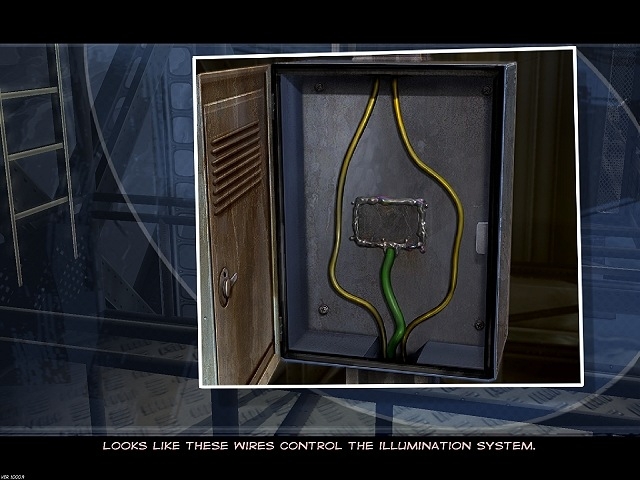
The gameplay in Diabolik can be just as uneven. In the early phases, the adventure relies on the same challenge over and over again: finding a key to open a closed door, behind which the player has to find yet another key and so on. Thankfully, as soon as Diabolik leaves the train, the puzzles become much more engaging. They are mostly inventory-based, but they are quite clever and often well-integrated into the plot. In fact, Diabolik has access to a wide array of technological devices – like soporific bombs, laser pens, life-like masks and cutting-edge electronics – and operating each according to the situation at hand is an appealing task, though knowing what to use in which situation can require a good deal of thinking (or possibly guessing) from the player. But if they sometimes prove to be quite a challenge, the puzzles are always logical and never frustrating, at least on their own. The same can be said for the occasional logic puzzle, like cracking a computer password or deducing the flight path of a helicopter based on its fuel capacity and geographical land formation.
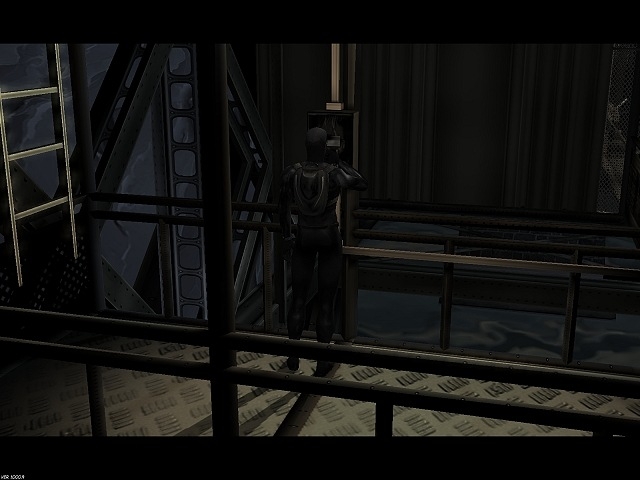
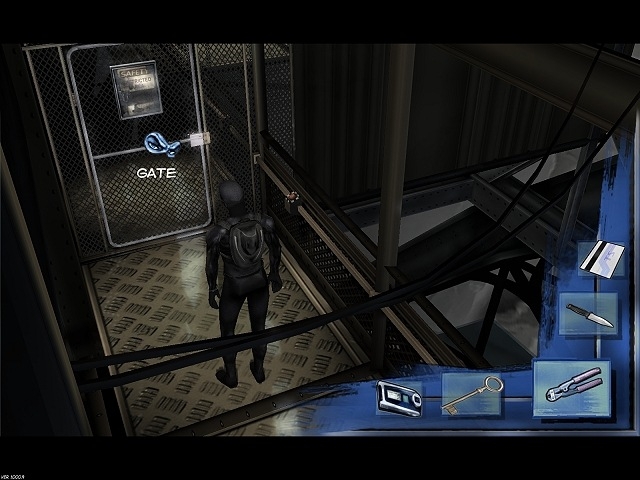
Unfortunately, the puzzles can’t be separated from the interface that drives them. The fully 3D environments of Diabolik are presented from a third-person perspective and navigated through a simple point-and-click interface, but the fixed camera angles are the most disorienting and clumsy I’ve ever experienced. Not only do they make it difficult to maintain your sense of direction, they guarantee that sometimes the real puzzle is simply to find the exit from certain locations. For example, when I was in a very tight compartment of the train, the camera was so poorly placed that I couldn’t find the way out, because when I clicked on the spot where the door was supposed to be, Diabolik kept turning around in place. Instead, I had to move him to the farthest edge of the screen, which made the camera angle switch, and then approach the door skirting the eastern wall to prevent the camera from switching again.
The cameras aren’t the only interface hindrance, either. While a right-click of the mouse cycles through the possible hotspot interactions – the usual look, take/operate and talk options – and a left-click performs them, you’ll need to repeat the same process for the inventory. Simply using an item is a tedious collection of scrolling and multiple clicks, which is far too cumbersome for such a basic task that you need to do so often. Diabolik also refuses to pick up anything if he hasn’t examined it first, forcing the player to click two times to grab even a perfectly recognizable item. This also means that sometimes the linearity of the game feels forced. When I was exploring a hydroelectric station, I found myself stuck and had to resort to a walkthrough to discover that I hadn’t looked at the station’s closed door. I obviously tried to open it, but only after Diabolik examines it does he announce “I have to find a key”, at which point the player is able to retrieve the necessary item. Far more importantly, the game also contains some rare but potentially game-stopping bugs, so players are advised to save occasionally since reloading a previous saved game is the only solution.
The unfriendly interface and strained linearity are a particular pain in the neck if you choose to play Diabolik in action mode. That’s right, when you first begin the game, you are presented with the option of playing the game as a traditional adventure or as an action-adventure. The two versions present the same story, the same chapters and so on, but the latter offers several different dexterity-based minigames, ranging from Simon-like Quick Time Events to stealth segments to frantic sequences where you have to push buttons as fast as you can. This action-adventure mode is also filled with timed sequences, where Diabolik has to perform certain actions before the countdown displayed at the top of the screen reaches zero. Needless to say, you have little time to be getting lost or fumbling with the controls when under this kind of pressure. These action sequences are removed from the adventure mode, providing a much more relaxing experience. Their absence, however, means the pacing can feel uneven at times, particularly in the late stages when cinematics begin to dominate the gameplay as a result.
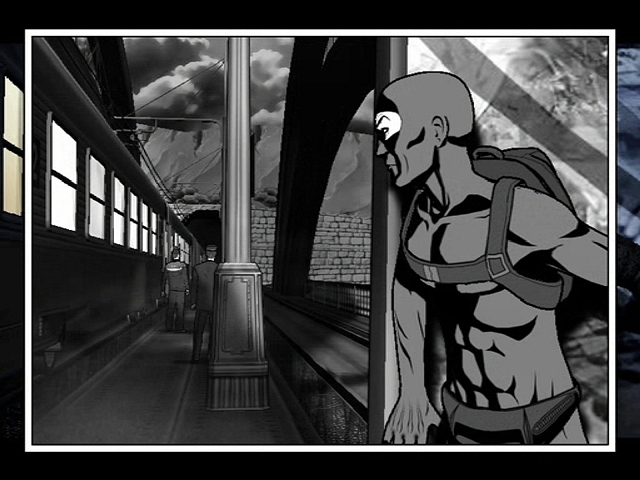
Visually, the game is quite nice to look at: the 3D environments are realistically depicted and often provide a nice atmosphere; the character models could have used a few more polygons, but generally they’re similar to their comic counterparts and are suitable without being sensational. The cinematic art design, however, is really awe-inspiring. Thanks to a striking blend of computer graphics and hand-drawn, comic-like black-and-white pictures, the frequent cutscenes are a real treat for the eyes. These sequences have been carefully planned, and it’s almost like watching a professional storyboard coming to life. The musical score, clearly inspired by the old spy movies, is catchy and serves the unfolding plot quite well, with the occasional electronic theme interspersing a softer orchestration. I particularly liked the title song, which has a distinct vintage flavor, and the peaceful piano notes heard in Diabolik’s den, where the melodious music and the velvety quality of the location help in creating a safe, colorful environment, far from the grey tones and grim atmosphere of the previous chapters.
The distinctly British-accented voice acting in Diabolik is fairly solid, though there isn’t a great deal of character interaction throughout. The thief’s deep, gravelly musings highlight his impenetrable cool, but at times it comes across as overly mellow for the dire circumstances. The only real complaint is each character’s tendency to pause at subtitle breaks, which works fine when letting you skip ahead, but sounds unnatural otherwise. Fortunately, most of the lines are short enough to avoid this problem entirely.
All in all, it took me almost twelve hours to complete the game in adventure mode, and although it isn’t extremely hard, the excessive linearity and the awkward interface make it more difficult than intended. Fortunately, even with these limitations, the story was good enough to keep me involved, and Diabolik himself is such a fascinating character that it’s impossible not to sympathize with him. Released on a variety of platforms, including the Wii, PlayStation 2, PSP, and DS (though this review is based on the PC version only), Diabolik: The Original Sin can certainly be an entertaining adventure, if a little rough around the edges. The plot doesn’t shine for its originality or depth, but it offers solid entertainment, and with two different modes available, Diabolik can offer a nice diversion for those who always wanted to use hi-tech spy devices or play out a Mission: Impossible movie.